
Amal Movement rejects direct Lebanon talks with 'Israel'
 3 Min Read
The Amal Movement insists that the Mechanism remains the framework for halting the Israeli aggression on Lebanon.
-
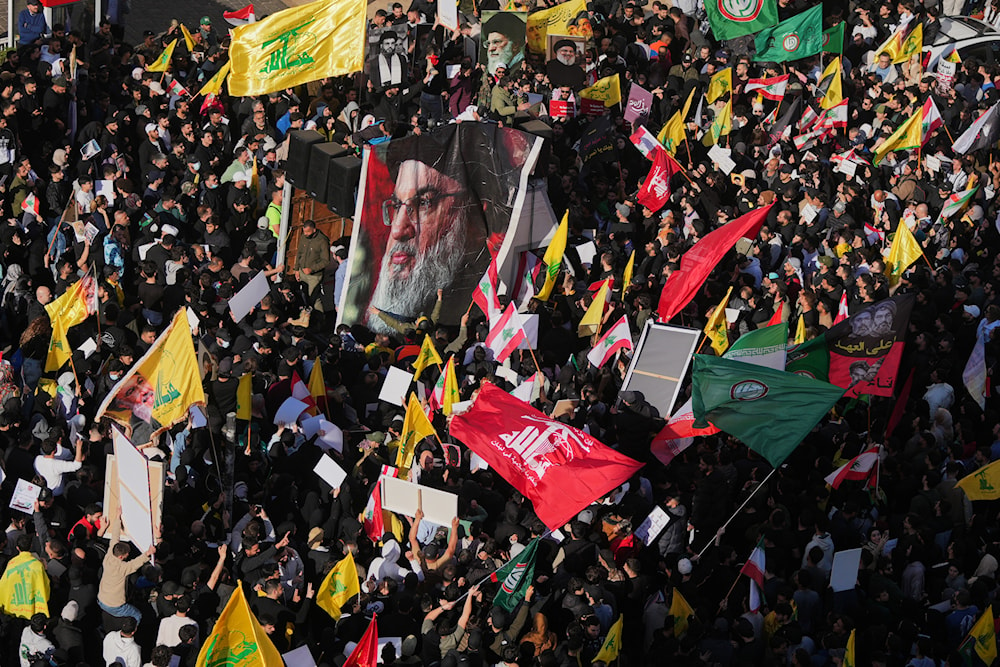
Protesters wave Lebanese and Hezbollah flags and hold portraits of Hezbollah leaders as they gather during a protest against Lebanese Prime Minister Nawaf Salam outside the government palace in Beirut, Lebanon, Saturday, April 11, 2026 (AP)
The Amal Movement completely rejects any form of direct contact with "Israel", the head of the Executive Body of the Amal Movement, Mustafa al-Fouani, reiterated on Tuesday.
Al-Fouani said that the Ceasefire Monitoring Mechanism remains the practical and executive framework for ensuring a halt to hostilities and for the full implementation of all provisions of the ceasefire agreement.
His remarks come after Lebanon’s ambassador to Washington, Nada Hamadeh Moawad, met earlier with the Israeli ambassador to the United States at the US State Department headquarters, under American sponsorship, despite continued Israeli strikes on several areas across Lebanon.
"Israel" made several lavish suggestions, one of which divides south Lebanon into three parts, two of which will be under occupation to attempt to dismantle the Resistance, while the Lebanese Armed Forces will follow through with the disarmament in the third zone.
Additionally, the direct contacts between the pair mark a sharp turn in Lebanon's history.
Yesterday, the Secretary-General of Hezbollah, Sheikh Naim Qassem, also reaffirmed the party’s rejection of direct negotiations with "Israel", describing such talks as “futile” and a gratuitous concession by the Lebanese authorities, amid public discontent over the decision within Lebanon.
Surrender, direct talks with 'Israel' not an option: Sheikh Qassem
On Monday, Sheikh Qassem strongly rejected any move toward direct engagement with “Israel", warning that such a course would represent a serious political misstep if pursued without broad national consensus. He stressed that decisions of this magnitude cannot be taken unilaterally or imposed under external pressure.
He argued that any attempt to initiate direct talks outside an agreed national framework lacks legitimacy and risks undermining Lebanon’s internal cohesion, particularly at a sensitive moment. According to Sheikh Qassem, national decision-making must reflect collective agreement rather than unilateral government action.
The Hezbollah leader also warned against efforts to sideline or weaken the Resistance in the context of political negotiations, maintaining that such moves ultimately serve the interests of the adversary rather than Lebanon. He emphasized that internal unity remains essential in confronting external pressures tied to the negotiation track.
Calling on the Lebanese government to reconsider its position, Sheikh Qassem urged a reversal of the unjust decision. He underscored that preserving sovereignty requires adherence to consensus-based policymaking, cautioning that any deviation from this approach could carry significant political consequences.


