
Anti-government protests continue in Bolivia’s capital as unrest grows
 3 Min Read
Bolivia is facing renewed unrest as anti-government protests and police clashes intensify in the capital over economic hardship.
-
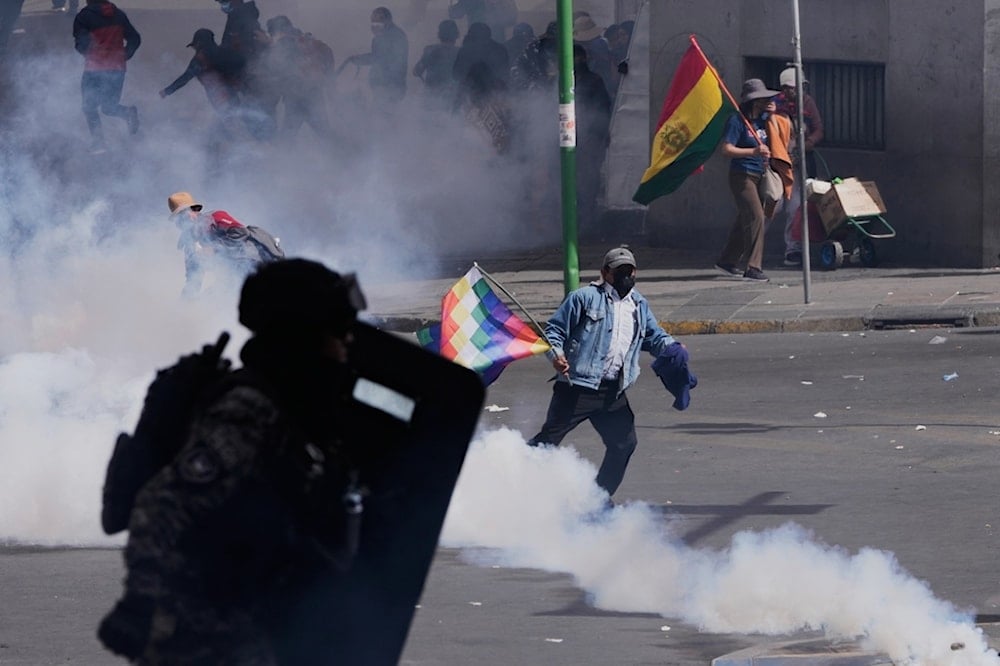
Protesters run through tear gas launched by police during an anti-government protest in La Paz, Bolivia, Friday, May 22, 2026. (AP Photo/Juan Karita)
Bolivian riot police clashed with anti-government demonstrators in La Paz on Friday, as unions and Indigenous groups escalated calls for President Rodrigo Paz to resign amid mounting economic hardship.
Indigenous and peasant women are at the front lines of the ongoing anti-government protests in #Bolivia. pic.twitter.com/NEpQkDiVIc
— Antifa_Ultras (@ultras_antifaa) May 20, 2026
The confrontation marked the second major clash in a week, with protesters flooding the capital’s streets, blocking traffic, and demanding the president step down despite his pledges to address their concerns.
“He should resign!” protesters shouted as farmers, miners, teachers, and transport workers marched through the Andean city waving Indigenous flags and carrying out coordinated blockades.
A general strike and protests against the US-backed government are continuing in #Bolivia. pic.twitter.com/DCMv6f68c2
— Antifa_Ultras (@ultras_antifaa) May 20, 2026
Security forces responded with tear gas after demonstrators threw stones and sticks, preventing crowds from reaching government buildings in the city center. Authorities later reported that the situation had largely stabilized.
Economic crisis fuels growing unrest
The protests come six months into Paz’s presidency, which began amid Bolivia’s worst economic crisis in decades, driven by fuel shortages, foreign currency scarcity, and rising inflation.
Demonstrators say conditions have worsened rather than improved. “Six months in office and he hasn’t been able to solve the basics... We have to choose between buying meat or buying milk,” said Melina Apaza, a protester from the mining region of Oruro.
Road blockades across key routes into La Paz have led to shortages of food, fuel, and medicine, further increasing tensions between protesters and residents.
As unrest spread, authorities said they would deploy police and military units to reopen supply routes and restore the movement of essential goods. In El Alto, a major Indigenous suburb of La Paz, protesters also briefly blocked access to the international airport.
#Bolivia — Clashes between police and protesters broke out in the center of the Bolivian capital when demonstrators attempted to reach Plaza Murillo, site of the presidential palace, to protest the right-wing government of Rodrigo Paz Pereira.
— Antifa_Ultras (@ultras_antifaa) May 16, 2026
Thousands of miners, supported by… pic.twitter.com/zBJDuTKOj5
Later in the day, hundreds of residents staged a counterdemonstration in the capital, protesting against disruptions caused by ongoing blockades.
The government has also attempted to ease tensions by dismissing its labor minister and promising greater consultation with unions and social groups, though protests have continued.
Political tensions deepen
The demonstrations reflect broader political and social divisions following Rodrigo Paz’s election, which ended two decades of left-wing rule associated with former president Evo Morales.
The government has accused Morales of encouraging unrest, while Morales, who is currently in hiding in the coca-growing Chapare region, has denied wrongdoing and remains a polarizing figure in Bolivian politics.
As blockades persist, the crisis continues to test Paz’s ability to stabilize the country amid deepening economic and political pressure.
A powerful image from the anti government march in #Bolivia: peasants, indigenous peoples, miners, workers, and antifascists standing shoulder to shoulder. (Video: Matanza Viva) pic.twitter.com/tabCTUQVXF
— Antifa_Ultras (@ultras_antifaa) May 18, 2026
Read more: Bolivia’s Mendoza links US policy to Latin America unrest: Exclusive


