
Araghchi: 'Israel', US bombing of Iran based on nuclear threat lie
 4 Min Read
Iran’s FM Abbas Araghchi said the Israeli-US strikes were justified by a fabricated nuclear threat, citing IAEA chief Grossi’s denial of any weapons program.
-
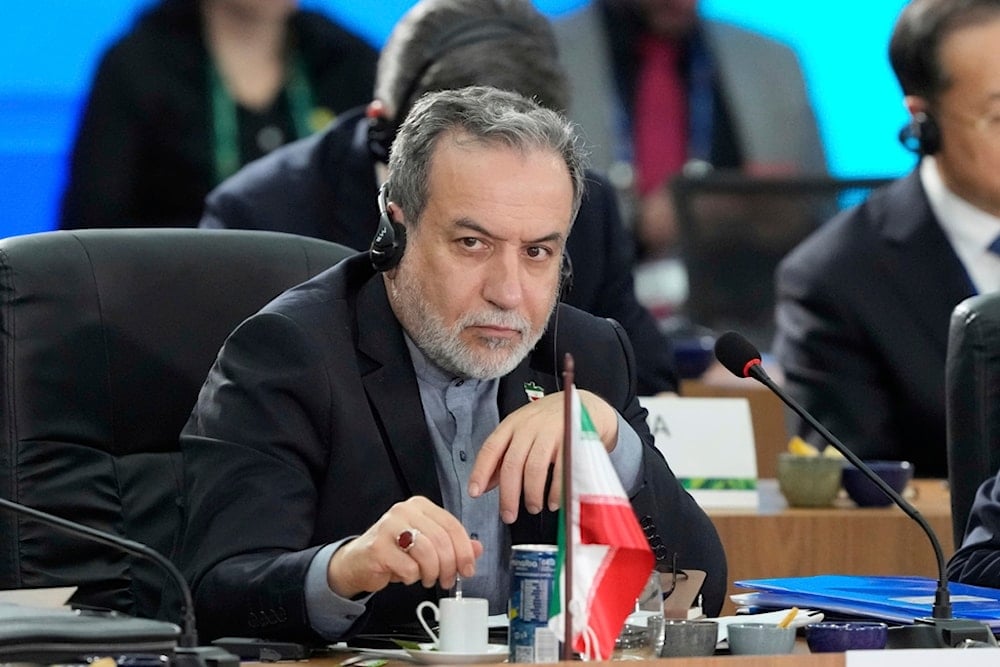
Iranian Foreign Minister Abbas Araghchi attends the 17th annual BRICS summit in Rio de Janeiro, Sunday, July 6, 2025. (AP)
Iranian Foreign Minister Abbas Araghchi said on Sunday that the past 48 hours have exposed what he described as “a heinous lie”, the claim that the joint US and Israeli bombing of Iran was motivated by an alleged “imminent nuclear threat.”
In a post on X, Araghchi cited a recent statement by IAEA Director General Rafael Grossi, who affirmed that “Tehran is not developing and has never been developing nuclear weapons.” Araghchi said this statement “conclusively dismantles the false pretext” used to justify the strikes.
He also attached a video clip of Omani Foreign Minister Badr al-Busaidi, describing him as “a trusted mediator between Tehran and Washington,” who has clarified that “there was never, at any time, such a thing as an imminent Iranian nuclear threat.”
In the past 48 hours, the heinous lie that the unlawful Israeli and U.S. bombing of Iran was motivated by an imminent nuclear threat has been thoroughly debunked by
— Seyed Abbas Araghchi (@araghchi) November 2, 2025
- The International Atomic Energy Agency Chief, who has explicitly stated that Iran "is not and was not"… pic.twitter.com/C2uBzBLOHD
'Israel' killed diplomacy
Araghchi stressed that Iran has not abandoned diplomacy, saying: “Iran did not kill diplomacy; those who blew up the negotiating table did.”
He accused “Israel” of deliberately targeting diplomatic channels: “Israel attacked diplomacy because its true fear lies in the collapse of its project of demonizing Iran.”
In the same post, the Iranian foreign minister rebuked the US president, noting that he “came into office promising to end Netanyahu’s deception of Obama and Biden.” Araghchi added, “It is not too late to reverse course.”
He further reiterated his long-standing position, expressed on October 25, that the root of the problem with the United States lies in its authoritarian nature, emphasizing that “there is no foundation of trust in Washington.”
Iran mulling continuation of talks
A proposal to resume talks on the Iranian nuclear program has been received by the Iranian Foreign Ministry, government spokesperson Fatemeh Mohajerani confirmed on Sunday.
"The [Iranian] Foreign Ministry has received messages containing a proposal to resume talks on the Iranian nuclear issue," the spokesperson stated, noting that the details of the proposal will be revealed in due course.
On Friday, Iraqi news agency Baghdad Al-Youm reported that the United States had sent a message to Iran via Oman proposing a resumption of the dialogue, which was suspended this summer, although this information was later refuted by several media outlets, including the agency itself.
Meanwhile, Iranian President Masoud Pezeshkian vowed to rebuild Iran's nuclear program in a statement published on Sunday.
According to a quote from his administration's Telegram channel, Pezeshkian stated, "Scientific knowledge is preserved in the minds of our scientists, so by destroying nuclear facilities and factories, [the US] will not create problems for Tehran."
How nuclear talks collapsed
On July 20, 2025, the Islamic Republic of Iran and the European troika of the United Kingdom, France, and Germany (often referred to as the E3) publicly announced an agreement in principle to resume nuclear talks.
Tehran emphasized that its right to uranium enrichment must be respected in any future deal, reaffirming its stance that “enrichment is our right, and it must be respected” during the Istanbul-based discussions held later in July.
By August 3, 2025, Iran confirmed that while talks with the E3 were ongoing, the process remained under serious strain with “complex and difficult circumstances.” The Iranian delegation insisted that its sovereign rights under the 2015 nuclear deal must be honored and cautioned against any move from Europe that might rely on political pressure or the activation of snap-back sanctions.
The definitive collapse came on September 28, 2025, when the E3 triggered the snapback sanctions mechanism under UN Security Council Resolution 2231, citing “persistent and significant non-performance” by Tehran of its nuclear commitments.


