
Araghchi arrives in Geneva for third round of indirect Iran-US talks
 4 Min Read
Iran and the US are set to hold a third round of indirect talks in Geneva on Thursday as Abbas Araghchi and Masoud Pezeshkian express cautious optimism.
-
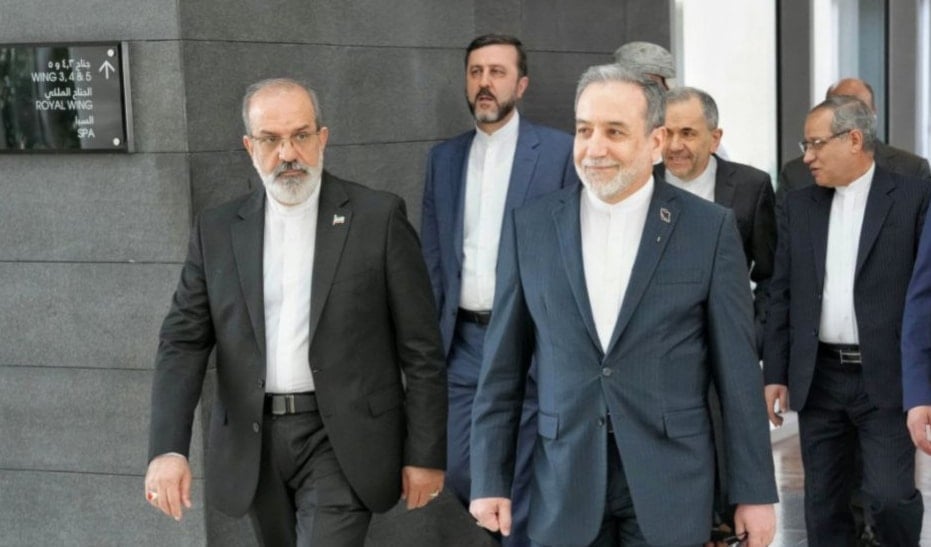
In this photo released by the Iranian Foreign Ministry, Iranian Foreign Minister Abbas Araghchi, center, heads to the venue for talks between Iran and the US, in Muscat, Oman, Friday, Feb. 6, 2026 (AP)
Iranian Foreign Minister Abbas Araghchi arrived in Geneva for a third round of indirect talks with US representatives over the Iranian nuclear program.
Araghchi and his accompanying delegation arrived in the Swiss city on Wednesday evening ahead of talks with American envoys Steve Witkoff and Jared Kushner, scheduled for the following day.
The planned talks, like the previous rounds, are being held indirectly under the mediation of the Sultanate of Oman.
Upon his arrival, Araghchi met with his Omani counterpart, Badr al-Busaidi, and they discussed items related to the nuclear file and sanctions, in preparation for the indirect talks scheduled for the following day.
Equal diplomacy or Iranian response
Earlier, speaking on the sidelines of the government’s weekly meeting, government spokesperson Fatemeh Mohajerani confirmed that the indirect Iranian-US talks will be held in Geneva on Thursday, stressing the government’s commitment to taking part in the negotiations.
Earlier in the day, Speaker of Parliament Mohammad Bagher Ghalibaf addressed Washington with a pointed message. “If you choose diplomacy on an equal footing, we will sit with you at the negotiating table,” he said, adding, “But if your choice is deception and aggression, you will receive a decisive response from the Iranian people.”
On his part, US President Donald Trump has previously stated that he prefers resolving the standoff with Iran through diplomatic means, while keeping the military option open.
Pezeshkian cites 'positive outlook' ahead of third round
Iranian President Masoud Pezeshkian said on Wednesday that he sees a “positive outlook” regarding ongoing talks, noting that Foreign Minister Abbas Araghchi will follow up on the third round of talks in Geneva on Thursday.
Speaking during the inauguration of economic projects in northern Iran, Pezeshkian stated that the country’s leadership has sought to manage affairs in a way that moves beyond the “no war, no peace” equation. He said this approach has been pursued under the guidance of the Leader of the Islamic Revolution and the Islamic Republic of Iran, Sayyed Ali Khamenei.
The remarks come ahead of the third round of indirect Iranian-US talks scheduled to take place in Geneva on Thursday. The upcoming meeting follows two previous rounds, one also held in Geneva and another in Muscat, with mediation by the Sultanate of Oman.
Earlier, on February 24, Deputy Foreign Minister Majid Takht-Ravanchi said Iran is prepared to take the necessary steps to reach an agreement with the United States on its nuclear dossier.
Speaking in an interview for NPR, Takht-Ravanchi signaled Tehran’s readiness to move forward with talks, emphasizing the urgency of securing a deal. “We are ready to reach an agreement [with the United States] as soon as possible. We want to do whatever necessary to make it happen,” he said during the radio interview.
Iran, United States divided over sanctions relief
Iran and the United States remain divided over the scope and mechanism for lifting sanctions on Tehran in exchange for limitations on its nuclear program, a senior Iranian official told Reuters on February 22. New rounds of talks are planned for early March, with negotiations continuing amid cautious optimism over a potential interim agreement.
The official said Tehran could consider a combination of measures, including exporting part of its highly enriched uranium (HEU) stockpile, lowering uranium enrichment levels, and establishing a regional consortium for enrichment. However, Iran insists that its right to “peaceful nuclear enrichment” must be formally recognized as part of any agreement.
“The negotiations continue, and the possibility of reaching an interim agreement exists,” the official said.
Iran is reportedly evaluating several technical pathways to address international concerns over its HEU reserves, which could form part of a phased arrangement linked to sanctions relief.
The official also emphasized that Tehran will not relinquish control over its oil and mineral resources, though US companies could participate in Iran’s oil and gas sector as contractors under specific frameworks.


