
Iran may be preparing for long war with US: Responsible Statecraft
 6 Min Read
After Operation Midnight Hammer, Iran appears prepared to expand the US-Iran war into a prolonged regional conflict, betting that Washington seeks to avoid full-scale escalation while nuclear talks continue.
-
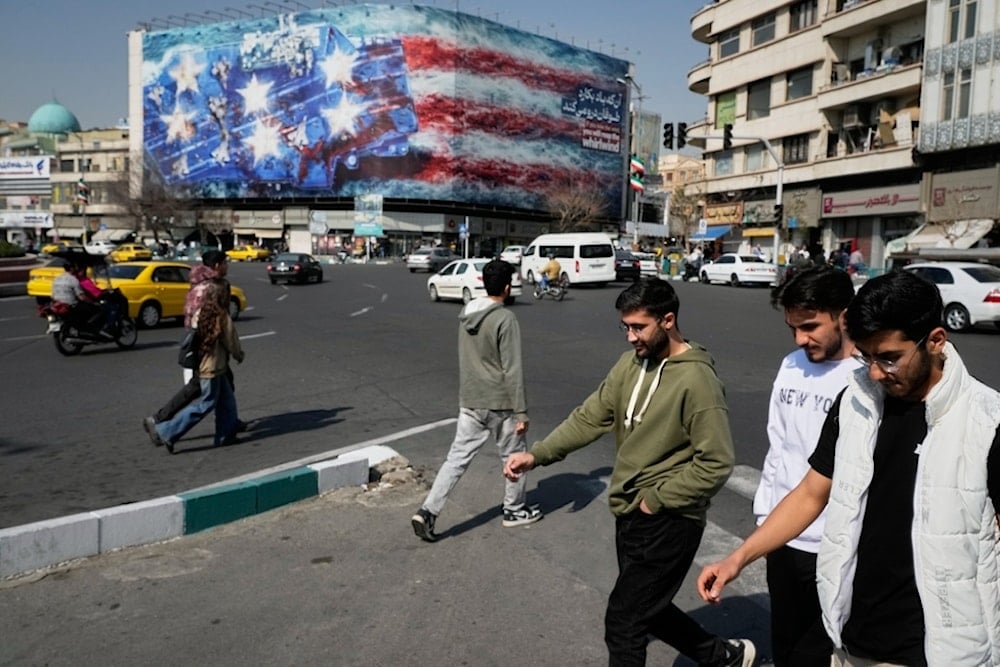
A billboard depicts a US aircraft carrier with damaged fighter jets on its deck and a sign in Farsi and English reading, 'If you sow the wind, you'll reap the whirlwind,' at in Tehran, Iran, Sunday, Feb. 22, 2026. (AP)
According to an analysis published by Responsible Statecraft and written by Sajjad Safaei on February 23, 2026, Iran may be preparing for a prolonged regional confrontation with the United States, betting that Washington lacks the political will for sustained escalation.
Trump’s decision in June 2025 to bomb Iran’s nuclear facilities in the final days of "Israel’s" war on Iran removed any lingering doubts about his administration’s willingness to cross the longstanding US red line of directly attacking Iran’s nuclear program.
The operation, dubbed Operation Midnight Hammer, fundamentally altered the strategic landscape of the US-Iran war. Every subsequent American military threat carried enhanced credibility rooted in precedent. The US military’s abduction of Venezuelan President Nicolás Maduro in January only reinforced that perception.
Yet the June attacks also triggered consequences that complicate Trump's Iran policy and Washington’s broader approach toward Iran’s nuclear program.
Operation Midnight Hammer and the new phase of the US-Iran war
According to the analysis, the brief US-Iran escalation following Operation Midnight Hammer sent a dual message to Tehran. While Washington demonstrated a readiness to use force, it also signaled reluctance to enter a prolonged and costly confrontation.
The Trump administration had warned that any Iranian retaliation would provoke devastating consequences. However, after Iran launched ballistic missiles at US bases in Qatar, Trump reframed the episode as an opportunity to move toward “peace and harmony.” This was followed by his brokering of a ceasefire between Iran and "Israel."
For Iranian decision-makers, this episode suggested that while the US might initiate high-impact strikes, it remained wary of open-ended escalation. That perception now shapes the trajectory of the US-Iran war.
Why Iran no longer fears total war
The joint US-Israeli war on Iran in June 2025 produced a deeper psychological shift in Tehran.
In the years preceding the 12-Day War, Iranian leadership operated under the belief that total war could and should be avoided at nearly any cost. That caution deterred Iran from retaliating decisively against repeated Israeli strikes, even as those strikes grew increasingly bold.
The events of June 2025 dismantled that strategic restraint. Iran’s leadership concluded that it was no longer standing at the brink of a preventable war but had already entered a recurring cycle of limited US and Israeli wars on its own territory.
From Tehran’s perspective, avoiding escalation no longer guarantees security. Instead, it invites further pressure, the article concluded.
Iran’s strategy: expanding the US-Iran war into a regional conflict
Iran’s generals appear to have reached a stark conclusion. The only reliable way to break the cycle of limited strikes is to expand the confrontation beyond Washington’s preferred model of swift, controlled military interventions.
As Iran’s Supreme Leader Ali Khamenei recently warned, “If they start a war this time, it will be a regional war.”
This reflects a structural asymmetry in resolve. The argument is not that Iran’s armed forces match the capabilities of the US military. Rather, Tehran may possess a higher tolerance for sustained confrontation.
In this sense, the US-Iran war may hinge less on military hardware and more on endurance. The militarily weaker party can sometimes absorb and impose costs more persistently, resulting in a strategic posture less favorable to the stronger power than raw military balance might suggest.
Paradoxically, this hardened Iranian posture has emerged at a moment of regional vulnerability. The collapse of Assad’s rule in Syria and the weakening of Hezbollah’s operational depth in southern Lebanon have narrowed Iran’s strategic cushion. Yet instead of retreat, Tehran appears to have embraced full mobilization for the possibility of a regional war.
Trump Iran policy and the return of US-Iran nuclear talks
Rather than signaling that Washington has successfully coerced Tehran, the resumed talks may highlight the limited choices facing the US, the article argue.
The Trump administration is confronted with a stark dilemma: it can escalate toward a full-scale war, whose course and consequences could quickly move beyond US control, or it can opt for a negotiated resolution to the nuclear dispute.
If the current discussions lead to an agreement, it would suggest that US policymakers have recognized the unpredictable and potentially catastrophic costs of all-out war with Iran.
Had Trump believed the United States could swiftly and decisively defeat Iran on its own terms, he would likely already have pursued that course, as he did with the operation targeting Venezuelan President Nicolás Maduro.
What has constrained Washington is Iran’s ability to compel the US and the wider region into a protracted war of attrition that could significantly accelerate the decline of US global influence.
War or nuclear settlement: Washington’s strategic dilemma
The present impasse is not new. Its core features were visible even before Trump withdrew from the JCPOA. President Obama’s pursuit of nuclear diplomacy was shaped by the same military realities that continue to constrain Trump's Iran policy today.
Nearly five decades after the 1979 Islamic Revolution, Washington’s options appear clearer than ever. One path leads to a total regional war whose limits would not be set by Washington. The other leads to a nuclear settlement that, while imperfect from Trump’s perspective, would pull the US back from the brink of open-ended regional confrontation.
If Washington’s participation in the Israeli June 2025 war elevated military force as a central tool of US-Iran war strategy, a successful diplomatic outcome would formally undermine that logic.
But if negotiations collapse, the next confrontation will not resemble June 2025. The Iran of today appears reconciled to the possibility that a decisive and painful confrontation may be preferable to chronic strategic vulnerability.


