
Australian soldier granted bail on five war crime murder charges
 4 Min Read
Former Australian SAS corporal and Victoria Cross recipient Ben Roberts-Smith has been released from prison under strict bail conditions while he awaits a potential trial over the killing of five unarmed civilians during military deployments to Afghanistan.
-
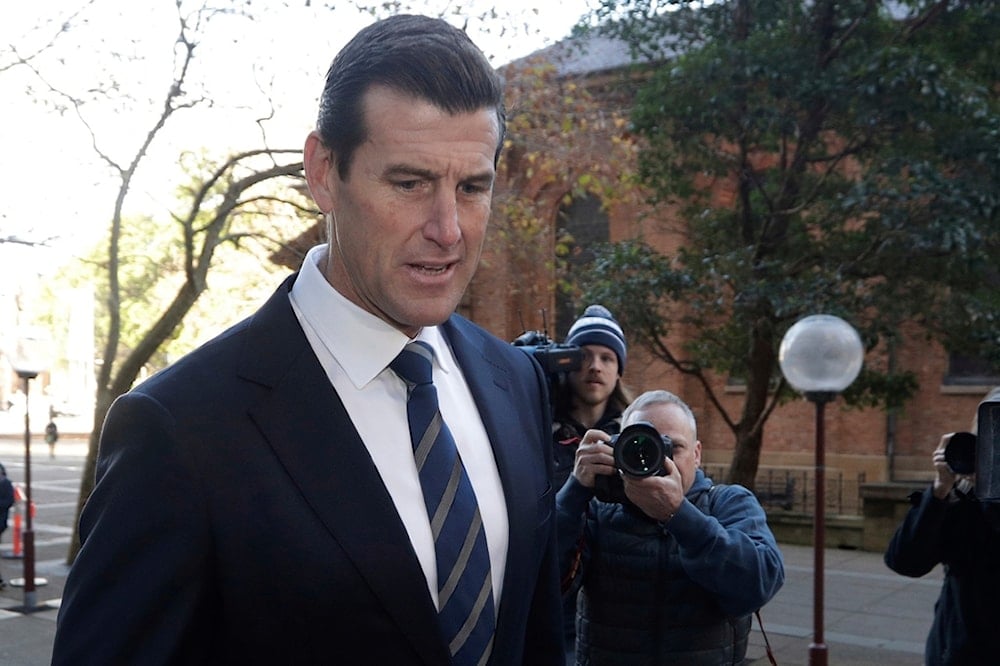
Ben Roberts-Smith arrives at the Federal Court in Sydney, Australia, on June 9, 2021. (AP)
Ben Roberts-Smith, once celebrated as Australia's most decorated soldier, appeared before Sydney's Downing Centre local court on Friday, where Judge Greg Grogin approved his release from Silverwater remand prison after ten nights in custody. The former special forces operator faces five counts of war crime murder, each carrying a potential life sentence.
Roberts-Smith has not yet entered a plea but has consistently denied any wrongdoing. The charges relate to three separate incidents during his service with the Australian SAS in Afghanistan between 2009 and 2012, according to court documents.
Judge Grogin determined that strict reporting requirements could mitigate the risks that Roberts-Smith might flee the country or interfere with witnesses and evidence. The judge warned that Roberts-Smith would undoubtedly be under surveillance while on bail, adding that any breach of conditions would see him once again "donned in green", a reference to prison attire.
Strict bail conditions imposed
The court demanded a $250,000 surety that would be forfeited if Roberts-Smith failed to appear in court or violated any bail condition. He must report to a police station three times per week and use only a single phone and computer to which the police will have access.
Roberts-Smith will be permitted to travel to Sydney and Perth for legal or medical reasons only. His father, Len, a former judge, had offered to provide the surety and sat in the front row of the court alongside Roberts-Smith's mother, Sue.
Prosecution argued flight risk
The court heard that Roberts-Smith was planning to move overseas and had not informed investigating authorities when he was arrested at Sydney airport on April 7.
Prosecutor Simon Buchen SC argued that there were two significant risks if Roberts-Smith were released: potential flight to avoid trial and potential interference with witnesses and evidence.
Buchen said evidence from a previous defamation case had demonstrated Roberts-Smith possessed a willingness and capacity to subvert court processes, including the use of burner phones, intimidating witnesses and collusion. He argued that given the nature of the allegations, the consequences of a conviction were of profound gravity.
Allegations involve killings of unarmed civilians
The five charges against Roberts-Smith relate to three incidents during his deployments to Australia's two-decade mission in Afghanistan.
On April 12, 2009, Roberts-Smith is alleged to have been complicit in the deaths of two men identified as Mohammed Essa and Ahmadullah at a village called Kakarak in Uruzgan province. A third charge relates to the alleged murder of a farmer named Ali Jan in the village of Darwan in September 2012.
The final two charges relate to the alleged murder of two prisoners during a mission in Syahchow in October 2012. All five individuals were described as not taking an active part in hostilities.
Previous defamation case found substantial truth to allegations
Roberts-Smith was awarded the Victoria Cross for conspicuous gallantry during the battle of Tizak in 2010. He was named father of the year and served as chair of the government's Australia Day council, enjoying sustained support from some of Australia's most powerful and wealthy figures including Kerry Stokes and Gina Rinehart.
However, he comprehensively lost a defamation action he brought against three newspapers that published allegations he had murdered civilians and bullied his comrades. Federal court judge Anthony Besanko found it proven to the civil standard that there was substantial truth to the published allegations that Roberts-Smith was a war criminal who had committed four murders of unarmed civilians in Afghanistan.
Roberts-Smith appealed against the findings to the full federal court and the high court but was unsuccessful on both occasions.
Case likely to take years to reach trial
Judge Grogin said it would probably be years before the case came to court. He noted that Roberts-Smith would have to face a trial with a jury requiring a unanimous verdict and proof beyond reasonable doubt, adding that no one could today predict what the outcome of that trial would be or when it would occur.
Roberts-Smith is the second SAS soldier charged with war crimes over actions in Afghanistan. Former trooper Oliver Schulz was charged in early 2023 with murdering an Afghan father of two in an alleged war crime in 2012.
Read More: Australia's 'hero' soldier arrested over Afghanistan war crimes


