
Barzani visits Damascus to discuss Kurdish forces integration
 3 Min Read
Kurdistan Region of Iraq President Nechirvan Barzani visited Damascus to discuss cooperation and the implementation of an agreement to integrate Kurdish institutions into Syria's state.
-
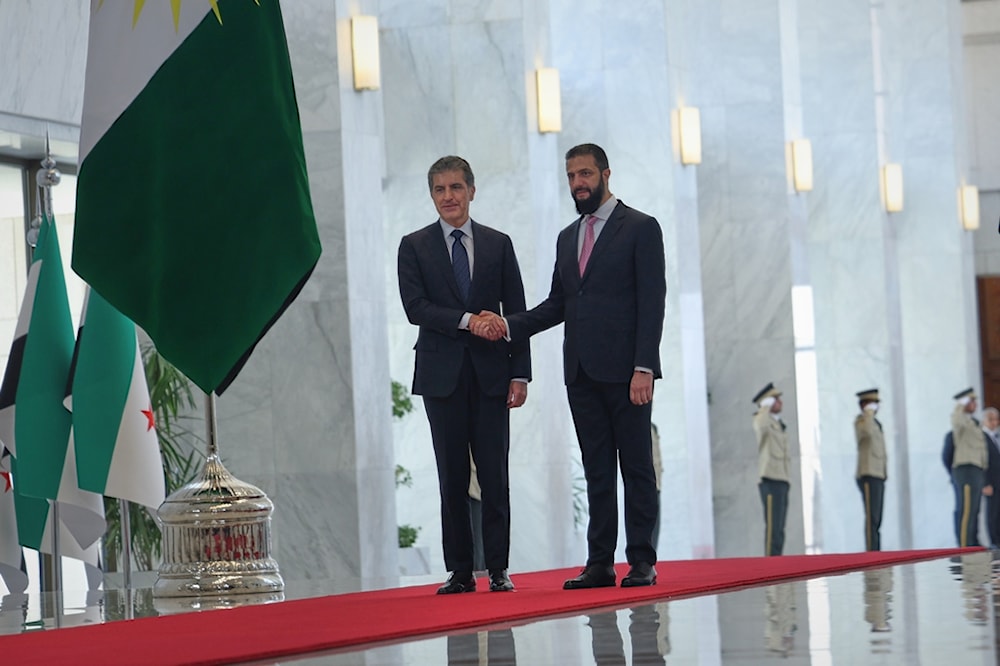
Syrian President Ahmad al-Sharaa, right, shakes hands with Nechirvan Barzani, President of Iraq's Kurdistan Region, at the People's Palace in Damascus, Syria, Monday, Aug. 3, 2026. (AP Photo/Ghaith Alsayed)
President of the Kurdistan Region of Iraq Nechirvan Barzani arrived in Damascus on Monday for his first visit since Syria's new authorities took power, with talks expected to focus on cooperation and the implementation of an agreement to integrate Kurdish institutions into the Syrian state, according to Syrian official sources cited by AFP.
Syrian President Ahmad al-Sharaa received Barzani and discussed ways to strengthen cooperation and coordination, particularly in the economic field, as well as regional developments and issues of mutual interest, the Syrian presidency said in a statement.
A Syrian government source told AFP that the visit aims to discuss the January 29 agreement and the procedures for integrating the Syrian Democratic Forces (SDF) into state institutions.
Damascus, Kurds discuss integration deal
A Syrian diplomatic source said Barzani's one-day visit would primarily focus on following up on the agreement between the Syrian government and the SDF, adding that the Kurdish leader is expected to meet with SDF commander Mazloum Abdi.
Erbil, the capital of the Kurdistan Region of Iraq, previously served as a venue for political discussions during clashes between Syrian government forces and Kurdish forces in early 2026. At the time, Abdi held meetings with Barzani under US sponsorship.
In late January, Damascus and Kurdish forces reached an agreement outlining the integration of Kurdish self-administration institutions and their armed forces into Syrian state institutions.
Barzani had welcomed the agreement, describing it as "an important step in the right direction" and expressing hope that it would contribute to rebuilding a united Syria, protecting the rights of Kurds and other communities in the future constitution, and achieving peace in Syria and the wider region.
Agreement reshapes Kurdish structures
The agreement represents a major setback for Kurdish forces, which had sought to preserve the autonomous administration structures they developed during years of war in Syria, as written by AFP.
Those structures included organized civilian and military institutions that administered large areas in northern and eastern Syria, including regions containing major oil and gas fields.
Following the agreement, Syrian security forces entered the cities of Hasakah and Qamishli, while the state took control of Qamishli airport and key oil fields in northeastern Syria.
The implementation process also included the appointment of senior Kurdish military figure Siban Hamo as deputy defense minister for the eastern region.
Under the agreement, an army division consisting of three SDF brigades is set to be formed within the Syrian military in northeastern Syria, alongside another brigade for the forces in Kobani (Ayn al-Arab).
However, differences remain between Damascus and Kurdish authorities over the practical mechanisms and procedures required to complete the integration process.


