
Battlefield gains will not be undermined by talks: Azizi
 3 Min Read
Iranian official Ebrahim Azizi outlines Tehran’s stance on negotiations, US tensions, "Israel", and new Strait of Hormuz maritime policy changes.
-
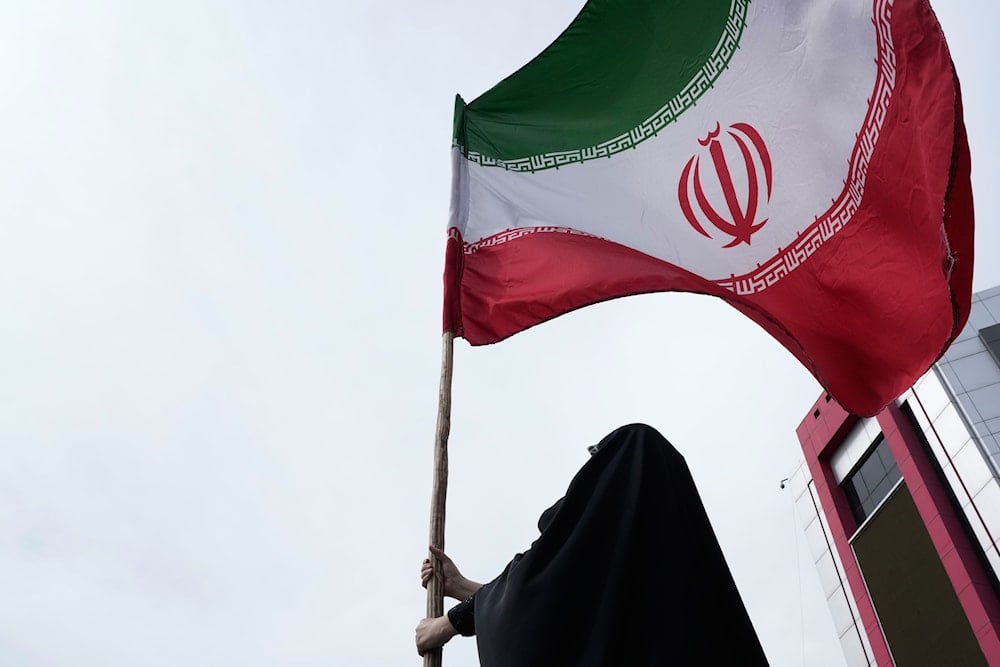
A woman holds an Iranian flag in downtown Tehran, Iran, on April 25, 2026 (AP)
The head of the Iranian Parliament’s National Security and Foreign Policy Committee, Ebrahim Azizi, has outlined Tehran’s positions on negotiations, national security, and recent regional tensions, while also referencing Iran’s wartime preparedness and leadership decision-making.
Azizi reiterated Iran’s long-standing position that talks must be conducted from a position of strength, saying negotiations “must always be conducted from a position of strength.” He accused Western powers of maintaining maximalist demands in nuclear talks, stating that “the Americans have always insisted in negotiations on ‘zero enrichment’ and the removal of uranium stockpiles.”
The Iranian official emphasized that Iran "held on to red lines, and the nuclear file is non-negotiable," emphasizing that the US will seize the opportunity to impose more demands, stating that "even if we handed in our uranium stockpile, this will not solve the problem and the Americans will raise the ceiling of their demands."
He also rejected false distinctions in US politics, arguing that Democrats and Republicans are “two blades of the same scissors,” and maintained that external pressure on Iran has continued since the 1979 Islamic Revolution.
Addressing recent regional escalation, Azizi said the brief but intense war with the United States had strategic implications, describing it as a “12-day war” that served as reconnaissance for Washington. He added that Iran’s response “pushed Washington toward activating the ‘snapback’ mechanism.”
Iran was prepared extensively for any scenario
He further stated that Iran had prepared extensively for such scenarios, saying, “All measures and strategies related to the war had been planned, and we struck around 14 American bases in the region.” Azizi also claimed that “terrorist and separatist groups had planned to enter the country through the northwestern borders in parallel with the American aggression.”
According to him, Iran’s response ultimately shaped the outcome of the confrontation. “We ended this war on our own terms and made the Americans suffer a defeat,” he said.
Azizi emphasized that Iran’s highest leadership remains involved in decision-making on security matters, noting that “although decisions of peace and war are within the authority of the Leader of the Islamic Revolution, martyr Sayyed Khamenei was always keen to consult with experts.”
Strait of Hormuz key pillar of Iran's strength
Turning to maritime affairs, Azizi reaffirmed Iran’s position on the strategic Strait of Hormuz, describing it as “one of the key pillars of Iran’s strength.” He announced what he called a new maritime navigation framework, stating, “We affirm the new maritime navigation system in the Strait of Hormuz.”
He added that longstanding practices in the waterway had changed, saying, “The 47-year ‘era of hospitality’ has ended, and all vessels wishing to transit the Strait of Hormuz must now pay passage fees.”
Azizi’s remarks collectively underscored Iran’s assertion of strategic strength, continued skepticism toward Western intentions in negotiations, and emphasis on military readiness and regional leverage, particularly in relation to the Strait of Hormuz and broader security dynamics.


