
Bennett, Lapid come together, join forces ahead of elections
 5 Min Read
Naftali Bennett and Yair Lapid have formed a joint electoral list to challenge Benjamin Netanyahu.
-
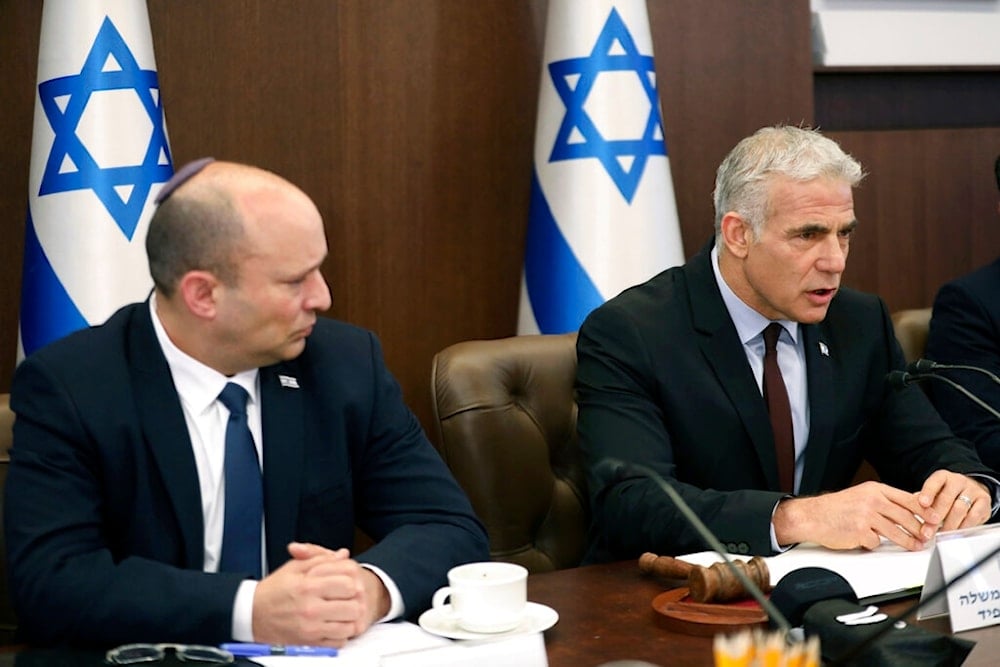
Former Israeli Prime Minister Naftali Bennett, left, and former Prime Minister Yair Lapid attend a cabinet meeting in occupied al-Quds Sunday, July 3, 2022 (AP)
Former Israeli prime ministers Naftali Bennett and Yair Lapid are preparing to unveil a joint political initiative ahead of upcoming elections, in what The Jerusalem Post described as a significant shift within the opposition landscape.
The two leaders finalized an agreement on Saturday evening to merge their respective political frameworks into a unified electoral list named “Together", which will be led by Bennett. Lapid’s Yesh Atid is expected to form the core of the alliance alongside Bennett’s new political formation.
The announcement is expected to be formally presented during a joint press conference, with both figures aiming to consolidate support across ideological lines within the opposition camp. Discussions have also left room for Gadi Eisenkot, leader of the Yashar movement, to potentially join the alliance. Eisenkot had previously declined an offer to take a secondary role under Bennett, though talks between the three figures have continued in recent weeks.
Lapid is said to support Bennett’s leadership of the joint list, viewing him as a figure capable of appealing to right-leaning voters while maintaining a commitment to institutional norms. The broader objective, according to the report, is to reduce internal fragmentation within the opposition and channel efforts toward a unified electoral strategy focused on securing victory and initiating political change.
Bennett-Lapid unity push
Recent polling data have indicated that a consolidated list under Bennett could strengthen the bloc’s electoral performance and improve its prospects of forming a government.
"The unity between us is a message to the entire people of Israel. The era of division has ended, and the era of repair is here," Bennett wrote on X.
"This brings about the unification of the Repair Bloc, and enables focusing all efforts on leading Israel toward the necessary repair," Lapid wrote on X.
Eisenkot responded by stressing alignment on the broader objective, stating that the "goal of winning the critical elections before us is a shared goal."
"I see Naftali Bennett and Yair Lapid as partners and will continue to do, with responsibility and wisdom, what is right to achieve the victory and the change needed for the State of Israel. Fixing Israel is the mission of my life, and I am determined to fulfill it," he wrote on X.
Reactions from across the political spectrum followed the announcement. Benny Gantz welcomed the development, calling for broader national cohesion and arguing that "only a broad Zionist unity government will ensure that, which will isolate the extremists and advance Israel forward, and not a government that relies on extremists or non-Zionist parties."
Meanwhile, Avigdor Liberman expressed support for the merger, noting, "We must remember that the goal is to replace the government of October 7."
Far-right backlash
At the same time, criticism emerged from figures aligned with Prime Minister Benjamin Netanyahu, who continues to lead the Likud and has confirmed plans to run in the upcoming elections. Members of the party and allied factions accused the alliance of lacking ideological consistency and relying on support from Arab political actors, including Mansour Abbas.
Police Minister Itamar Ben-Gvir and Finance Minister Bezalel Smotrich were among those who issued sharp criticisms, while other officials dismissed the move as politically driven rather than programmatic.
The formation of the “Together” list reflects ongoing efforts within the opposition to reorganize ahead of elections, as parties weigh strategic alliances to maximize electoral viability in a highly fragmented political environment.
Policy continuity
Despite presenting itself as a vehicle for political change within "Israel", the emerging alliance is not expected to bring any meaningful transformation in policies toward Palestinians, which have long been marked by systemic violence and dispossession.
Previous governments led by Naftali Bennett and Yair Lapid oversaw intensified military incursions across the occupied West Bank, repeated airstrikes on Gaza that resulted in significant civilian deaths, and the continued expansion of illegal settlements on Palestinian land. These actions, widely documented by international organizations, form part of an entrenched system that has produced recurring mass killings, displacement, and the erosion of Palestinian life and infrastructure.
While differences with the government of Benjamin Netanyahu may appear in rhetoric or political composition, particularly with the inclusion of more openly hardline figures in the current ruling coalition, the broader framework of occupation, blockade, and military domination has remained consistent across successive Israeli administrations.
As a result, the formation of the new alliance is widely seen as unlikely to alter the material realities on the ground for Palestinians, where cycles of violence, including large-scale killings of civilians and ongoing territorial expansion, have persisted regardless of shifts within "Israel’s" political leadership.
Read more: 'Israel' president delays Netanyahu pardon amid deepening crisis


