
Berri: Washington agreement is an imposition, not a deal for Lebanon
 3 Min Read
Lebanese Parliament Speaker Nabih Berri denounces the Washington agreement as an imposed diktat, warning it threatens Lebanon's unity and exceeds the dangers of the 1983 May 17 Agreement.
-
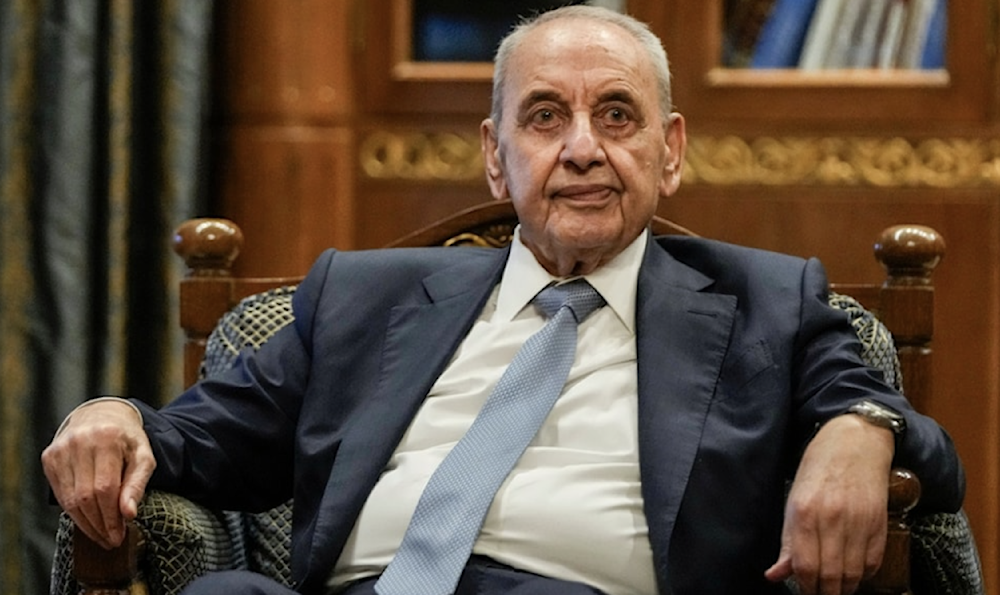
Lebanese Parliament speaker Nabih Berri during his meeting with the European Union foreign policy chief Josep Borrell, in Beirut, Lebanon, Sunday, Nov. 24, 2024. (AP)
Lebanese Parliament Speaker Nabih Berri sharply criticized the agreement signed in Washington, describing it as an imposed set of dictates rather than an agreement that safeguards Lebanon's rights.
In remarks to Al Akhbar newspaper, Berri said the deal "is an imposition, not an agreement that preserves Lebanon's rights," warning that its consequences would be severe.
Berri argued that the agreement is "ten times worse" than the 1983 May 17 Agreement, which was widely rejected in Lebanon and later annulled.
He warned that its most dangerous aspect is its potential to fuel internal divisions and sectarian strife, ultimately serving the interests of the Israeli occupation.
Warning against internal unrest
"The agreement constitutes a sedition that threatens the unity of Lebanon and the Lebanese people," Berri said, adding that describing it as "sedition" represents "the highest level of political warning."
Despite his criticism, Berri stressed that there would be no call for street mobilization or actions that could be exploited to drag the country into chaos.
"We will not be drawn into any street movements or reactions that could be exploited to push the country into disorder and internal conflict," he said, urging restraint amid escalating political tensions surrounding the agreement.
'A great achievement for Israel'
US Secretary of State Marco Rubio announced on Friday that a framework agreement had been reached between Lebanon and "Israel", describing the deal as a first step in what he called a "difficult journey."
Rubio emphasized that "this is the beginning of the beginning," adding that "there is still a long road ahead for Lebanon and Israel."
"Israel's" envoy to the United States, Yechiel Leiter, claimed that under this framework, "Iran is out, Hezbollah is out, and the road to peace between Israel and Lebanon is in." Meanwhile, Israeli Prime Minister Benjamin Netanyahu hailed the agreement as a major achievement for the occupation, calling it a blow to Iran, which he said was trying to force Israeli withdrawal from southern Lebanon by force.
Additionally, Netanyahu declared that "Israel" would not allow Lebanese residents or Hezbollah to return to the security belt area under Israeli occupation, and stressed that "Israel" would remain in the areas of southern Lebanon it is occupying until "Hezbollah is disarmed." Israeli Channel 12 quoted a senior Israeli official who described the agreement with the Lebanese government as a "great achievement for Israel."


