
Bolivia Congress clears way for military deployment against protesters
 4 Min Read
Bolivia's Congress repealed Law 1341, giving Paz power to deploy troops as protests enter week four and rights concerns mount.
-
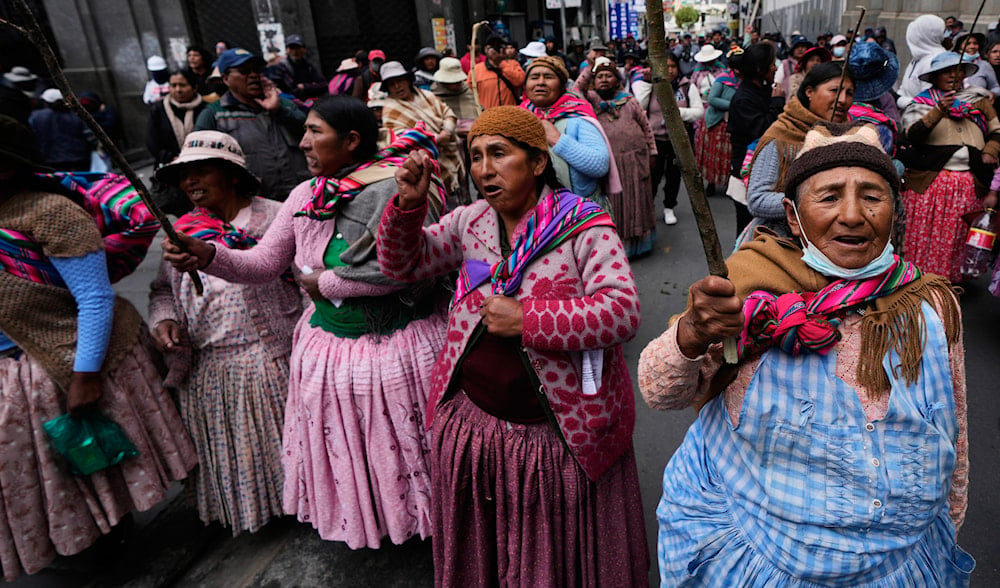
Demonstrators shout slogans during an anti-government protest in La Paz, Bolivia, Monday, May 25, 2026. (AP Photo/Juan Karita)
Bolivia's lower house of Congress has cleared the way for President Rodrigo Paz to deploy the military against demonstrators, repealing a key piece of legislation that had constrained executive authority to impose states of emergency since the country's last deadly political crisis seven years ago.
The Chamber of Deputies voted by more than a two-thirds majority on Tuesday to repeal Law 1341, the legislative guardrail that since 2020 had required congressional approval before any state of emergency could be declared; a protection embedded in Bolivia's legal framework following the 2019 unrest that left 36 people dead and forced then-President Evo Morales from office.
Speaker Roberto Castro confirmed the result, noting that more than two-thirds of the 117 members present in the 130-seat chamber backed the measure. The repeal had already cleared the Senate and was pushed through outside ordinary congressional procedure to allow passage within a single week.
With the restriction lifted, Paz can now deploy the armed forces and impose curbs on civil liberties, including freedom of movement and assembly.
Opposition, unions warn repeal puts protesters at risk
Opposition lawmakers and labor leaders condemned the decision. Deputy Sonia Sinani said the measure would only "pour gasoline on the flames," while colleague Alejandro Reyes called the law "a straitjacket," implying that its removal leaves citizens with far less protection.
The sharpest warning came from Eduardo Ferrufino, general secretary of the Bolivian Workers' Central (COB), who told Sputnik that the repeal effectively handed the security apparatus a blank check. "They are going to hand a blank sheet to the military and police to kill," he said.
The concern is not abstract. During a government operation to clear the La Paz–Oruro highway on May 23, protester Víctor Cruz Quispe was shot dead in the municipality of Calamarca. Authorities said the killing is under investigation.
Paz makes gestures as movement consolidates
On Monday, Paz announced a 50 percent salary cut for himself and senior officials, a concession to one of the movement's demands. His monthly wage, currently around 24,000 bolivianos (approximately $3,500), is already among the lowest of any Latin American head of state, though it remains roughly eight times the average Bolivian worker's income.
He also acknowledged in a speech in Sucre that his government had failed to build sufficiently broad coalitions. "Perhaps, I say this with the greatest humility, we neglected building a government broad enough to include all sectors," he said.
The gestures have done little to slow the momentum of the protests, which began in early May with trade union demands over wages, fuel supplies, and economic management, and have since grown into a broad popular movement now entering its fourth week.
US backing, regional dimensions
The Paz government has attributed the protests to orchestration by former President Morales. Protest leaders have pushed back on that characterization, pointing instead to unmet campaign promises on wages, fuel, and state enterprises as the driving grievances.
The US State Department has publicly expressed support for the Paz administration. Critics of Washington's position, including protest representatives, argue that US backing is tied to Bolivia's lithium reserves and a broader interest in preventing a leftward political shift in the country.
The crisis has also spilled into regional diplomacy. Earlier this month, Bolivia and Colombia exchanged diplomatic expulsions after President Gustavo Petro called the situation a "popular insurrection," a description La Paz rejected as interference in its internal affairs.
Read more: Bolivia’s Mendoza links US policy to Latin America unrest: Exclusive


