
Bolivia enters fourth week of protests against Paz government
 4 Min Read
Bolivia entered its fourth week of anti-government protests as demonstrators demanded President Paz’s resignation amid clashes, road blockades, and political tensions.
-
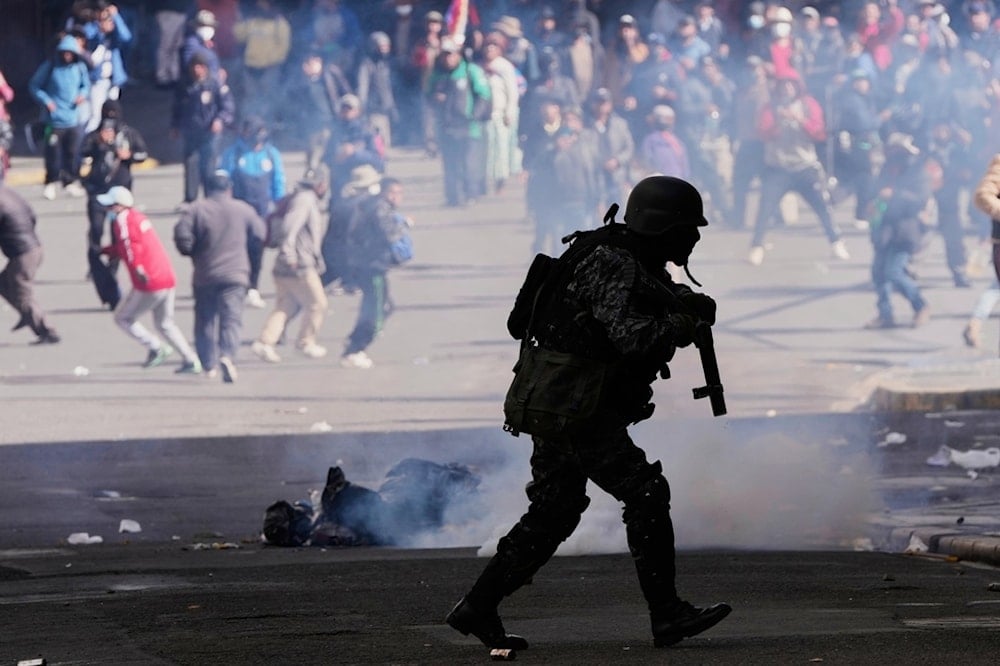
A police officer runs after launching tear gas at protesters during an anti-government demonstration in La Paz, Bolivia, Monday, May 25, 2026 (AP)
Bolivia entered its fourth consecutive week of anti-government protests on Monday, with growing demonstrations demanding the resignation of Bolivian President Rodrigo Paz amid mounting political and economic unrest.
Thousands of demonstrators descended from La Ceja in the city of El Alto toward the capital La Paz, where clashes erupted with security forces guarding access to Plaza Murillo, the political center of the country.
Farmers, industrial workers, and union representatives were dispersed by police using tear gas during clashes in the streets surrounding the square. Reports indicated that at least 20 people were detained during the demonstrations.
The protests come as Bolivia continues to face widespread road blockades that have severely disrupted commercial activity across much of the country for nearly a month.
Read more: Bolivia’s Mendoza links US policy to Latin America unrest: Exclusive
Debate intensifies over emergency powers law
Simultaneously, discussions advanced within Bolivia’s Plurinational Legislative Assembly over repealing Law 1341, legislation that currently limits the government’s ability to impose a state of emergency.
Business sectors and institutions opposing the nationwide blockades have pushed for broader executive powers to confront the protests and reopen transport routes.
Critics of the proposal, however, warned that repealing the law would hand sweeping authority to security forces at a moment of heightened political tension.
Eduardo Ferrufino, the general secretary of the Bolivian Workers' Central, told Sputnik that the measure would effectively provide military and police forces with unchecked powers.
“They are going to hand a blank sheet to the military and police to kill,” Ferrufino warned.
President Paz acknowledges failures in dialogue
Earlier Monday, Paz spoke from the city of Sucre during commemorations marking the anniversary of the “First Libertarian Cry” of Latin America, linked to anti-colonial uprisings against Spanish rule in 1809.
During his address, Paz announced that he and senior government officials would cut their salaries by 50 percent, responding to one of the demands raised by protest movements.
The president also admitted shortcomings in the government’s engagement with sectors now leading the protests.
“In these six months we have tried to listen, learn, and understand the immense majority of the homeland,” Paz said. “And perhaps, I say this with the greatest humility, we neglected building a government broad enough to include all sectors, all organizations, and all differences within the unity of the homeland and the government.”
Despite the remarks, demonstrations continued to intensify throughout the day.
Protesters interviewed by Sputnik expressed anger over a recent government operation aimed at clearing the highway connecting La Paz and Oruro on May 23.
During clashes in the municipality of Calamarca, Víctor Cruz Quispe, a supporter of the road blockades, was killed by gunfire. Authorities said the case would be investigated.
Mientras tanto en Bolivia, los trabajadores y los mineros siguen en pie de guerra contra el régimen de Rodrigo Paz, pidiendo la renuncia del títere de EEUU y el fin de la privatización del pais para entregárselo a las empresas gringas.
— Daniel Mayakovski (@DaniMayakovski) May 26, 2026
Estas imágenes no interesan enseñarlas, las… pic.twitter.com/sIcC0JGMZF
Trade unions maintain pressure on government
Labor organizations said they had instructed demonstrators to permit the passage of humanitarian supplies, including ambulances, oxygen, and food shipments.
Ferrufino stated that protest organizers were attempting to prevent harm to civilians despite the nationwide transport paralysis.
“We have already instructed mobilized sectors at blockade points to allow oxygen, ambulances, and food to pass. We keep our word,” he said.
According to government figures, four people have died during the protests after failing to receive timely medical treatment for underlying conditions.
More than 50 roadblocks remain active across Bolivia, with the exception of the departments of Beni, Pando, and Tarija.
Meanwhile, Mario Argollo, the second-highest-ranking leader of the Bolivian Workers’ Central, reportedly went into hiding after authorities issued an arrest order accusing him of terrorism and other charges.
Miners’ union accuses elites and US of interference
Andrés Paye, executive secretary of the Bolivian Federation of Mining Workers, accused the government of failing to fulfill campaign promises made during the 2025 presidential election.
Paye also alleged that the administration was backed by economic elites and foreign influence.
“The national government has the support of the elite, of economic and political power, as well as interference from the United States, which wants to subjugate the people, but Bolivia is sovereign,” he said. “These damned people interfere in different countries to steal natural resources.”
Read more: Colombia expels Bolivian ambassador after tensions with La Paz


