
US, Bolivia move toward restoring diplomatic ties after 18-year rift
 3 Min Read
The US and Bolivia are moving to exchange ambassadors for the first time since 2008, signaling a thaw in relations following nearly two decades of diplomatic estrangement.
-
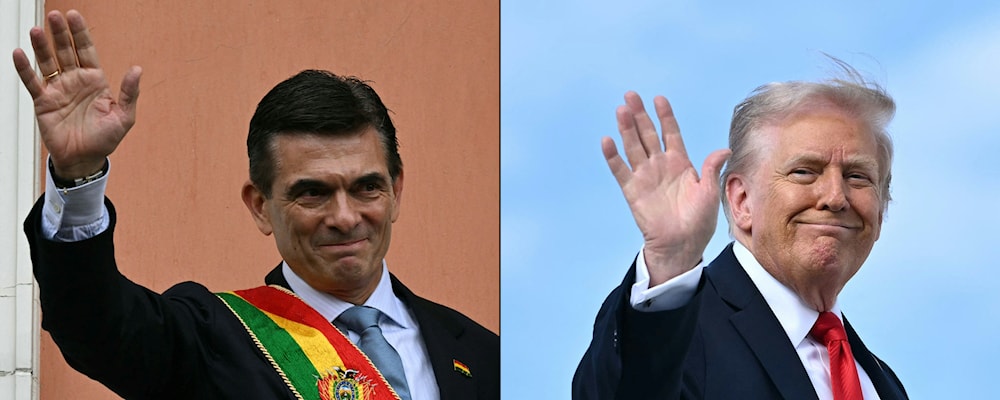
This combination of pictures created on February 05, 2026 shows Bolivia's new president Rodrigo Paz waving to supporters alongside his wife Maria Elena Urquidi from a balcony of the Palacio Quemado government palace during his inauguration in La Paz on November 8, 2025, and United States President Donald Trump waving as he boards Air Force One at Joint Base Andrews, Maryland, on September 11, 2025. (AFP)
The United States and Bolivia are coordinating to exchange ambassadors “as soon as possible,” signaling a potential end to nearly two decades of diplomatic estrangement, Bolivian Foreign Minister Fernando Aramayo said on Thursday.
Speaking to Agence France-Presse, Aramayo said the issue was discussed during his meeting with US Secretary of State Marco Rubio in Washington on Wednesday, noting that both sides expressed readiness to move forward with restoring full diplomatic representation.
“The idea is to complete this step as soon as possible,” Aramayo said, referring to the reappointment of ambassadors.
Neither country has hosted an ambassador from the other since 2008, when Bolivia’s then-president, Evo Morales, expelled the US ambassador, after Washington conspired against his government. The White House responded by expelling Bolivia’s ambassador in a reciprocal move. The diplomatic rupture marked a sharp downturn in bilateral relations and reflected broader tensions between Bolivia and Western governments during the administrations of Morales and his successor, Luis Arce.
Since assuming office in November, the government of President Rodrigo Paz, a center-right leader, has sought to reset relations with the United States. The push represents a departure from the more confrontational foreign policy that characterized Bolivia’s stance toward Washington over the past decade and a half. The planned exchange of ambassadors would mark the most significant step yet toward normalizing ties between the two countries since their diplomatic break nearly 18 years ago.
A political reset
The restoration of ambassadorial ties represents what Bolivian officials have described as a political “reset,” aimed at overcoming the long-standing standoff.
Paz has framed the rapprochement as part of a broader shift in Bolivia’s foreign policy, emphasizing cooperation and mutual respect. His administration has sought to reverse years of diplomatic distancing from Western governments, positioning engagement with the United States as a cornerstone of its new approach.
Economic considerations have also featured prominently in the renewed dialogue. Washington has expressed support for privatization and fiscal austerity, while Paz has actively courted US investment and announced plans to lift visa requirements for American tourism and business travel. High-level discussions have additionally covered cooperation on critical minerals and technology, including approval for Starlink to operate in Bolivia to expand internet access.
Security cooperation has emerged as another area of convergence, with both governments voicing interest in coordinating responses to transnational crime and broader citizen security challenges. Following talks in Washington on February 4, 2026, officials from both sides confirmed that coordination is underway to reinstate ambassadors “as soon as possible,” although no formal nominations have yet been announced.
Read more: Bolivia restores diplomatic relations with 'Israel'


