
Brazil's Lula holds call with Trump, agrees to visit Washington
 3 Min Read
Lula and Trump discuss Venezuela, the Gaza-focused "Board of Peace," and a future visit to Washington during a 50-minute phone call.
-
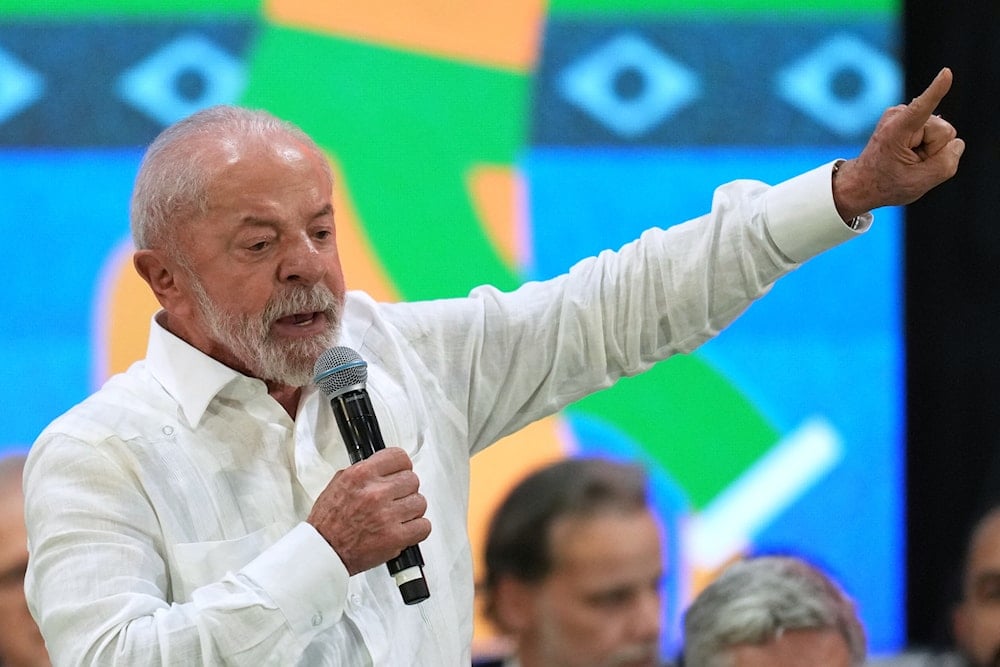
Brazilian President Luiz Inacio Lula da Silva speaks during a Christmas event with the families of collectors of recyclable trash in Sao Paulo, Friday, Dec. 19, 2025 (AP)
Brazilian President Luiz Inácio Lula da Silva held a 50-minute phone call with US President Donald Trump on Monday, during which the two leaders discussed Venezuela, Trump’s "Board of Peace," and efforts to combat organized crime.
The Brazilian government said in a statement that Lula agreed to visit Washington in the near future.
On the topic of Venezuela, President Lula stressed the importance of “preserving peace and stability in the region." He also emphasized the need to work for the welfare of the Venezuelan people, reflecting his ongoing criticism of the US abduction of Venezuelan President Nicolas Maduro earlier this month, which Lula had condemned as crossing “an unacceptable line.”
The Brazilian president also addressed Trump’s new initiative, the "Board of Peace," suggesting that it be limited to the situation in Gaza. Lula called for Palestinian representation on the board, amid concerns that the initiative could take on a wider role and potentially rival the United Nations. Last week, Lula warned that the plan risked creating a “new UN” under US control, although Trump has stated that the "Board of Peace" would work alongside the UN.
Trump tariffs create rift between Brasilia, Washington
Tensions between Trump and Lula began escalating sharply in mid 2025, when the Trump administration slapped 50 % tariffs on Brazilian goods, a move Lula condemned as politically motivated and an interference in Brazil’s sovereign affairs. Lula explicitly rejected direct engagement with Trump, saying outreach would be a “humiliation" and instead sought support from other global leaders.
Relations deteriorated further as Trump’s foreign policy grew more assertive. Lula openly criticised US “unilateral attacks” on Brazilian institutions and sovereignty, accusing Washington of arbitrary sanctions and punitive measures tied to domestic Brazilian legal processes.
In October 2025, Trump’s military pressure on Venezuela, part of a broader US counter‑narcotics and regime‑change strategy, deepened the rift, with Lula denouncing such interventions as dangerous precedents that threaten regional stability and violate international norms. Latin American peers echoed this critical stance, insisting US actions bordered on bullying.
By January 26, 2026, the abduction of Venezuelan President Nicolás Maduro by US forces intensified Brazilian criticism, with Lula calling it an act that “crosses an unacceptable line” and undermines peace prospects. This event underscored broader Latin American alarm over Trump’s aggressive approach in the Western Hemisphere.
Despite occasional diplomatic gestures, the relationship remains strained, shaped by Lula’s firm resistance to what he views as US overreach and Trump’s willingness to employ economic coercion and military force, revealing deeper ideological clashes over sovereignty, multilateralism, and the role of powerful states in global affairs.


