
Caribbean leaders launch new reparations manifesto on slavery
 4 Min Read
Caribbean leaders unveil a new reparations manifesto seeking compensation for slavery, genocide, and gender-based violence from former colonial powers.
-
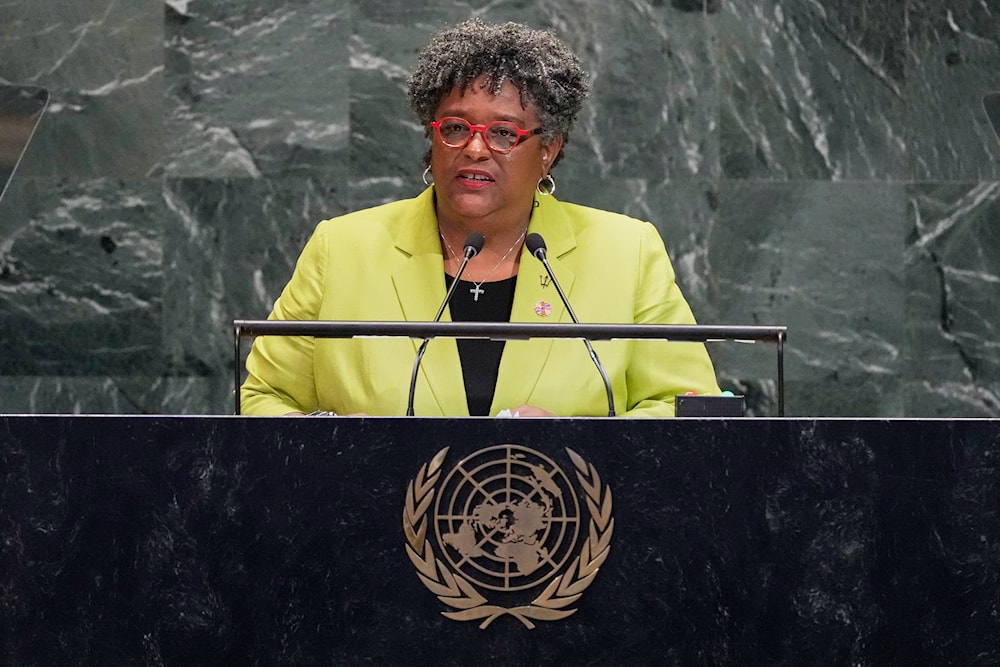
Barbados Prime Minister Mia Mottley addresses the 80th session of the United Nations General Assembly, Friday, Sept. 26, 2025 (AP)
Caribbean leaders have issued a sweeping new reparations manifesto, making a "moral, ethical and legal case" for compensation from former colonial powers for centuries of enslavement and genocide, Barbados Prime Minister Mia Mottley announced on Thursday.
Speaking at a "historic" conference in Ghana, Mottley unveiled an updated version of the Caribbean Community (Caricom) 15-year-old reparations plan. The revised 52-page document expands the original 10-point agenda with fresh legal arguments and new demands, including explicit compensation for gender-based violence suffered by enslaved women and girls.
The announcement comes on the heels of a landmark United Nations resolution declaring the transatlantic trafficking of enslaved Africans the gravest crime against humanity.
New focus on gender-based violence
For the first time, the manifesto specifically calls for reparations for sexual violence, citing data that "women represented approximately 30% of the estimated 20 million Africans forcefully transported across the Atlantic Ocean." The document also notes that at least 1.2 million enslaved women experienced sexual assault.
Highlighting the update, Mottley drew a direct comparison to other internationally recognized compensation cases.
"The compensation for gender-based violence and assault on family," she said, "is no different from the compensation that has been awarded to other nationalities such as the Japanese."
Climate justice and slavery reparations linked
The draft, which The Guardian has seen, also forges a new link between climate justice and slavery reparations, arguing the two are "inextricably linked". Additionally, it calls for a dedicated plan to support Indigenous peoples who inhabited the Caribbean before European arrival and were subjected to genocides.
The document makes clear that Caricom is demanding monetary compensation from Britain, other European nations, monarchies, churches, corporations, and families. The claim covers "loss of life and uncompensated labour, loss of liberty, personal injury, mental pain and anguish and gender-based violence" for both Indigenous victims and enslaved Africans.
However, the manifesto stops short of specifying a dollar amount, framing the initiative instead as "a collective vision for an approach to the pursuit of reparatory justice."
No statute of limitations
The legal backbone of the new manifesto is unequivocal and argues that crimes against humanity "are not subject to a statute of limitations," meaning that regardless of how much time has passed, "legal proceedings for accountability and justice can still be initiated."
The document cites the 1968 UN Convention on the Non-Applicability of Statutory Limitations to War Crimes and Crimes Against Humanity to bolster its case.
It also condemns the "failure of former colonial powers to apologise and make amends for their racist actions against Indigenous and African ancestors and their descendants."
No retreat on repair
Describing the Accra gathering as a watershed moment, Mottley struck a firm but non-aggressive tone, challenging the global community to find moral clarity.
"We live in a world today where people call out people for everything, for misogyny, for sexual assault, for all kinds of behaviour," she said, noting that "...Yet we have not found the moral courage to state unanimously across humanity that this grave crime against humanity that persisted for centuries ought to be declared so by all."
She added, "That others choose to remain silent is a reflection of them, not of us. We have equally come to say that there should be no retreat on repair. The language used from this platform this morning is not one of aggression, is not one of violence but it is one of the necessities for healing for humanity."
Second update
The document, which is still awaiting formal approval from Caricom member governments, represents the second update to the original 2014 plan. The Caribbean Reparations Commission has previously stated that the revisions incorporate emerging scientific and historical evidence to strengthen the legal and moral arguments.
While the manifesto does not set a specific financial sum, it clearly signals that Caribbean nations are shifting from advocacy to a more assertive, legally grounded demand for justice, one they insist is long overdue.


