
China, Russia conduct strategic 3rd joint anti-missile drill
 5 Min Read
China and Russia hold their third joint anti-missile drills, emphasizing a defensive posture amid US missile-defense expansion, nuclear threats, and regional tensions.
-
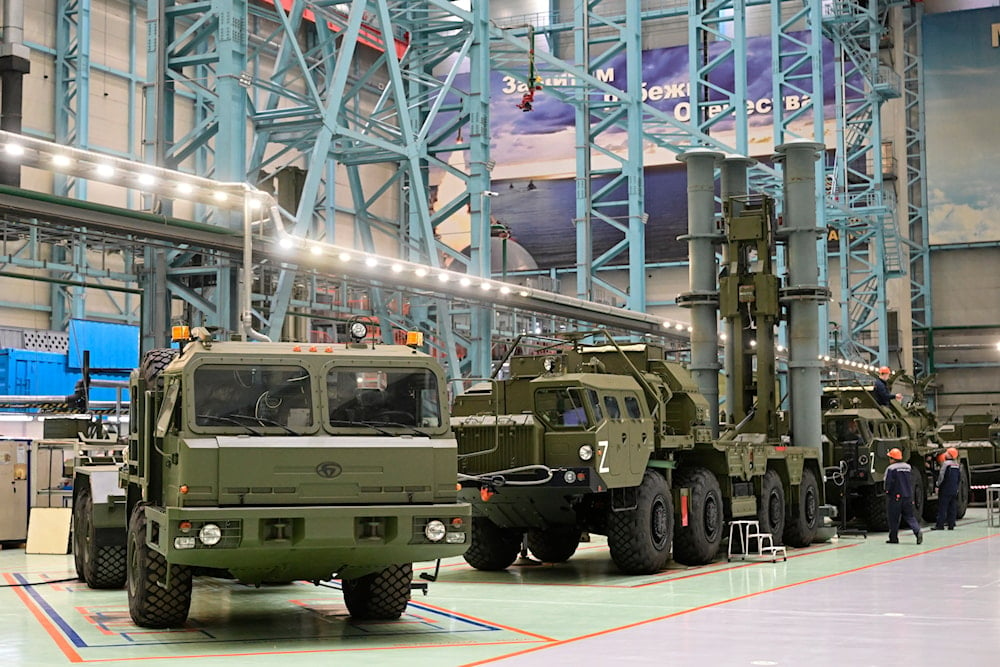
Military vehicles are seen at the assembly shop of the Almaz-Antey Corporation's Obukhov Plant in Saint Petersburg, Russia,on January 18, 2023 (Sputnik via AP)
China and Russia have carried out their third joint anti-missile exercise, held on Russian territory in early December 2025. Both sides emphasized that the drills “do not target any third party” and are “not related to the current international and regional situation,” according to a statement from China’s Ministry of National Defense.
The exercise highlights the continued deepening of Sino-Russian military cooperation, following previous joint operations and ongoing discussions on missile defense and strategic coordination.
While the drills are defensive, they also serve to signal the two countries’ growing interoperability and alignment on regional security matters.
Previous Sino-Russian anti-missile exercises
The 2025 drills build on a history of missile-defense cooperation between Beijing and Moscow. The first exercise of its kind, Aerospace Security 2016, was held in May 2016 under the auspices of Russian air- and missile-defense forces. It marked the first formal collaboration aimed at rehearsing joint responses to missile threats.
The second exercise, Airspace Security 2017, took place in December 2017 in Beijing as a computer-simulated “command-post” drill. It focused on planning, command-and-control coordination, and joint responses between Chinese and Russian missile- and air-defense units, including simulated scenarios involving ballistic or cruise missiles. Official statements at the time emphasized the defensive nature of the drills, opposing global missile-defense systems, and aiming to uphold regional strategic balance.
Despite plans for a potential 2019 iteration, publicly available records indicate that no joint anti-missile exercises took place after 2017 until the resumption of drills in 2025.
China-Russia agree to strategic security cooperation
On November 20, the Russian Foreign Ministry said that Russia and China held talks in Moscow on missile defense and strategic stability and agreed to strengthen cooperation in both areas. The Ministry added in a statement that the discussions included a joint analysis of destabilizing factors that create strategic risks to global and regional security, as well as an exchange of views on ways to mitigate these risks.
Russian Defense Minister Andrei Belousov held talks with General Zhang Youxia, Vice Chairman of China’s Central Military Commission, during the Chinese delegation’s visit to Moscow. The delegation was welcomed at Russia’s National Defense Management Center with an honor guard and military band before bilateral discussions began.
Read more: China, Russia advance in hypersonic missiles as US lags behind
Strategic rationale behind the drills
The recurring missile-defense exercises reflect a convergence of strategic interests between China and Russia. This includes shared security concerns as both nations have voiced opposition to global missile-defense initiatives, particularly those led by the West, which they argue undermine their deterrence capabilities. Joint drills allow China and Russia to reinforce shared security interests and counterbalance Western threats.
Additionally, the 2017 command-post exercises highlighted the critical importance of synchronizing command-and-control infrastructures, establishing a foundation for more effective cooperation across missile and air-defense systems, a capability that has become particularly significant as Beijing has transitioned from Soviet-era designs to its own advanced, indigenous programs. Yet, while the two countries maintain a “strategic partnership", they have repeatedly denied forming a formal military alliance.
Resumed drills amid growing regional, global threats
As missile technologies, including ballistic, cruise, and hypersonic systems, proliferate, both powers see joint drills as a means to enhance readiness and coordination in response to emerging threats.
The timing of the 2025 resumption of Sino‑Russian anti‑missile drills, after an eight‑year hiatus, comes amid a recalibration of global strategic posture. In May 2025, the Trump administration unveiled Golden Dome, a sweeping US missile‑defense project combining ground- and space‑based sensors and interceptors, aiming to defend the US against ballistic, hypersonic, and cruise missiles, even those launched from space.
From Moscow’s and Beijing’s standpoints, the Golden Dome represents more than a shield. In the words of their joint May 2025 statement, it challenges the “inseparable interrelationship between strategic offensive arms and strategic defensive arms,” thereby undermining established norms of deterrence and strategic stability.
Moreover, the announcement by Trump on October 30 that the US would “start testing nuclear weapons” has reverberated globally. While it remains unclear whether he referred to full-scale explosive tests or more limited “system tests", the move alone signals Washington’s willingness to reopen a chapter of nuclear competition.
This announcement has fed into growing anxieties in Beijing and Moscow over strategic imbalance. At the same time, East Asia is witnessing increased tensions, notably between China and Japan, as aerial and maritime confrontations escalate over Tokyo's threats to South China Sea security.
Read more: Trump’s nuclear claims: Misreading strategy as Russia, China modernize


