
China, US top diplomats hold talks ahead of expected Trump-Xi summit
 3 Min Read
China's Wang Yi and US Secretary of State Marco Rubio held talks ahead of an expected Trump-Xi meeting, with trade, AI, Taiwan, and the US war on Iran among the key issues shaping bilateral relations.
-
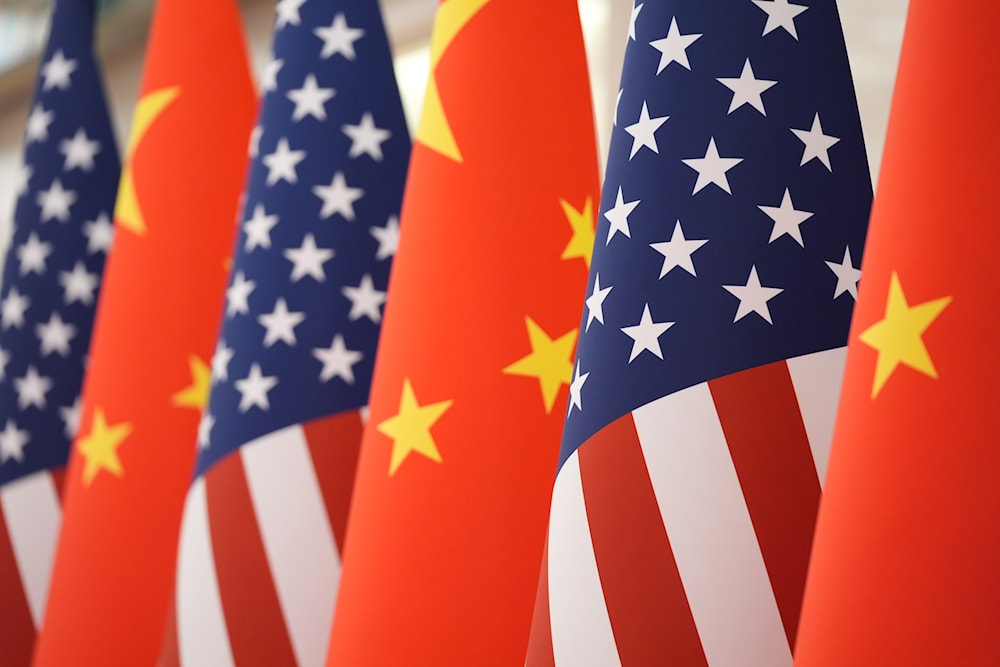
The U.S. and Chinese flags are pictured at the Great Hall of the People prior to the state dinner of President Donald Trump and Chinese President Xi Jinping, May 14, 2026, in Beijing (AP)
China’s Foreign Minister Wang Yi and US Secretary of State Marco Rubio held talks by phone on Thursday as Beijing and Washington prepare for a new round of high-level diplomacy, with Chinese President Xi Jinping expected to meet US President Donald Trump in Washington next week.
The call comes as the two powers navigate disputes spanning trade, artificial intelligence, Taiwan, and the ongoing US war on Iran, all of which are expected to loom over the upcoming leaders’ talks.
According to China’s Xinhua news agency, Wang told Rubio that the two sides “should prepare for the next stage of high-level exchanges in spirit of equality, mutual respect, and mutual benefit”.
He also said relations between Beijing and Washington have “generally” advanced along the “track of constructive strategic stability for some time”.
Beijing, Washington prepare ground for high-level talks
Xi is expected to meet Trump in Washington on September 24, although Beijing has yet to formally confirm the visit. The meeting would come amid efforts by both sides to manage an increasingly complex relationship without allowing existing disputes to trigger a broader confrontation.
Economic tensions remain a central issue, with the world’s two largest economies continuing to grapple with tariffs, technology restrictions, and competition over strategic industries.
Artificial intelligence has also emerged as a major point of contention ahead of the expected summit, particularly over advanced semiconductor access, export controls, military applications of AI, and Washington’s restrictions on Chinese access to high-end US technology.
War on Iran enters China-US discussions
Wang and Rubio also exchanged views on developments in the Middle East, according to Xinhua, as China continues diplomatic efforts surrounding the US war on Iran.
The discussion follows Wang’s contacts with Iranian Foreign Minister Abbas Araghchi, with Beijing calling for restraint and renewed negotiations aimed at easing the war.
The war, which erupted following US-Israeli strikes on Iran in late February, has added another layer of tension to US-China relations as Beijing maintains close economic and diplomatic ties with Tehran while Washington seeks to restrict Iran’s access to international markets.
China has also sought to position itself as a diplomatic actor in efforts to halt the fighting, while resisting US pressure surrounding its relations with the Islamic Republic.
Trade, Taiwan remain major fault lines
Beyond the war on Iran, trade remains one of the most consequential issues hanging over the relationship, with Washington and Beijing still seeking to contain the fallout from years of escalating tariffs and technology restrictions.
Taiwan also remains a major source of friction. Beijing considers the island part of China and has repeatedly opposed US military and political support for authorities in Taipei.
The issue is receiving renewed attention ahead of the expected Trump-Xi talks, particularly as regional governments monitor whether Washington’s approach toward Taiwan could shift as part of broader negotiations with Beijing.
Thursday’s Wang-Rubio call therefore signals an effort by both sides to establish diplomatic groundwork ahead of the anticipated presidential meeting, as China and the United States confront several overlapping geopolitical and economic disputes.
Read more: Iran hopes China plays bigger role in Middle East peace: Araghchi


