
China tells EU not to blame Beijing for Europe’s problems
 3 Min Read
China’s Wang Yi told France and Germany not to blame Beijing for the European economy’s problems during talks at the Munich Security Conference.
-
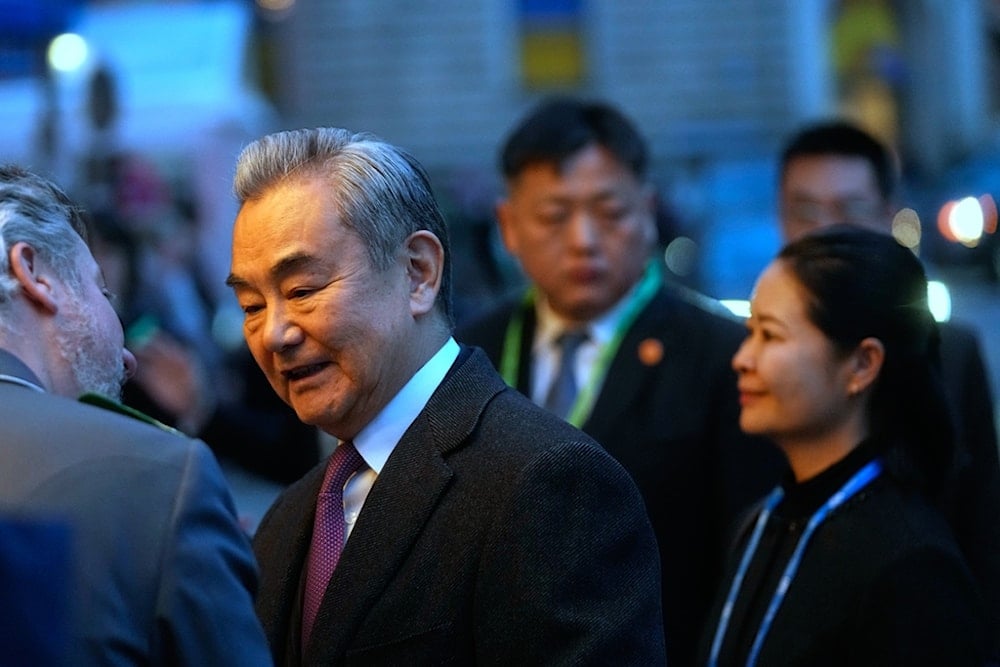
China's Foreign Minister Wang Yi arrives at the Munich Security Conference in Munich, Germany, Friday, February 13, 2026. (AP Photo/Michael Probst)
China’s Foreign Minister, Wang Yi, told his French and German counterparts that Beijing was not responsible for the European economy’s challenges or the bloc’s broader security concerns, as he pushed for deeper cooperation during talks in Germany.
Yi made the remarks during a meeting with France’s Jean-Noel Barrot and Germany’s Johann Wadephul on the sidelines of the Munich Security Conference on Friday, according to a Chinese foreign ministry statement.
"China's development is an opportunity for Europe, and Europe's challenges do not come from China," Wang said, according to the statement.
Read more: China reaffirms opposition to use of force amid Iran tensions
China seeks closer ties with the European Union
Beijing has been seeking to position itself as a reliable partner of the European Union at a time when the bloc is attempting to reduce its dependence on both China and an increasingly unpredictable Washington.
Warning that "unilateralism, protectionism, and power politics" were on the rise globally, Wang said he hoped Europe would "pursue a rational and pragmatic policy towards China."
"The two sides are partners, not adversaries; interdependence is not a risk; intertwined interests are not a threat; and open cooperation will not harm security."
The comments come amid growing friction over trade and geopolitical issues, including Brussels’ concerns about China’s ties with Russia during the Ukraine conflict.
Trade tensions and economic concerns
The European Union has been working to reduce its reliance on China for strategic goods such as rare earth materials, while also addressing what it views as an imbalanced trade relationship that leaves the European economy running a significant deficit with the world’s second-largest economy.
Recent disputes have centered on Chinese electric-vehicle exports to Europe, which EU officials argue benefit from unfair subsidies and pose risks to the bloc’s automotive sector. In response, China has imposed tariffs on a range of EU goods, including cheese and cognac.
Wang urged France and Germany to help "give a clear direction for the development of China-Europe relations".
Read more: EU seeks to fast-track fee on cheap Chinese online parcels to 2026
In a separate meeting with Wadephul on Friday, Wang described economic and trade cooperation as "the cornerstone of China-Germany ties", according to the foreign ministry readout.
Wang also met Britain’s foreign minister, Yvette Cooper, stating that Beijing and London should "explore more potential for cooperation". The two sides also discussed Ukraine and Iran.


