
CNN: Iran holds the upper hand in the Strait of Hormuz
 5 Min Read
Iran's geography, unconventional arsenal, and firm negotiating position leave the US scrambling and Trump's contradictions exposed.
-
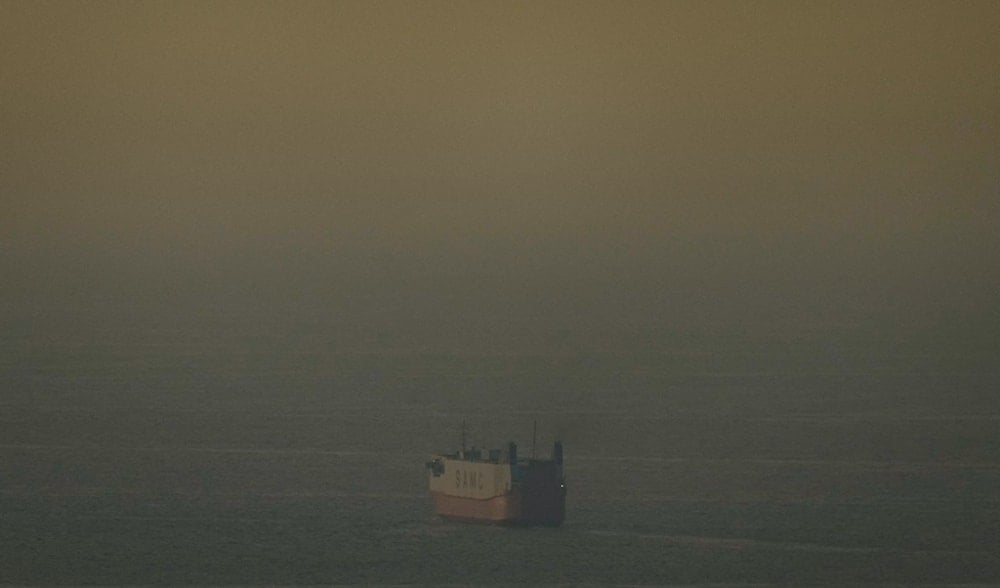
A cargo ship sails in the Gulf towards the Strait of Hormuz, as seen from the United Arab Emirates, Thursday, March 19, 2026. (AP)
Nearly four weeks into the effective closure of the Strait of Hormuz, the United States finds itself in a deepening strategic bind, caught between Iran's geographic and military advantages, a global energy crisis it cannot insulate itself from, and a president whose public statements have grown increasingly erratic and contradictory.
The Strait of Hormuz has become the defining battleground of the US-Israeli war on Iran that began on February 28. And by virtually every military and geographic measure, Iran holds the upper hand.
At its narrowest, the strait spans approximately 24 miles (38 km), with almost all maritime traffic funnelled through two heavily constricted shipping lanes. Unlike open-ocean routes, there is no alternative passage, making the strait, in the words of analysts, a uniquely unforgiving chokepoint.
"In the open ocean, there is always the option of re-routing; in a chokepoint or narrow sea, that option is impossible," said Kevin Rowlands, journal editor at the Royal United Services Institute and former head of the UK's Royal Navy Strategic Studies Centre. "That means that Iran doesn't necessarily need to seek out and find its targets. It can sit and wait," he told CNN.
This effectively creates what Rowlands describes as a "kill zone," in which the warning time for an incoming attack can be mere seconds. Nick Childs, senior fellow for Naval Forces and Maritime Security at the International Institute for Strategic Studies (IISS), echoed the assessment to CNN, describing the strait as "a uniquely challenging one, because there are no alternatives."
Geography as a weapon
Iran's strategic geography compounds the challenge for any would-be military response. The Islamic Republic commands nearly 1,000 miles of Gulf coastline, from which it can launch mobile anti-ship missile batteries; mobility being key, as it makes those systems far harder to locate and eliminate.
The terrain on the Iranian side of the strait, encompassing hills, mountains, valleys, built-up areas, and offshore islands, further complicates detection of incoming Iranian strikes and provides ample cover for concealed weapons systems, Rowlands noted to CNN.
Iran's unconventional arsenal, including cheap drones, sea mines, fast-attack small vessels, and explosive-laden unmanned boats, continues to pose a deterrent to hostile vessels that is, in practical terms, impossible to reduce to zero, Childs told CNN.
Iran sets the terms
Iranian officials have repeatedly affirmed that the strait remains closed to the United States, "Israel", and their allies, but remains open to non-hostile vessels that are not involved in the ongoing US-Israeli aggression on Iran.
Iranian Foreign Minister Abbas Araghchi has affirmed that Tehran's control over the waterway is a legal right under international law, placing the blame for regional instability squarely on Washington and Tel Aviv.
In a call with UN Secretary-General António Guterres, Araghchi stressed that the insecurity gripping the strait is a direct consequence of the US-Israeli aggression, and called on the UN to condemn the aggressors rather than pressure Iran into restraint.
Tehran has also insisted that its influence over the Strait of Hormuz constitutes a mechanism to ensure compliance with any future commitments, and that this must be formally acknowledged.
Trump's flip-flops underscore Washington's confusion
Against this backdrop, the Trump administration's posture has been marked by contradiction and confusion. Trump has simultaneously claimed diplomatic progress that Iran has denied, declared the war "won" while escalating military deployments, threatened to strike Iranian power plants only to back down days later, and announced pauses in attacks that mediators say Iran never requested.
Most strikingly, Trump publicly stated on March 20 that the United States does not "need" the Strait of Hormuz, urging Japan, China, and South Korea to "get involved." By March 26, he was doubling down, telling reporters after a Cabinet meeting that the US is effectively immune to Hormuz disruptions due to its domestic oil wealth, claiming the country holds twice the oil reserves of Saudi Arabia or Russia, and would soon hold three times as much.
View this post on Instagram
The remarks are difficult to reconcile with Washington's simultaneous deployment of thousands of additional Marines and sailors to the region and its development of naval escort plans for oil tankers.
Trump's assertion that the US is "not affected" by the closure also jars with the reality of spiralling global energy prices, the chaos gripping international oil markets, and the economic shockwaves emanating from the near-total halt in Gulf energy exports.


