
Cuba condemns US military threats and intervention in Venezuela
 4 Min Read
Cuba warns that US military escalation in the Caribbean threatens regional stability, condemning attempts to undermine Venezuela’s legitimate government.
-
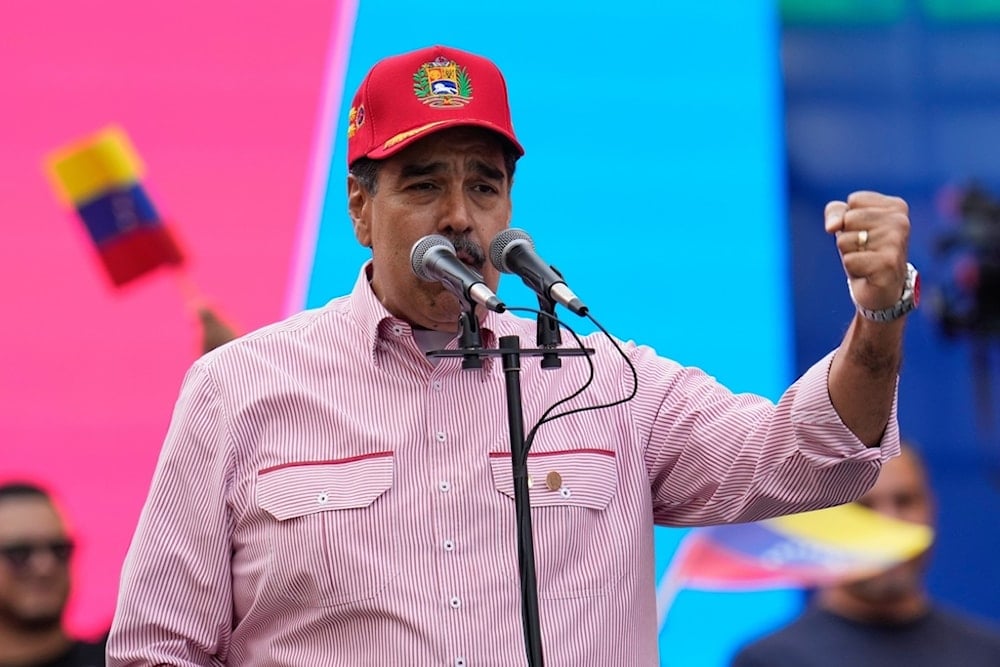
Venezuelan President Nicolas Maduro addresses supporters during a swearing-in event for government-organized community committees at the presidential palace in Caracas, Venezuela, Monday, December 1, 2025 (AP)
Cuban President Miguel Diaz-Canel strongly condemned the US government’s interventions, threats, and military aggression targeting Venezuela, describing Washington’s actions as “unacceptable” and a continuation of “old colonial practices.”
He stressed that Latin America and the Caribbean must remain a zone of peace and reaffirmed Havana’s unwavering support for the Venezuelan government.
Diaz-Canel criticized what he called the revival of the “gunboat policy” and the long-discredited Monroe Doctrine, asserting that these policies “belong to the past” and have no place in the region’s future. He reiterated that Cuba stands firmly with Venezuela in the face of escalating foreign pressure.
Earlier, Cuban Foreign Minister Bruno Rodriguez warned that the heightened and hostile US military presence in the Caribbean poses a direct threat to the security and stability of Latin America and the Caribbean.
He said recent deployments, pushed directly by US Secretary of State Marco Rubio, aim to forcibly overthrow Venezuela’s legitimate government, calling the escalation dangerous and irresponsible, with the potential for far-reaching and unpredictable consequences.
Both Cuban officials stressed that safeguarding regional peace requires rejecting external interference and upholding national sovereignty across Latin America.
Maduro vows loyalty to Venezuelan people
A massive popular mobilization marked the swearing‑in ceremony of new community leaders under the banner of the United Socialist Party of Venezuela (PSUV), as Venezuelan President Nicolás Maduro reaffirmed his “absolute loyalty” to the Venezuelan people and renewed his vow to carry forward the legacy of Hugo Chávez.
Under a clear sky on Monday, December 1, tens of thousands gathered in front of the Miraflores Palace for the formal induction of the newly formed grassroots bodies, known as the Bolivarian Community Commands of Integral Communities (CCBI).
Amid chants and red banners, Maduro invoked his oath made to Chávez at his farewell, declaring,“Just as I swore absolute loyalty to our Commander Chávez … today I swear absolute loyalty to you, until the last breath," adding, “I will never, ever fail you.”
Maduro framed the moment as a reaffirmation of the revolutionary path and a call to defend Venezuela’s sovereignty. He said the country seeks “peace with sovereignty, peace with equality,” rejecting any peace rooted in subjugation or colonial hangovers. “We don’t want the peace of slaves, nor the peace of the colony,” he affirmed, instead pledging “freedom, a republic, peace with dignity.”
To underpin his message, Maduro emphasized that true power stems from popular organization. “You are the national power, in that street, in that community,” he told the crowd. “If you consolidate yourselves there as People’s Power, national power becomes invincible, eternal, perpetual.” He reiterated his commitment to deepening the Bolivarian Revolution and advancing a model of political, economic, and social reconstruction built on grassroots foundations.
US escalates its anti-Venezuela campaign
This comes as the United States continues to escalate its campaign against Venezuela, with the alleged aim of curbing drug trafficking into the country.
On November 29, US President Donald Trump declared that the airspace over and around Venezuela is to be treated as completely closed, posting on Truth Social a message directed at airlines, pilots, drug traffickers, and human traffickers, urging them to consider the entire airspace above and surrounding Venezuela off-limits and warning that this restriction is to be enforced.
This follows remarks made by Trump, warning on November 27 that US operations against Venezuelan drug trafficking "by land" would begin very soon, claiming, "We've almost stopped — it's about 85% stopped by sea. The land is easier, but that's going to start very soon."
The closure declaration follows a substantial US military deployment to the Caribbean, the largest in decades. The USS Gerald R. Ford carrier strike group, including advanced fighter jets, warships, and over 15,000 personnel, entered the region in mid-November. Strategic B-52 bombers have also flown near Venezuelan territory, including a high-profile flight near Caracas on November 24.


