
Cuba vows self-defense amid US regime-change schemes
 3 Min Read
Cuba's foreign ministry vows self-defense as US officials weigh a Venezuelan-style abduction of Raul Castro and an imminent criminal indictment.
-
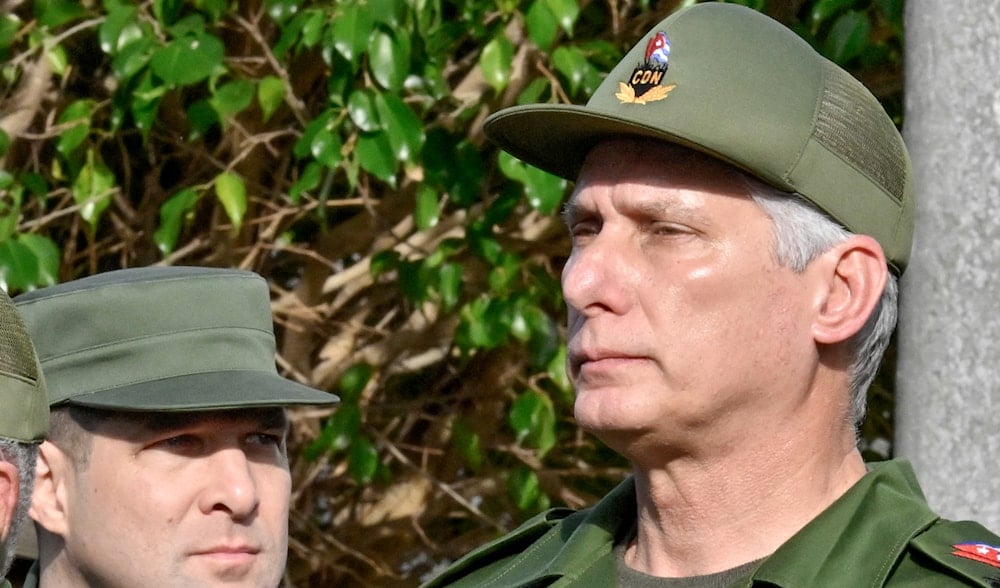
Cuba's President Miguel Diaz-Canel attend the funeral of the 32 Cuban soldiers killed during the US aggression against Venezuela at Colon cemetery in Havana on January 16, 2026 (Photo by ADALBERTO ROQUE / AFP)
Cuba's foreign ministry on Sunday declared the country would exercise its right to self-defense if attacked, as reports emerged that senior US officials are weighing options to forcibly remove the island's leadership.
"If Cuba is attacked, it will exercise its right to legitimate defense," the foreign ministry wrote on X.
Si Cuba es atacada, ejercerá su derecho a la legítima defensa.#LaPatriaSeDefiende 🇨🇺 https://t.co/hmCB9lEVBA
— Cancillería de Cuba (@CubaMINREX) May 17, 2026
Cuban President Miguel Diaz-Canel, responding to questions about a possible resignation under US pressure, said the idea of surrendering is entirely foreign to Cuban revolutionaries.
He also rejected comparisons with Venezuela, citing fundamental differences in the two countries' historical and political development.
US mulls regime change, Castro indictment
The defiant posture followed a New York Times report, citing sources within the US administration, that high-ranking officials are considering the possibility of former Cuban leader Raul Castro being abducted in the same fashion Venezuela's President was kidnapped.
The report coincided with a separate Reuters account citing a US Department of Justice official who said an indictment against the 94-year-old former president appears imminent, pending grand jury approval.
The potential case is expected to center on the 1996 downing of a Cessna aircraft linked to Brothers to the Rescue, a Cuban exile group that supported regime-change efforts in Cuba, which Cuban fighter jets shot down.
CIA director visits Havana
Yet alongside the escalatory moves, Washington has also pursued back-channel engagement.
Cuba announced on Thursday that it had hosted a delegation led by CIA Director John Ratcliffe following a request from the US government, describing the meeting as part of efforts to advance political dialogue amid "complex bilateral relations."
Ratcliffe met senior Cuban officials, including Interior Minister Lazaro Alvarez Casas and the head of Cuban intelligence services. A CIA official said Ratcliffe delivered a message from President Donald Trump that Washington was prepared to engage seriously on economic and security issues, but only if Cuba made "fundamental changes."
Cuban officials maintained throughout the talks that the island poses no threat to US national security and reiterated their rejection of Cuba's designation as a state sponsor of terrorism.
A tightening blockade
Washington has intensified its economic campaign against Havana in recent months, imposing sanctions on Cuba's GAESA conglomerate and Moa Nickel. GAESA, established in 1995, manages a broad portfolio of state enterprises across sectors, including tourism, retail, and finance.
In January, the Trump administration introduced tariffs on imports from countries supplying oil to Cuba and declared a national emergency, alleging an unspecified Cuban threat to US national security.
Havana has repeatedly rejected those claims, arguing the measures constitute an economic blockade intended to worsen living conditions for the Cuban population.
Energy crisis deepens
The political and legal pressure compounds an already dire energy situation. Power was restored across Cuba on Friday, 15 May, following a large-scale blackout that saw 65 percent of Cuban territory endure simultaneous outages, but the reprieve offered little relief.
Energy Minister Vicente de la O Levy told state television on Wednesday that the country's oil reserves had "run out," and the most important of Cuba's aging thermoelectric plants remained out of service following a breakdown. Scheduled blackouts continued even after the grid was reconnected.


