
Eight drones bound for Diplomatic Quarter shot down over Saudi Arabia
 3 Min Read
Saudi Arabia says its air defenses intercepted eight drones and thwarted an attempted strike toward Riyadh’s Diplomatic Quarter amid regional escalation.
-
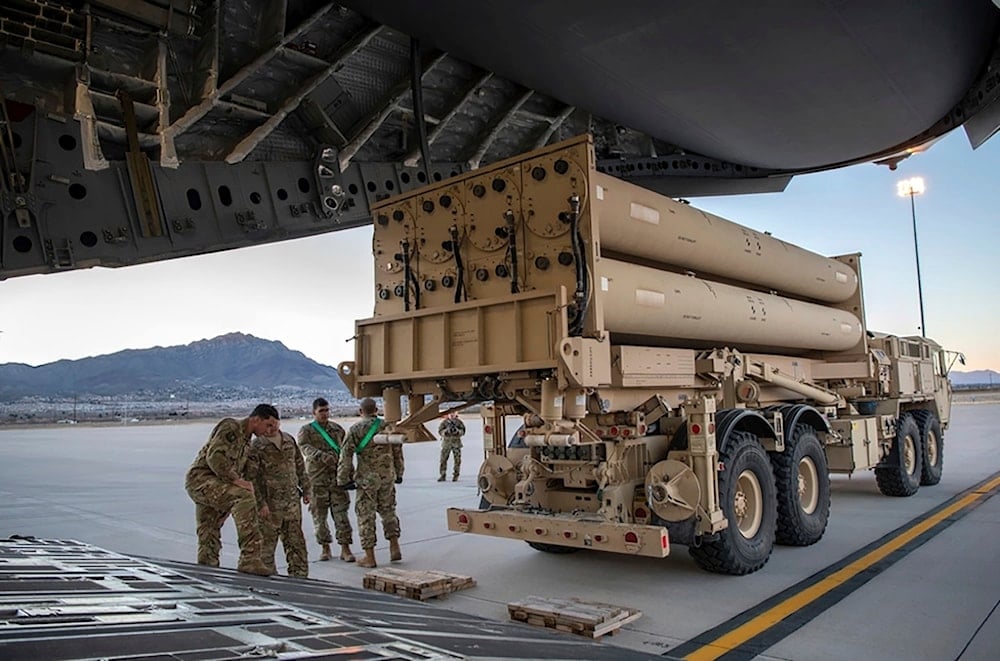
This image provided by the U.S. Air Force shows the US Army Terminal High Altitude Area Defense (THAAD) launching station preparing to load onto a 4th Airlift Squadron C-17 Globemaster III at Fort Bliss, Texas, February 23, 2019 (AP)
Saudi Arabia’s Ministry of Defense announced that the kingdom’s air defenses intercepted eight drones after they entered Saudi airspace, confirming that an attempted drone strike targeting Riyadh Diplomatic Quarter was thwarted.
According to the ministry, the Saudi Air Force successfully engaged the drones and prevented them from reaching their intended targets inside the country.
Earlier, US CNN released a satellite image taken on March 1, 2026, showing smoke rising from a compound near Prince Sultan Air Base in Saudi Arabia.
The report said the location previously hosted a radar belonging to a THAAD missile defense system battery deployed at the base.
Gulf states strained by costly interceptions
The outcome and duration of the widening war on Iran may hinge less on battlefield maneuvers and more on a stark calculation of the size of Iran’s missile and drone stockpiles versus the interceptor reserves held by the United States, "Israel", and Gulf states, according to analyses published by The Economist and The Guardian.
In the first three days of the current war, Iran reportedly fired hundreds of ballistic missiles and a couple of thousand one-way attack drones at Israeli targets in occupied Palestine and US military and intelligence assets in the United Arab Emirates, Bahrain, Kuwait, Qatar, Saudi Arabia, Jordan, and Iraqi Kurdistan.
By comparison, during the 1991 Gulf War, Iraq launched fewer than 100 missiles at Israeli targets and Saudi Arabia combined, The Economist noted, pointing to the scale of Iran's early retaliatory strikes.
While Gulf governments insist that most incoming projectiles have been intercepted, the pace of fire has placed extraordinary strain on air defense systems. Cities such as Dubai now reportedly experience near-daily interceptions overhead.
According to The Economist, Gulf states may have expended around 800 interceptor missiles, such as the Patriot PAC-3 and THAAD, within just two days. Production capacity appears limited in comparison.
Gulf burns through stockpiles to defend US aggression
Kelly Grieco, a strategic and military analyst at the Stimson Center, cautioned that while precise inventory levels are unclear, Gulf states are “burning through a lot” of their defensive munitions. She warned that difficult decisions may soon be required about what assets to shield.
“The Iranians know this,” Grieco said, describing Tehran’s strategy as sustaining smaller but continuous waves of attacks to exhaust defenses over time as “death by a thousand cuts”.
Beyond the military balance, cost and production timelines will shape the conflict’s trajectory. Grieco estimates that intercepting a drone can cost up to five times more than producing one. Advanced US-made interceptors are not only expensive but also slow to replenish and in high demand globally, including in Ukraine and Taiwan.
Pettyjohn suggested that if US, Israeli, or Gulf interceptor stockpiles were significantly depleted, pressure could mount to halt offensive operations and pursue negotiations. While the United States could theoretically withdraw forces, she noted, "Israel" cannot.


