
Ending Israeli occupation of Syrian land required for peace: al-Sharaa
 4 Min Read
Syrian President Ahmad al-Sharaa says restoring Syrian rights is essential for lasting regional peace, as Damascus pursues talks over "Israel", foreign forces, and the Golan.
-
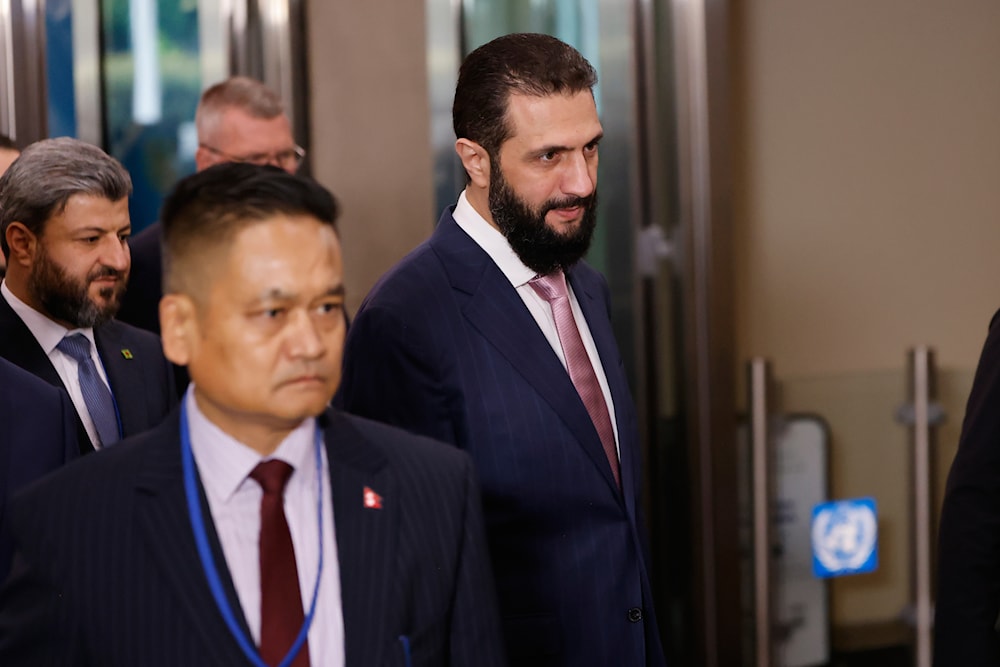
Syria's President Ahmed al-Sharaa, right, arrives ahead of the 81st session of the United Nations General Assembly at United Nations headquarters, Tuesday, Sept. 22, 2026 (AP)
Restoring Syrian rights is a fundamental condition for achieving lasting peace in the region, interim President of Syria Ahmad al-Sharaa said, noting that "Israel" continues its attacks and its occupation of Syrian lands it advanced into after the fall of Assad.
Speaking during a dialogue session hosted by the Atlantic Council in New York on the sidelines of the 81st session of the United Nations General Assembly, al-Sharaa explained that Syria has taken a diplomatic path and resorted to dialogue with friendly countries including Washington.
According to al-Sharaa, direct talks with "Israel" began about a year and a half ago and were disrupted by the latter's withdrawal for circumstances of its own, while Damascus remained engaged in the hope of reaching results.
He indicated that the first phase focused on the area occupied by "Israel" after December 8 through its advance beyond the 1974 borders and the conclusion of a security agreement, adding that if the agreement succeeds, Syria may engage in a long-term discussion on permanent peace and the Golan, affirming that the Golan is Syrian land according to a majority of more than 130 countries at the United Nations.
Al-Sharaa called for the formation of an international committee to assess Israeli "concerns" and distinguish the serious ones to prevent conflicts, warning that measuring "Israel's" policies toward Syria based on Gaza is a wrong path that does not bring security to Israelis, but rather stirs up disputes and wars.
Syria seeking to clear all foreign military bases
On the military file, al-Sharaa explained that Syria's approach is based on clearing the country of foreign bases, affirming that any future presence is subject to a legal description approved by the People's Assembly that guarantees the state's rights, noting that there is no need for foreign bases in the near term.
He revealed that results had been reached with the Russian side stipulating the reduction of its bases to two and their conversion to training the Syrian army, pointing out that Turkish forces had previously entered under exceptional circumstances to protect their borders amid a volatile region.
The number of Turkish bases in northwestern Syria has shrunk amid ongoing discussion to establish a legal description for arranging their presence, he stated.
Economic cooperation and missing US journalist
Economically, al-Sharaa announced a strategic project to extend an oil pipeline linking Iraqi fields to Syrian ports to secure a safe corridor for exports and avoid passage through the Strait of Hormuz.
He also praised the distinguished relations with the Kurdistan Region of Iraq and President Masoud Barzani, commending their contribution to supporting stability and helping to integrate the Syrian Democratic Forces with the Syrian state in a way that serves common interests.
On the file of the missing American journalist Austin Tice, he expressed sympathy with his family, noting that Syria has formed a special body for the missing to search for them, and is drawing on some international expertise, including forensic expertise, indicating that there are some preliminary leads related to the Tice case.
It is noted that Syria witnessed a series of changes, most notably the lifting of all sanctions that the United States had imposed on Damascus, which has become an ally of Washington, the removal of Hayat Tahrir al-Sham from "terrorism" lists, and the removal of al-Sharaa's own name and that of his interior minister.


