
Erdogan rejects Israeli aggression, backs Lebanon security efforts
 3 Min Read
Turkish President Erdogan condemns Israeli actions against Lebanon and signals readiness to join international efforts to support Lebanese security.
-
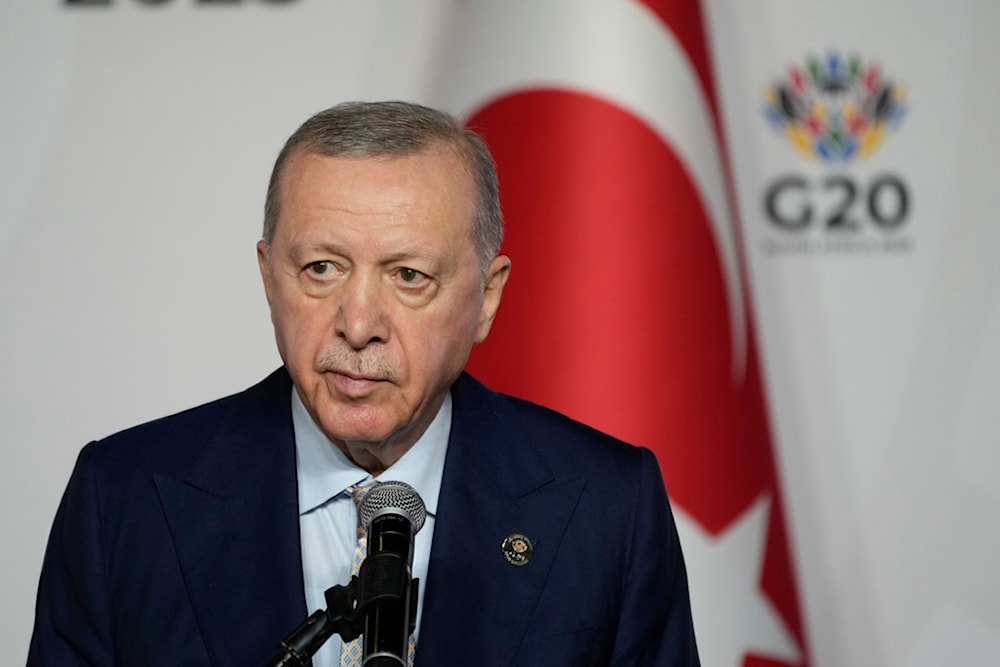
Turkish President Recep Tayyip Erdogan listens, during a press conference at the G20 leaders' summit, in Johannesburg, South Africa, Sunday, November 23, 2025. (AP)
Turkish President Recep Tayyip Erdogan has rejected what he described as the aggressive stance of the Israeli occupation toward Lebanon, expressing Turkey’s readiness to participate in international mechanisms aimed at supporting Lebanese security and stability, according to a statement from the Turkish presidency.
The remarks were made during a phone call with Lebanese President Joseph Aoun, during which Erdogan voiced Ankara’s opposition to Israeli actions targeting Lebanon amid rising regional tensions. He stressed that Turkey is prepared to contribute to international efforts designed to safeguard Lebanon’s sovereignty and prevent further escalation.
During the call, Erdogan also told his Lebanese counterpart that Ankara expects Beirut to adopt a position that “protects the rights and interests of Turkish Cypriots,” underscoring a longstanding Turkish policy stance on Cyprus-related issues.
Erdogan further said that Turkey would continue to provide support aimed at contributing to major changes underway in Syria, which he described as essential for broader regional stability. The Turkish presidency said Ankara views developments in Syria as closely linked to security dynamics across the Eastern Mediterranean and the Levant.
The exchange comes against the backdrop of heightened regional strains, with Turkey seeking to reinforce its role as an active regional actor while defending its strategic interests and allies, particularly as security tensions on the Lebanese front continue to intensify.
Israeli aggression targets Lebanon
Erdogan's statements come mere hours after the Lebanese Army announced on Tuesday the martyrdom of Staff Sergeant Ali Abdullah of the Support Brigades' Anti-Armor Regiment, after an Israeli airstrike struck the vehicle he was traveling in on the Quneitra–Maamariyeh–Saida road in southern Lebanon.
These attacks come after continued violations of the ceasefire that came into effect on November 27, 2024. According to the United Nations Interim Force in Lebanon (UNIFIL), "Israel" has committed more than 10,000 ceasefire violations since the truce began, including over 7,500 airspace violations involving drones and warplanes, and nearly 2,500 ground violations north of the Blue Line.
UN human rights experts have repeatedly warned that these violations have resulted in mounting civilian harm and infrastructure damage. Israeli air and drone strikes have continued across South Lebanon and other areas under various pretexts, hitting civilian vehicles, homes, and agricultural land, and preventing the stabilization envisioned under the ceasefire framework.
Lebanese authorities and international observers have noted that the persistence of Israeli attacks has undermined efforts to implement the truce, displaced civilians in border areas, and obstructed the full deployment of the Lebanese Army in the South. The ongoing strikes are widely seen as part of a broader strategy of military pressure that violates international law and further destabilizes Lebanon’s already fragile security situation.


