
Erdogan says Israeli attacks go beyond security motives
 3 Min Read
Turkish President Recep Tayyip Erdogan says Israeli attacks across Gaza, Yemen, Lebanon, and Iran exceed security justifications, urging global awareness.
-
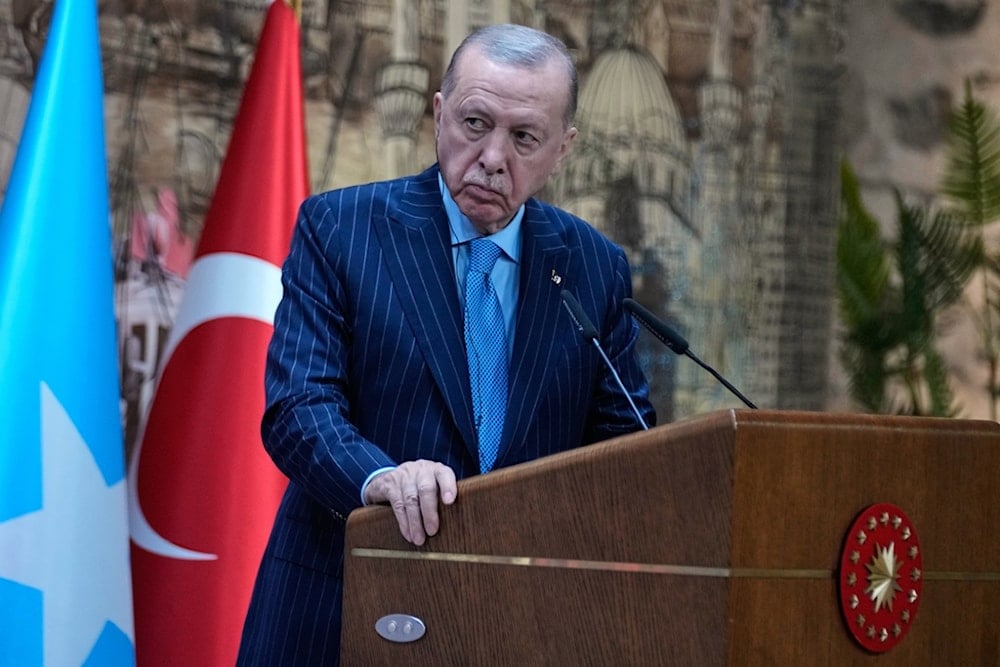
Turkey's President Recep Tayyip Erdogan listens as Somalia's President Hassan Sheikh Mohamud speaks during a joint news conference in Istanbul, Turkey, Tuesday, December 30, 2025 (AP)
Speaking during a media gathering at the presidential complex in Ankara, Erdogan said the ongoing war in the region, led by the Israeli occupation, has resulted in the killing of civilians and the displacement of populations from their historical lands.
He emphasized that these developments come amid major transformations in the global order following World War II, highlighting the importance of informing the international community.
Erdogan also addressed the closure of al-Aqsa Mosque, describing it as arbitrary and lacking legitimate justification. He stated that Muslims continue to be prevented from worshipping at the site, referring to it as Islam’s first qibla.
Warnings over regional escalation
The Turkish president said that the emergence of narratives surrounding the “promised land” and apocalyptic scenarios amid the attacks is not coincidental.
He pointed to what he described as a network wielding power and acting with a sense of superiority, warning that it is dragging the region toward disaster.
Erdogan called for expanding Turkey’s media and diplomatic reach, urging the development of widely followed journalists and media platforms capable of conveying these developments globally.
He stressed that Turkey, as an influential country with a strong voice, must broaden its scope and engage more actively on the international stage.
Thousands of missiles within days
According to analysis by the Foreign Policy Research Institute, citing figures from the Payne Institute for Public Policy, approximately 5,197 munitions across 35 different weapon types were used in the first four days of what the US has named "Operation Epic Fury," marking what researchers describe as the most intensive opening air campaign in modern history.
The scale of the barrage reflects the heavy reliance on precision strikes and missile defenses during the initial phase of the war, which began on February 28.
Read more: Trump’s inner circle shows 'buyer’s remorse' over Iran war decision
War places pressure on wider US military posture
The heavy use of advanced weapons during the war has also had wider strategic implications.
According to the analysis, the Pentagon has already begun redeploying air defense systems from the Indo-Pacific region to West Asia to support operations.
Such shifts highlight the logistical and industrial pressures created by sustained high-intensity warfare, particularly when large quantities of advanced weapons systems are required over a short period of time.


