
EU finalizes Russian gas phaseout deal, sets 2027 deadline
 4 Min Read
The EU agrees to phase out all Russian gas imports by 2027, triggering backlash from several countries reliant on Russian gas imports.
-
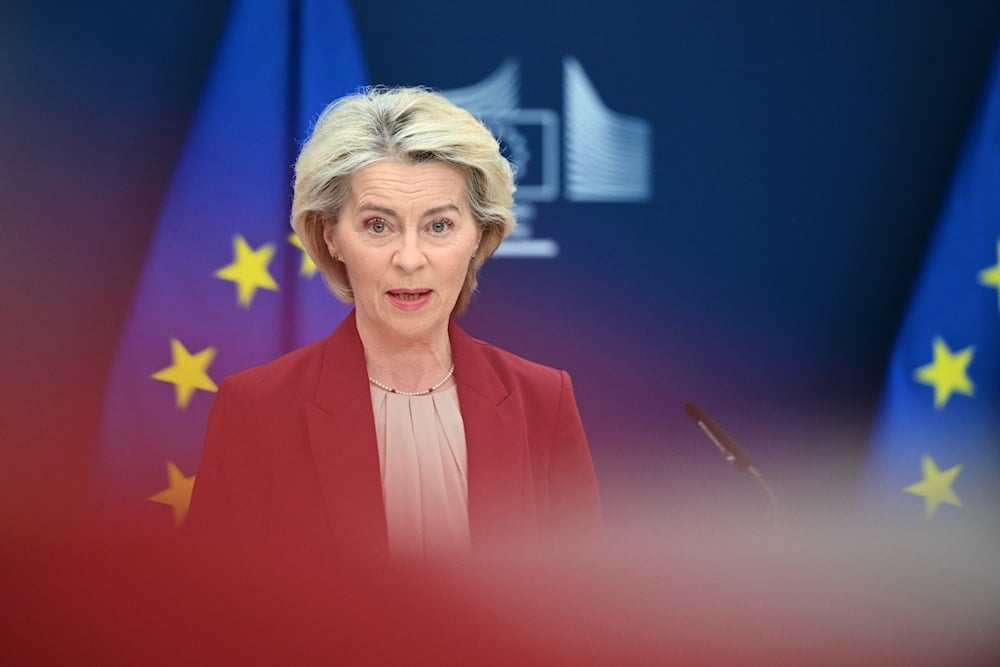
European Commission President Ursula von der Leyen speaks during a media conference regarding the provisional agreement on the phasing out of Russian fossil fuels under REPowerEU, at EU headquarters in Brussels, Wednesday, Dec. 3, 2025 (AP)
The European Union reached an agreement to phase out all Russian gas imports by late 2027, taking its most decisive step yet to unwind decades of energy dependence on Moscow.
The deal was sealed in the early hours of Wednesday after EU governments and the European Parliament endorsed proposals first put forward by the European Commission in June, following the outbreak of the war in Ukraine.
Under the agreement, the EU will permanently halt the import of Russian gas and pursue a gradual phase-out of Russian oil. Liquefied natural gas (LNG) imports from Russia will end by December 2026, while pipeline gas supplies will be terminated by the end of September 2027.
“Today, we are stopping these imports permanently,” European Commission President Ursula von der Leyen said. “By depleting Putin’s war chest, we stand in solidarity with Ukraine and set our sights on new energy partnerships and opportunities for the sector.”
Hungary, Slovakia consider legal action
The decision has triggered backlash from Hungary, which remains heavily dependent on Russian energy. Foreign Minister Peter Szijjarto said Budapest would challenge the measure at the EU Court of Justice, arguing that the legislation was improperly framed as a trade policy to bypass the unanimity required for sanctions.
“Accepting and implementing this Brussels order is impossible for Hungary,” Szijjarto said in a televised briefing. Slovakia is also exploring possible legal avenues, citing concerns that alternative supplies would be significantly more expensive and could harm its economy.
The Kremlin criticized the EU’s decision, warning that the bloc was undermining its own competitiveness and exposing consumers to higher energy costs.
As of October, Russia supplied 12% of EU gas imports, down sharply from 45% before the war in Ukraine began, with Hungary, France, and Belgium remaining among the few EU members still receiving Russian gas.
Phaseout timeline begins in 2026
For short-term contracts signed before June 17 of this year, the ban will take effect on April 25, 2026, for LNG and June 17, 2026, for pipeline gas.
Long-term contracts concluded before June 17 face cut-off dates at the start of 2027 for LNG and early October 2026 for pipeline gas, with the possibility of a one-month extension for countries struggling to meet storage requirements.
All Russian gas imports will require prior authorization unless they originate from major producing countries that themselves restrict Russian gas.
The Commission also plans to end remaining Russian oil imports by the end of 2027, with a legislative proposal expected early next year.
Under the agreement, member states must submit “national diversification” plans for oil and gas supplies by March 1 and notify the Commission of any existing Russian gas contracts or domestic bans on such imports.
History behind the decision
On May 6, 2025, the European Commission unveiled a legal roadmap to fully eliminate the EU’s dependency on Russian fossil fuels by the end of 2027. This decisive move came after growing concerns that voluntary efforts were insufficient to end reliance on Russian energy. The roadmap laid the foundation for the December 2025 agreement to ban all Russian gas imports by late 2027, the most far-reaching energy shift in the bloc’s history.
In early 2024, Russian liquefied natural gas (LNG) imports into the EU had rebounded, despite prior reductions. Countries such as Hungary, France, and Belgium continued to receive Russian LNG, complicating the EU's aim for complete energy diversification. This highlighted the need for binding legislation, as market-based shifts alone were proving inconsistent and incomplete.
Between 2022 and 2023, the EU managed to significantly cut its Russian gas imports, both pipeline and LNG, reducing Moscow’s share in EU gas supplies from about 45% in 2021 to roughly 15% by late 2023. Russia, for its part, began limiting pipeline flows in mid-2022, leveraging energy supplies amid the intensifying war in Ukraine. This triggered an energy crisis across the bloc, prompting emergency measures and alternative sourcing efforts.
The first formal step toward energy independence was taken on March 8, 2022, when the European Commission launched the REPowerEU plan. Announced just weeks after the war in Ukraine began, the strategy aimed to drastically reduce reliance on Russian fossil fuels through renewable expansion, improved efficiency, and new energy partnerships.