
Macron-Zelensky talks focused on sanctions on Russia, US peace plan
 4 Min Read
French President Macron hosted Ukraine’s Zelensky in Paris for high-stakes talks on a potential peace plan, urging European involvement.
-
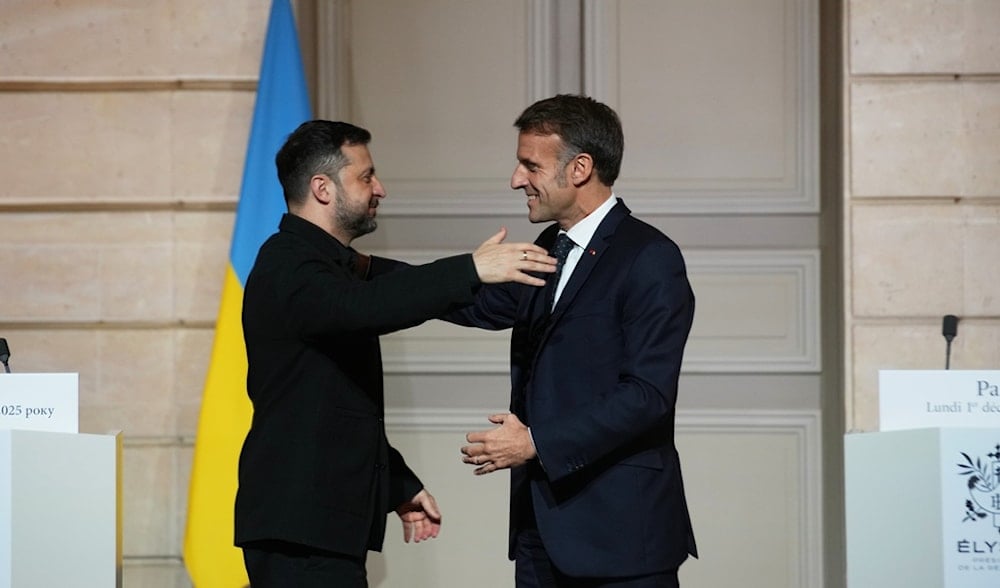
French President Emmanuel Macron, right, and Ukrainian President Volodymyr Zelenskyy hug each other after a joint press conference at the Elysee Palace in Paris, Monday, Dec 1, 2025. (AP)
French President Emmanuel Macron hosted Ukrainian President Volodymyr Zelensky in Paris on Monday for discussions framed as “a moment that could be a turning point” for peace in Ukraine and security in Europe.
The meeting comes amid an intensifying wave of diplomatic efforts aimed at shaping the terms of a potential ceasefire in the war, now approaching its fourth year. Macron underlined that while the talks are still in the preliminary phase, they mark a pivotal moment in coordinating international efforts.
Ukraine, US, and European allies weigh US proposal
Zelensky’s visit followed a meeting in Florida between Ukrainian and US officials on Sunday. According to US Secretary of State Marco Rubio, the talks were productive, and both sides are revising a US-authored plan developed in earlier negotiations with Moscow. However, the proposal has drawn criticism, particularly from Ukraine’s European allies, for allegedly favoring Russian positions.
Macron acknowledged those concerns, emphasizing that “Ukraine is the only one that can discuss about its territories,” reaffirming the country’s sovereignty. He also praised Washington’s peace initiative, saying, “I want to praise the peace efforts of the US.”
Europe's promise of using Russian assets broken
Macron stressed the need for European participation in shaping the final agreement, especially on key issues such as frozen Russian assets, post-war security guarantees, and Ukraine’s EU accession path.
“There is currently no finalised plan on the territorial issues. It can only be finalised by President Zelensky,” Macron said. “On the issue of frozen assets, security guarantees, accession to the European Union, and European sanctions, it can only be finalised with the Europeans at the table.”
Later on Tuesday, the European Central Bank (ECB) rejected a proposal to back a €140 billion payment to Ukraine, casting doubt on the European Union’s plan to create a “reparations loan” using frozen Russian assets, the Financial Times reported.
According to multiple officials cited by the newspaper, the ECB concluded that the European Commission’s proposal violated its mandate, adding a significant hurdle to Brussels’ efforts to raise the loan against Russian central bank assets currently immobilized at Euroclear, the Belgian securities depository.
Sanctions to intensify despite dependence on Russian energy
Macron added that the coming weeks would see increased sanctions pressure on Russia’s energy sector, calling it a potential “game changer.”
“The level of pressure on the oil and gas companies and the oil and gas industry in Russia will be in the weeks to come at the highest since the beginning of the war,” Macron said.
The European Union had put on hold the release of a long-anticipated proposal aimed at ending its dependence on Russian fossil fuels and nuclear technology in March, as Trump moved to normalize relations with Moscow and shape his vision for peace in Ukraine.
Talks involve wider Western coalition
Earlier in the day, Macron and Zelensky held joint discussions with leaders from Germany, Britain, Poland, Italy, Norway, Finland, Denmark, and the Netherlands, as well as EU officials Antonio Costa and Ursula von der Leyen, and NATO Secretary-General Mark Rutte.
Macron’s office also confirmed that the two leaders spoke by phone with US special envoy Steve Witkoff, who is currently in Moscow engaging in diplomatic talks with President Putin.
Read more: Europe is driving the continent toward war: Putin