
EU warns 'Israel' over West Bank settlements as displacement surges
 4 Min Read
European criticism of "Israel's" settlement expansion has intensified as new projects like E1 coincide with record levels of Palestinian displacement, settler violence, and demolitions.
-
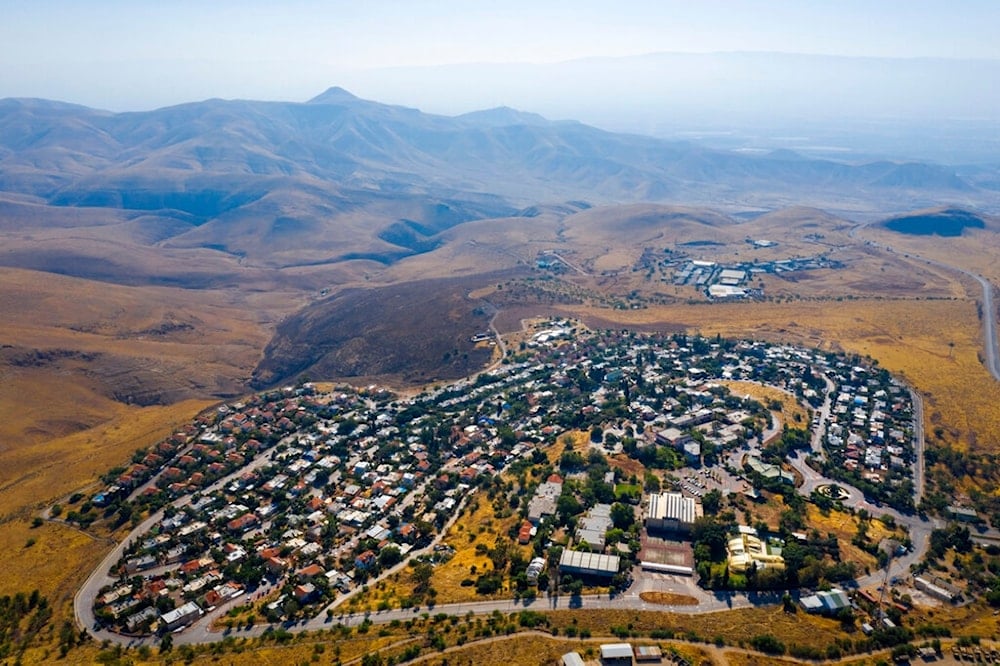
This June 30, 2020, file photo shows the illegal settlement of Ma'ale Efrayim in the Jordan Valley. (AP)
European Union diplomats on Friday issued a sharp warning over "Israel’s" renewed push to expand settlements in the occupied West Bank.
The immediate trigger was "Israel’s" decision to advance the E1 settlement project, including the publication of a tender deadline for 3,401 housing units and plans for the so-called "Sovereignty Road", a bypass that would entrench Israeli control while further restricting Palestinian movement east of al-Quds. The EU warned these steps risk permanently fracturing Palestinian territory and provoking deeper instability.
Speaking for the EU, European Commission spokesperson Anouar El Anouni described the developments as "a serious provocation," warning that settlement expansion threatens displacement, deepens violence, and further fragments the West Bank. The EU also flagged settlement plans in Atarot and Nahalat Shimon in occupied East al-Quds, where Palestinian families face mounting pressure via forced evictions and demolitions.
Yet the unusually forceful language also reflects a deeper contradiction in Europe’s policy. For decades the EU has declared Israeli settlements illegal under international law while maintaining close political, economic, and security ties with "Israel". Over that same period, the settler population in the area has grown steadily.
Forced displacement and demolitions
UN humanitarian agencies document thousands of Palestinians displaced through demolition orders, settler violence, and access restrictions. Broader assessments by UNRWA and humanitarian research indicate that well over 40,000 Palestinians have been forced from their homes in the West Bank since late 2023, as Israeli forces razed residential areas, including entire refugee camp neighbourhoods, and imposed conditions that render communities uninhabitable.
UN agencies say Israeli policies have created a coercive environment across at least 85 Palestinian communities and residential areas, driving both partial and full displacement. Thirty-three of those communities have been entirely or almost entirely depopulated, primarily due to settler attacks, movement restrictions, and repeated demolitions.
When combined with mass displacement caused by Israeli military operations, particularly in Jenin, Tulkarm, and Nur Shams refugee camps, the cumulative number of Palestinians forcibly displaced in the West Bank since late 2023 exceeds 40,000, according to UN agencies and humanitarian assessments.
Escalating violence and abuses
Settler violence against Palestinians has surged to historically high levels. The United Nations reported a record 264 settler attacks against Palestinians in October 2025 alone, the highest monthly total since tracking began in 2006, resulting in casualties and property destruction. Overall, thousands of such incidents have been recorded in recent years amid intensifying settlement activity.
Recent reporting also documents the forced departure of entire Palestinian Bedouin communities, such as families fleeing Ras Ein el-Auja in the central West Bank under sustained settler harassment and violence, part of a broader displacement trend affecting more than 2,000 Palestinians since late 2023. Rights groups warn this pattern reflects de-facto ethnic cleansing facilitated by outposts and state indifference.
Human rights and legal findings
UN human rights bodies have found that the ongoing settlement project and related policies, including unequal application of law, restricted movement, and land confiscations, amount to systemic discrimination and serious violations of Palestinians’ rights. The International Court of Justice (ICJ) and UN human rights mechanisms have repeatedly stated that settlements and related practices are illegal under international law and contribute to entrenched human rights abuses in the occupied territory.
In addition to displacement and settler violence, UN and humanitarian sources document regular casualties among Palestinian civilians, including children, attributed to both settler attacks and Israeli security operations in the West Bank. These incidents contribute to a climate of fear and insecurity that disproportionately affects Palestinian communities living under occupation.
Europe’s Dilemma
For many observers, however, the episode exposes Europe’s central predicament: continuing to rhetorically denounce Israeli settlement expansion and abuses while avoiding the political and economic costs of enforcing its own stated principles.
As "Israel" presses ahead with projects that further entrench occupation, fragment Palestinian land, and displace families, European criticism increasingly appears less like a turning point and more like an attempt to preserve credibility amid a policy it has long helped sustain.
Read more: After months of backing war crimes, West demands end to Gaza genocide


