
EU warns its 'survival' depends on ending reliance on US defense
 3 Min Read
Bloomberg reported that EU foreign policy chief Kaja Kallas warned of a structural shift away from US security guarantees, calling on Europe to rapidly build independent defense capabilities and reconsider unanimity rules in foreign policy.
-
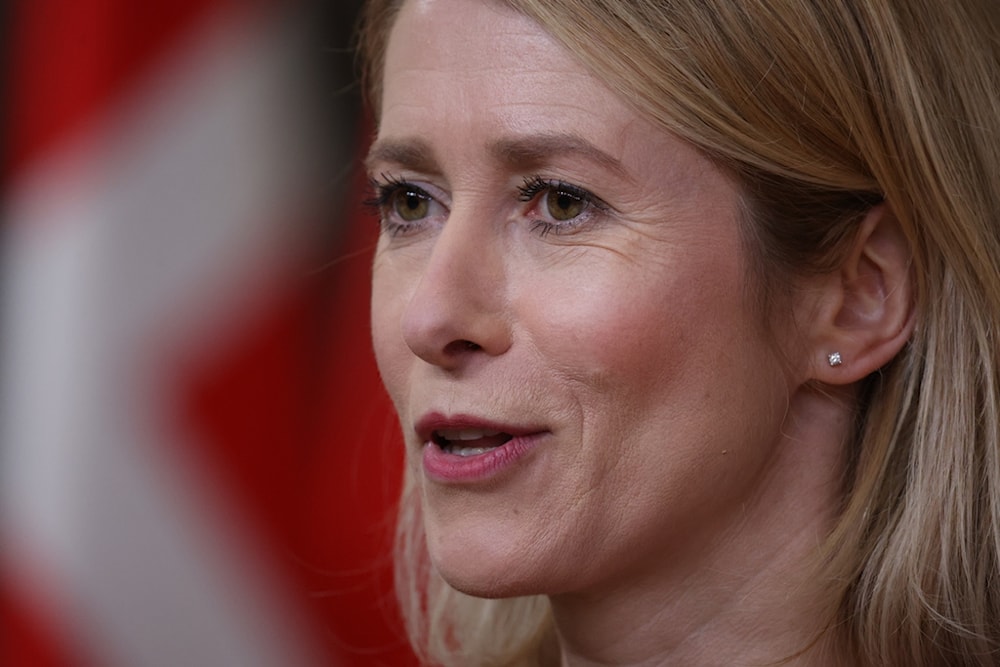
European Union foreign policy chief Kaja Kallas speaks with the media as she arrives for the EU summit in Brussels, on January 22, 2026. (AP Photo/Omar Havana)
Bloomberg reported on Wednesday that the European Union’s top diplomat has warned of a deepening rupture in transatlantic relations, urging Europe to rapidly rethink its security posture and assume far greater responsibility for its own defense amid a shifting global power balance.
Speaking at the European Defence Agency, EU foreign policy chief Kaja Kallas said growing reliance on "coercive power politics" and what she described as a sustained decline in US strategic attention toward Europe meant the bloc could no longer afford to treat its security as something outsourced. She raised the prospect of developing European defense capabilities independent of Washington and floated the idea of an EU-level military force financed and owned collectively by member states.
Kallas’ remarks come as confidence in Europe’s long-term security partnership with the United States has eroded, driven by repeated political signals questioning the durability of US commitments to its allies. US President Donald Trump has repeatedly cast doubt on Washington’s dedication to the North Atlantic Treaty Organization, framing collective defense obligations as conditional and transactional. More recently, Trump threatened to take control of Greenland, the semi-autonomous territory of Denmark, a move widely viewed in European capitals as a direct challenge to allied sovereignty.
Beyond Trump’s rhetoric, EU officials have grown increasingly concerned that Washington’s strategic priorities are shifting structurally toward China, the Indo-Pacific, and domestic political pressures, leaving Europe lower on the list of US defense priorities. In that context, Kallas argued, reliance on American security guarantees now represents a vulnerability rather than a safeguard.
“This shift has been ongoing for a while; it is structural, not temporary,” Kallas said. “It means that Europe must step up; no great power in history has ever outsourced its survival and survived.”
Defense coordination
Kallas outlined several proposals aimed at increasing European autonomy while strengthening internal cohesion within NATO. Among them was the idea of assigning “European capability targets” to the 23 countries that are both EU and NATO members. Currently, NATO issues procurement requirements to states individually and under strict confidentiality, a system Kallas said makes it difficult for EU countries to identify synergies or coordinate defense investments.
She also called for major improvements in intelligence sharing between the EU and NATO, noting that cooperation remains informal and fragmented. Intelligence exchanges are hindered by longstanding political tensions between EU member Cyprus and NATO member Turkey, leaving information flows dependent on bilateral arrangements that are often slow and incomplete.
Kallas further urged the EU to make its own mutual-defense clause operational, noting that it has never been activated despite multiple security crises affecting the bloc. She also criticized the requirement for unanimity in EU foreign policy decisions, arguing that repeated vetoes by individual states have paralyzed collective action. Instead, she called for a shift toward qualified majority voting.
Her proposals have drawn skepticism from NATO leadership. Mark Rutte told lawmakers in Brussels earlier this week that Europe should “keep on dreaming” if it believes it can defend itself without US backing, underscoring deep divisions over how far European strategic autonomy should go within the alliance.
Read more: EU, India to explore defense cooperation in expanded deal


