
Every war is a defeat of negotiation and shared humanity: Pope Leo XIV
 4 Min Read
Pope Leo XIV uses a historic address to Spain's parliament to call for diplomacy over war, urge humane treatment of migrants, and condemn political polarization.
-
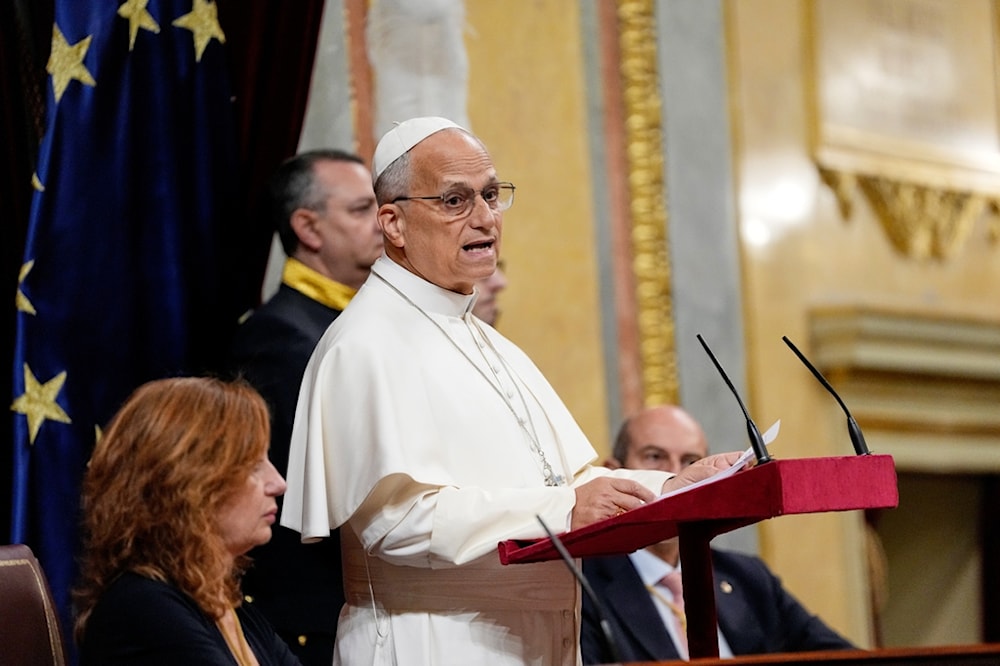
Pope Leo XIV delivers his speech as he meets with members of the Spanish Parliament at the Congress of Deputies, in Madrid, Monday, June 8, 2026 (AP)
Pope Leo XIV on Monday delivered a sweeping appeal for peace and dialogue during a landmark address before Spain's parliament, warning that the world is facing a deep crisis marked by conflict, mistrust, and growing political divisions, CNN reported.
The pope's remarks came amid an escalation in the region after "Israel" bombed Beirut's Southern Suburb, prompting Iran to respond, followed by Israeli aggression on the Islamic Republic, fueling fears of a wider regional conflict.
Speaking before lawmakers in Madrid during the first papal address to the Spanish Cortes Generales, Leo called on governments to prioritize diplomacy and international law over military confrontation, as tensions continue to rise across several regions, including the Middle East.
"Every war constitutes, ultimately, a painful defeat of the capacity to negotiate and also of that shared conscience of humanity that recognizes bonds of justice between nations," Leo told Spain's political leaders.
Challenges trespass armed conflict
The pope said the international community is facing challenges that extend beyond armed conflict, describing a broader deterioration in social and political relations.
"The world is going through a profound spiritual and cultural crisis, which manifests itself in multiple forms of violence, polarization and mutual distrust. In this context, peace presents itself as a political aspiration and, even more so, as a true moral imperative."
Calling peace both a political objective and a moral duty, Leo stressed the importance of dialogue and legal mechanisms in resolving disputes between states.
"Peace demands diplomatic courage, ethical responsibility" and requires countries "to resolve their disputes through the peaceful means offered by international law," he said.
Migration and human dignity
A significant portion of the pope's remarks focused on migration, a recurring theme of his visit to Spain. He argued that governments must place human dignity at the center of their policies, particularly regarding those displaced by war, poverty, and insecurity.
"The affirmation of human dignity cannot remain abstract when so many people are forced to leave everything behind in search of peace, security and a future," Leo said.
"The tragic drama of migration also challenges the conscience of nations and the ethical foundation of the international order today."
The pope is scheduled to travel later this week to Spain's Canary Islands, one of the principal arrival points for migrants seeking entry into Europe.
Addressing Spain's increasingly divided political climate, Leo urged elected officials to moderate their rhetoric and engage in constructive debate.
"Political pluralism should not degenerate into the constant disparagement of the adversary," he said, while calling for what he described as a broader process of moral renewal.
Abuse crisis and Church accountability
Earlier in the day, Leo met with Spanish bishops and addressed the issue of clergy sexual abuse, describing it as a persistent challenge for the Catholic Church and calling for greater accountability and support for survivors.
"One of the most painful encounters is with those who have been wounded precisely by those who were supposed to care for them, including members of the clergy," he said.
"Faced with this scourge, the ecclesial community is called to respond with listening, truth, justice, reparation and an ever more determined commitment to prevention and a culture of care. Every wounded person must be able to find sincere listening, welcome, protection and real paths to healing."
The pope is expected to meet abuse survivors during his visit to Spain.
Defense of life and religious freedom
Leo also reaffirmed longstanding Catholic teachings on abortion, euthanasia, and the protection of human life.
He argued that faith should continue to have a place in public debate and defended the confidentiality of religious confession, describing it as essential to preserving "a sacred space of inner freedom."
Questioning whether societies can be considered fully just while neglecting vulnerable groups, the pope asked, "Can a community that casts into the shadows the unborn child, the elderly, the sick, those who suffer in silence, or those who depend entirely on the care of others, be called fully just?"
The remarks come as Spain's government under Prime Minister Pedro Sánchez maintains policies supporting abortion rights and assisted dying, positions that remain opposed by the Catholic Church.
Read more: Spain's PM Sanchez attends pro-Palestine Primavera Sound festival


