
Exclusive: Joint Sino-Pakistani proposal reshapes Iran-US talks
 3 Min Read
Asian diplomatic sources told Al Mayadeen that ongoing Iran-US negotiations are increasingly reflecting a broader Chinese-Pakistani initiative aimed at linking regional security, sanctions relief, and a new Gulf order beyond unilateral US control.
-
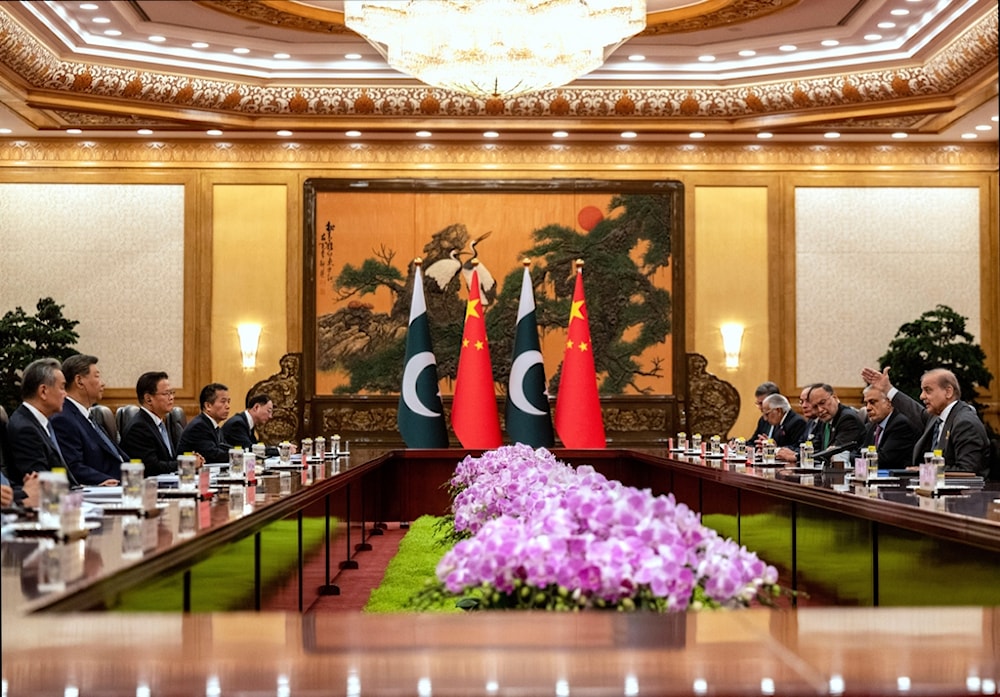
Pakistan Prime Minister Shehbaz Sharif, right, speaks at the beginning of a meeting with Chinese President Xi Jinping, second left, at the Great Hall of the People Tuesday, Sept. 2, 2025 in Beijing, China. (Pool Photo via AP)
East Asian diplomatic sources told Al Mayadeen that emerging details surrounding a potential agreement between Iran and the United States reflect provisions previously included in a Chinese-led initiative reportedly shared with Pakistan on March 31 as part of a joint Sino-Pakistani proposal.
According to the sources, the proposed framework agreement corresponds to the fourth clause of the initiative, which links regional security arrangements with economic development through a five-point plan centered on de-escalation and regional cooperation.
Hormuz at center of proposed settlement
The first point of the initiative reportedly calls for a complete cessation of military confrontations and guarantees preventing renewed war in the region.
The second proposes reopening the Strait of Hormuz from both sides, alongside the withdrawal of US military assets from the Indian Ocean, while the third includes the return of part of Iran’s frozen financial assets.
The fourth point involves lifting some unilateral sanctions imposed on Iran’s energy sector, while the fifth stipulates that all regional parties, including Iran, should benefit from the movement of energy supplies through the Strait of Hormuz.
Sources said the initiative seeks to transform the Strait of Hormuz from a focal point of confrontation into a platform for economic cooperation and regional settlement.
Second phase would address nuclear file
According to the sources, the Sino-Pakistani initiative also outlines a second phase of negotiations divided into two tracks: one concerning Iran’s nuclear program and another focused on the future political and security order in the region after the war.
The sources said the nuclear issue would be addressed through a separate agreement under a new international framework guaranteed by China, Russia, European states, and regional actors.
Under the proposed mechanism, the Iranian nuclear file would no longer remain exclusively under Washington’s oversight, with the United States becoming one of several signatories to a broader internationally backed accord.
The reported framework would cover Iran’s nuclear activities, including its enriched uranium stockpile, under a comprehensive arrangement supported by multiple international powers.
Regional order without US dominance
Sources added that the second track of negotiations focuses on shaping a post-war regional order, including efforts by Beijing to establish a Gulf security architecture without direct US involvement.
Under the proposal, management of the Strait of Hormuz would reportedly be coordinated jointly between Iran and Gulf states through a regional mechanism.
The sources argued that Washington is under pressure to accept such an arrangement due to its strategic need for de-escalation, despite understanding that the agreement would reduce its unilateral influence over regional decision-making.
According to the sources, the agreement would reposition the United States as one major actor among several competing powers in the region rather than the dominant force.
Potential obstacles to implementation
The diplomatic sources warned that these dynamics could lead Washington to delay implementation of the agreement, attempt to renegotiate aspects of it, or potentially withdraw altogether.
They also identified “Israel” as a potential challenge to the success of any future agreement between Tehran and Washington, noting that the United States may seek either to persuade or pressure the occupation into adhering to the arrangement and halting further military aggression.
Read More: Exclusive: Iran, US to finalize framework understanding via Pakistan


