
The war on Iran is hurting the US economy more than Trump admits
 12 Min Read
Trump says the US economy is roaring and energy independence shields it from the war on Iran. Inflation rates, 30-year treasury bond yields, and the Federal Reserve tell a different story.
-
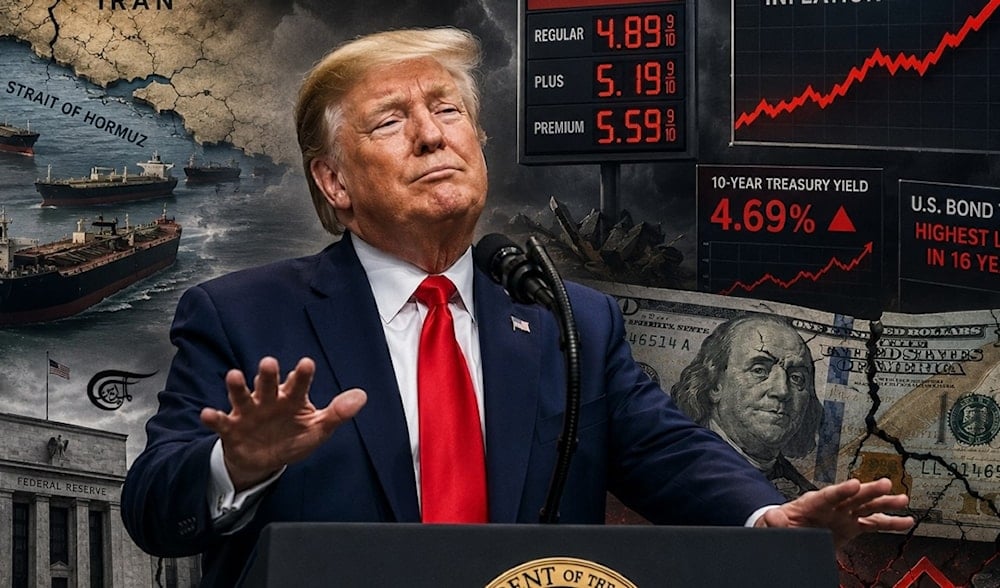
The economic backdrop to Trump's wartime optimism, with surging gas prices, rising inflation, and Treasury yields at a 19-year high. (Illustrated by Zeinab al-Hajj for Al Mayadeen English)
Last week, on May 12, a reporter asked US President Donald Trump whether the financial hardship Americans were facing because of the war on Iran was factoring into his decision-making. He answered with a blunt "not even a little bit."
Trump said he did not "think about Americans' financial situation," insisting that his sole concern was preventing Iran from acquiring a nuclear weapon. "That's all," he said.
The remark came on the same day April inflation data showed prices rising at 3.8% year-on-year, the steepest increase since May 2023, driven in significant part by energy costs that have surged since the closure of the Strait of Hormuz. It also came one week after Trump stood before business leaders at a White House Small Business Week event and described the US economy as "roaring," insisting that high gas prices would be "falling very substantially" soon.
Trump's May 12 remark was not an isolated display of indifference, but the endpoint of a wartime narrative that began weeks earlier, when he sought to minimize the significance of the Strait of Hormuz's closure by insisting that the United States no longer depended on West Asian energy.
In a televised address on April 1, as fuel prices climbed above $4 a gallon, Trump claimed the spike was short-term and said the US had already achieved full energy independence. He stressed that "we're now totally independent of the Middle East. We don't need their oil. We don't need anything they have."
The claim was part of a broader effort by Trump to downplay the economic consequences of the war on Iran. Since the closure of the Strait of Hormuz, he has repeatedly insisted that the disruption is temporary, that the United States is shielded by energy independence, and that the economy remains strong despite rising prices.
But the cracks are starting to show. What began as an energy shock has moved steadily through the US economy, pushing up petrol prices, reigniting inflation, driving Treasury yields higher, and narrowing the Federal Reserve's room for manoeuvre.
The war has not created all of these pressures from scratch, but it has exposed how vulnerable the US economy remains to a disruption Washington had claimed it could withstand.
The limits of 'energy independence'
Trump's claim, while misleading, rests on a genuine fact. According to the US Energy Information Administration, the United States produced a record 13.6 million barrels per day of crude oil in 2025, the highest of any country in the world. The US has also been a net total energy exporter since 2020.
But production volume and price insulation are not the same thing.
The United States still imports roughly 6.2 million barrels per day of crude oil, in part because of a structural mismatch in its energy system. US shale fields, concentrated in Texas, North Dakota, and New Mexico, produce mostly "light, sweet" crude. Many US refineries, especially along the Gulf Coast, were built decades ago to process "heavy, sour" crude from West Asia and Canada. Those refineries cannot simply switch to domestic light crude without costly and time-consuming infrastructure changes.
In other words, the United States may produce record volumes of oil, but its refining system was not built around the kind of crude it now produces most abundantly.
Even that does not capture the full issue. Oil is traded as a global commodity, so when supply is disrupted anywhere, whether because of a strait closure, a hurricane, or a pipeline failure, prices rise everywhere. American producers sell their output at the global price, and American consumers pay that price too.
That is the central weakness in Trump’s argument. "Energy independence" may describe a national balance sheet of production, imports, and exports, but it does not mean price independence. It does not remove the United States from the global oil market, and it does not shield American households from a shock at the Strait of Hormuz.
The evidence arrived quickly. By the end of March, Brent crude had risen by roughly 65%, recording its highest monthly increase ever. By mid-May, the average price of a gallon of regular petrol in the United States had reached $4.50.
Oil shock travels to the bond market
The consequences of the Hormuz shock did not stop at the petrol station. Higher energy prices fed into inflation, and inflation quickly moved into the US government bond market.
The mechanism is straightforward. When inflation rises, investors demand higher yields on Treasury bonds to compensate for the loss of purchasing power over time. Higher yields then raise borrowing costs across the economy, affecting mortgages, auto loans, corporate debt, and the government’s own interest bill.
By May 19, 2026, the 30-year Treasury yield had hit 5.197%, its highest level since July 2007. The 10-year yield, the benchmark most closely tied to mortgage rates and broader credit conditions, climbed to 4.687%.
These numbers matter because the US entered the war with very little fiscal room. The federal budget deficit stood at $1.8 trillion for fiscal year 2025. Nine months before the war began, Moody's stripped the United States of its last AAA credit rating, downgrading it to Aa1 and citing the rise in government debt and interest-payment ratios over more than a decade. For the first time since World War I, no major credit agency rated US debt at the highest possible level.
The oil shock, then, did not hit a healthy fiscal structure. It hit a government already carrying a large deficit and rising debt-service costs.
That made the increase in yields more dangerous. Each one-basis-point rise in the 10-year yield, one hundredth of a percentage point, adds approximately $3.9 billion in annual interest costs as debt is refinanced at higher rates. The roughly 63-basis-point rise in the 10-year yield since the war began translates to nearly $250 billion in additional yearly borrowing costs.
That money must itself be borrowed at higher yields, widening the deficit further and increasing pressure on the bond market. The result is a self-reinforcing cycle where higher inflation raises yields, higher yields raise debt costs, and higher debt costs deepen concerns about the fiscal outlook.
For ordinary Americans, the immediate consequences are visible in the housing market. The 30-year fixed mortgage rate has climbed to 6.54% for refinancing and 6.34% for new purchases as of mid-May. The Mortgage Bankers Association projects rates will remain between 6.1% and 6.3% for the rest of 2026, a forecast made before the latest inflation data came in hotter than expected.
This is how an oil shock becomes something larger than an oil shock. It starts with fuel prices, feeds inflation, pushes bond yields higher, worsens the government's borrowing costs, and tightens financial conditions for households and businesses.
The Fed has no easy exit
In normal circumstances, the institution expected to manage these pressures would be the Federal Reserve. But the war on Iran has placed the Fed's two mandates, stable prices and maximum employment, in direct conflict.
Before the war, the Fed was on a path toward easing. It had cut rates three times in 2025, bringing its benchmark rate to a range of 3.5% to 3.75%. Financial markets widely expected another cut at the June 2026 meeting.
That expectation evaporated within weeks of the Strait closing, as higher oil prices reignited inflation, making rate cuts risky. Cutting rates while inflation is already above target could entrench price pressures further. But the war also introduced uncertainty about growth, making rate hikes risky as well.
The Fed has therefore held rates steady at two consecutive meetings, in March and April, citing "uncertainty about the economic outlook" and acknowledging that it is "attentive to the risks on both sides of its dual mandate."
At Harvard in late March, Fed Chair Jerome Powell acknowledged the bind, saying there was "currently tension between the Fed's dual mandates" and that it would be "misleading" to expect unanimity among policymakers.
In plain terms, the Fed is facing a stagflation problem as prices rise and growth weakens, which is one of the hardest environments for a central bank to manage. Raising rates can worsen the growth slowdown, cutting rates can worsen inflation, but doing nothing risks satisfying neither side.
Political pressure on the Fed
Trump has also kept pressure on the Federal Reserve to lower interest rates, even as the economic data makes that harder to justify. For months, he publicly attacked Jerome Powell, calling him a "numbskull" and a "stubborn mule," while demanding that the Fed cut rates "immediately." The Trump administration wanted cheaper borrowing, even as inflation risks were building.
That pressure matters because the Hormuz shock has made the Fed's job harder. Higher energy prices have reignited inflation, making rate cuts risky. But the war has also created uncertainty about growth, making further tightening difficult as well. If the Fed keeps rates elevated, households and businesses continue to face high borrowing costs. If it cuts too soon, it risks making inflation worse.
This dilemma now falls to Kevin Warsh, who was confirmed by the Senate as the new Fed chair in May 2026. Warsh will chair his first policy meeting on June 16-17, at a moment when markets are watching not only what the Fed does, but whether it can still act independently under intense political pressure.
Central bank independence is one of the foundations of monetary credibility. Investors buy long-term government debt partly on the assumption that the central bank will act to protect the value of money over time, even when doing so is politically inconvenient. If that assumption weakens, inflation expectations can become harder to contain, and investors may demand higher yields to compensate for the risk that price pressures will be allowed to persist.
This is why political pressure on the Fed can itself become a market problem. A rate cut delivered under conditions of falling inflation may reassure investors. A rate cut delivered while inflation is accelerating, and after repeated pressure from the White House, could have the opposite effect. It could signal that monetary policy is being shaped less by economic conditions than by political demands for short-term relief.
For the bond market, that distinction matters. Treasury yields do not only reflect current inflation; they also reflect confidence in the institutions tasked with controlling future inflation. If investors begin to doubt that the Fed is willing or able to act independently, the pressure on yields could intensify further, raising borrowing costs for the government, households, and businesses alike.
The Fed, then, is not simply responding to the fallout from the Hormuz shock. It has become another place where that shock is exposing the limits of Trump’s effort to present the war’s economic consequences as manageable.
A war the economy was not built to absorb
Three months into the war on Iran, the economic consequences Trump described as short-term and manageable have compounded into something more structural. An oil shock has become an inflation problem. An inflation problem has become a bond market problem. And a bond market problem, imposed on a government already carrying record deficits and a downgraded credit rating, has become a constraint on the very institution meant to keep the economy stable.
None of these vulnerabilities was created by the closure of the Strait of Hormuz. The refinery mismatch predates this administration, the fiscal deterioration that prompted Moody's downgrade built over more than a decade, and the pressure on Federal Reserve independence began well before the first attack on Iran. What the war did was activate all of them at once, under conditions, rising inflation, frozen monetary policy, elevated yields, that leave little room for the kind of policy response that might otherwise absorb the shock.
Whether Trump contemplates Americans' financial circumstances or not, those circumstances are being shaped, in measurable and concrete ways, by forces his administration has consistently said do not apply to the United States.


