
Explosions heard in Daraa as Israeli patrol enters Syria's Quneitra
 5 Min Read
An explosion was heard in western Daraa as an Israeli occupation patrol reportedly entered the Tal al-Kurum area in central Quneitra countryside.
-
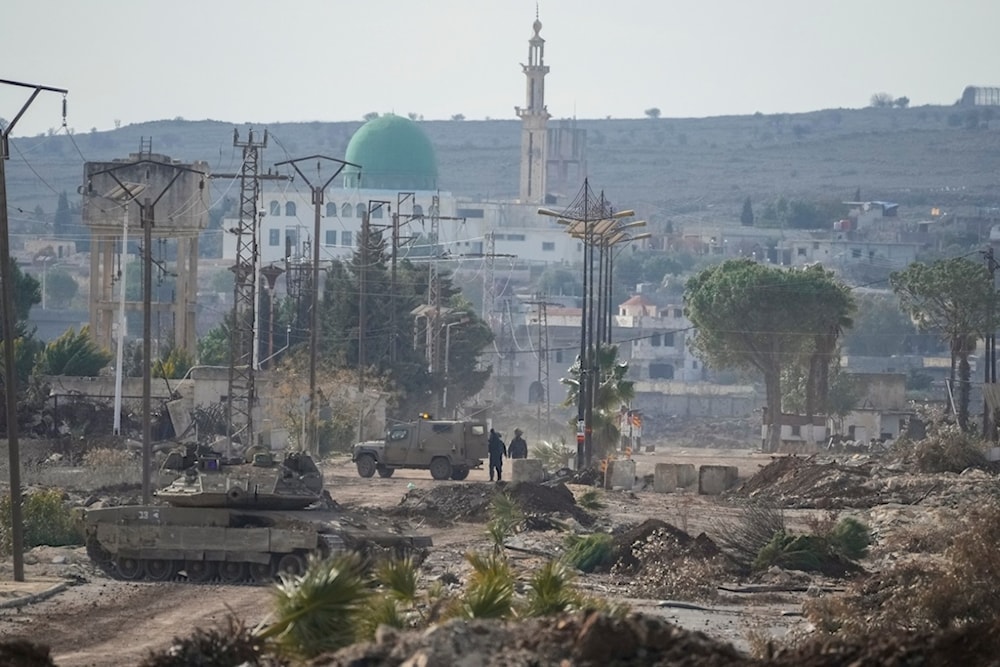
Israeli army armored vehicles block a road leading to the town of Quneitra, Syria, on January 5, 2025. (AP Photo/Mosa'ab Elshamy)
An explosion was reported in the western countryside of Daraa shortly after midnight on Wednesday, while an Israeli occupation patrol entered the Tal al-Kurum area in central Quneitra countryside, according to Syrian sources.
The patrol's entry into Tal al-Kurum is the latest in a series of reported Israeli incursions into southern Syria in recent weeks.
Israeli occupation continues incursions in southern Syria
The Israeli occupation continues near-daily incursions into the countryside of Quneitra and Daraa, according to local reports. The incursions have reportedly included the establishment of temporary military checkpoints, searches of civilians and vehicles, raids on homes, and the detention and interrogation of Syrians.
Israeli occupation forces have also carried out land-clearing operations targeting agricultural areas in southern Syria. The latest reported developments come amid heightened Israeli military activity inside Syrian territory.
The Israeli occupation's strike on Syria's Abu al-Duhur military airbase in eastern Idlib countryside has drawn condemnation from Damascus and concern from Washington, with the attack becoming part of wider tensions over Israeli military activity in Syrian territory and alleged Turkish military cooperation with Damascus.
Eight Israeli airstrikes targeted the airbase's runway on Tuesday; the attacks caused material damage to the airport's infrastructure but resulted in no reported injuries.
The Syrian Foreign Ministry condemned the attack as a violation of Syria's sovereignty and territorial integrity, describing it as a dangerous escalation that threatens regional security and stability. Damascus called on the international community and the UN Security Council to condemn the strikes and held the Israeli occupation responsible for the escalation.
A Syrian security source said the airport had been out of service for years and was being used by protection forces affiliated with the Syrian Defense Ministry. Government forces were reportedly placed on heightened alert following the strikes. The attack marked the first reported Israeli strike on Abu al-Duhur since the fall of Bashar al-Assad in December 2024, although the Israeli military did not officially confirm responsibility for the operation.
Israeli claims of Turkish military presence
Israeli Prime Minister Benjamin Netanyahu's office claimed that Syria had been on the verge of violating a security understanding with "Israel" by allowing Turkish forces to deploy at an airbase near Aleppo. The office said such a deployment "would pose a threat to Israel's security" and accused Damascus of ignoring repeated Israeli warnings against the move.
A senior Israeli official later told Fox News that "highly sensitive intelligence was shared with the United States in advance" of the strikes. The official also suggested that Syrian leader Ahmad al-Sharaa may not have fully understood the implications of the alleged Turkish presence.
The claims came as US Ambassador to Turkey Tom Barrack expressed concern over the Israeli operation, saying Washington was "deeply concerned" that the strikes "constitute an unnecessary escalation that does not advance regional stability."
Barrack said al-Sharaa had not "adopted a predatory posture nor maintained proxy forces" and had "repeatedly indicated a preference for de-escalation with Israel." He added that Washington continued to believe "restraint and engagement offer the more constructive course," urging all parties "to prioritize logical discourse over further military incidents."
Syria rejects Israeli justification
Syrian Foreign Minister Asaad al-Shaibani rejected the Israeli justification for the strike in written responses to Axios, saying Damascus had made clear beforehand that it was not working with Turkiye to establish a military presence at Abu al-Duhur. "There was no intention to establish a Turkish base there, nor to establish a permanent Turkish military presence or deploy Turkish forces at the site," al-Shaibani said.
He said work at the airbase "was limited to rehabilitating the airfield and its facilities that were damaged during the war," for use by the Syrian Air Force. "There was no Turkish military build-up at the base in any sense that would justify such an interpretation," he wrote, adding that the base was "largely empty" and had not yet been fully rehabilitated or become operational.
Al-Shaibani acknowledged that Turkish military officers had visited the base days before the strike but described the visits as routine "military cooperation in the areas of training and the exchange of expertise," similar to programs Syria conducts with Saudi Arabia, Jordan, Qatar and Russia. "Syria is a sovereign state, and it has the right to establish relations of cooperation and alliance with any country, including Turkey," he said.
The Syrian foreign minister also said Syria and "Israel" had been in contact before the strike, with Damascus explaining the work taking place at the facility and emphasizing that the base "is Syrian and will remain under Syrian sovereignty and control." He further said Syria had contacted Washington and other countries following the attack to protest the strike, contain its repercussions and prevent a recurrence.


