
Former MI6 officer says Iran has forced US into strategic retreat
 7 Min Read
Alastair Crooke argues that Iran’s asymmetrical strategy, including pressure on Hormuz, has shifted the balance of power, leaving the US facing demands it may be unable to accept.
-
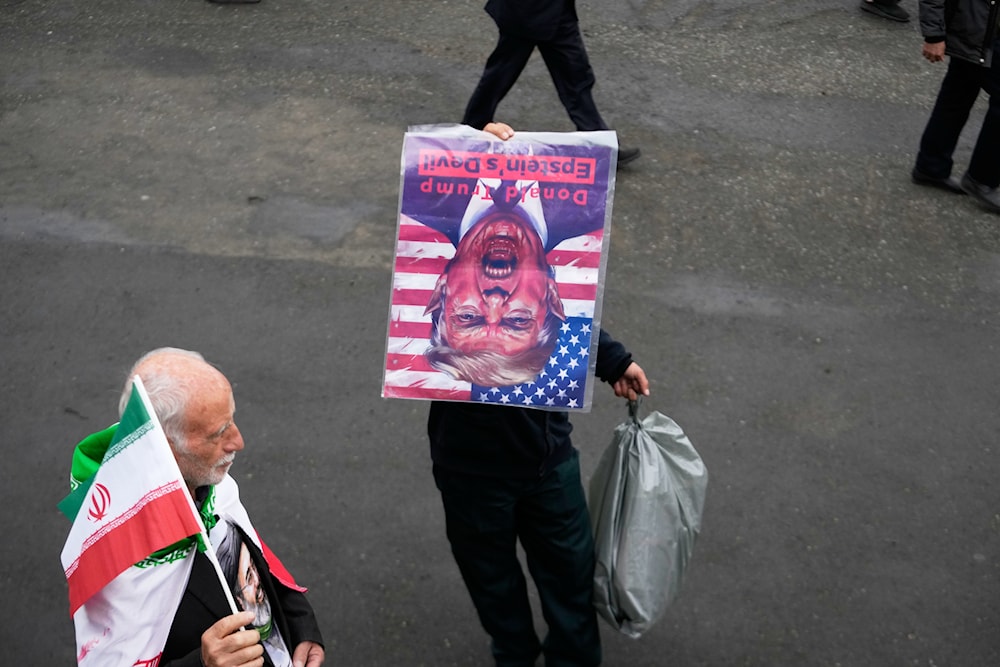
A man holds a picture of US President Donald Trump upside down after Friday prayers at the Imam Khomeini Grand Mosque in Tehran, Iran, March 20, 2026 (AP)
Retired British diplomat Alastair Crooke said US President Donald Trump appeared caught off guard by Iran’s response to the ongoing war, despite repeated warnings that such a scenario was likely.
Speaking in an interview with political commentator Danny Haiphong, Crooke framed the escalation as the result of a calculated Iranian strategy, stating, “This is asymmetrical warfare and it has been thought out.”
He criticized Trump’s reaction, adding, “Trump said, ‘Oh, we didn’t expect this.’ You know, we didn’t think they were going to. I didn’t think they would shut Hormuz. Come on.”
Crooke stressed that Iran had long signaled its intentions, particularly regarding the Strait of Hormuz.
“The Iranians have said that if they were attacked, Hormuz would be shut for the long term. They said that… and they’ve done it.”
The blockade of the strategic waterway has not only materialized Tehran’s warnings but also exposed the structural vulnerability of the global economy to disruptions along a single chokepoint. Roughly one-fifth of the world’s oil supply passes through the Strait of Hormuz, and the ongoing disruption has already begun to constrain tanker traffic, forcing Gulf producers to scale back exports and sending shockwaves through global energy markets.
Limited Western options
According to Crooke, Washington and its European allies now face a narrowing set of options.
“And so what can America or Europe do about it? Uh nothing except… finally they will have to come to terms with Iran,” he said.
The scale of disruption in maritime trade has reinforced this assessment. With hundreds of vessels stranded and international agencies warning of escalating risks to shipping, the ability of Western powers to restore stability without engaging Tehran directly appears increasingly limited.
Crooke argued that any resolution would require concessions beyond what the United States is politically prepared to accept, warning that the outcome would amount to a significant strategic retreat.
“The terms that Iran will impose on the United States to… get the economic crisis resolved are going to be… beyond… the capacity of the United States to tolerate that degree of retreat and humiliation,” he said.
Iran’s conditions
Crooke outlined what he described as Iran’s likely demands in exchange for de-escalation, including “a lifting of all sanctions on Iran, a return of all their frozen assets,” alongside broader regional conditions.
“It will include… the continued enrichment of uranium… and it would also include… the demand for Israeli withdrawal from Gaza and an end to what is happening in the West Bank,” he said.
“So that will be, I think, quite hard for Washington to digest… but that’s basically what they’d have to contemplate to set this right.”
These demands intersect with ongoing disputes over Iran’s nuclear capabilities. While US and Israeli officials have claimed significant degradation of Iran’s infrastructure, international assessments indicate that Tehran retains both the technical knowledge and industrial capacity to continue uranium enrichment, reinforcing its leverage in any future negotiations.
‘Iran is dictating terms’
Crooke further argued that Tehran is no longer operating defensively, but from a position of strategic leverage.
“That’s exactly what Iran is putting out there as proposals… they are operating… with the understanding that they are in fact dictating terms,” he said.
Developments on the ground appear to support this shift. By leveraging its geographic position and its capacity to disrupt critical energy flows, Iran has effectively imposed new constraints on the global economy, forcing Western policymakers to react to conditions set by Tehran rather than dictate them.
The broader implications extend beyond the immediate conflict. As energy markets destabilize and supply chains strain, the confrontation is increasingly seen as a challenge to the long-standing model of US economic dominance, particularly its reliance on sanctions as a primary tool of coercion.
Psychological shift in Washington
Separately, Crooke described what he called a “profound psychological shift” within the United States, accompanied by rising anxiety and uncertainty over the direction of the war.
He questioned the rationale behind Washington’s escalation, asking why Trump chose to pursue what he suggested could become a losing course, and pointed to the presence of powerful, less visible forces shaping US decision-making.
Crooke also raised questions about who ultimately controls US strategic direction, suggesting the existence of deeply rooted structures of influence.
This sense of uncertainty has been compounded by the growing economic fallout of the war, particularly as rising energy prices and supply disruptions begin to translate into domestic political pressure within Western states.
Conflicting battlefield narratives
Meanwhile, competing claims continue to emerge regarding the effectiveness of US military operations.
US Central Command has reported significant strikes against Iranian targets, including the use of bunker-buster munitions against coastal missile systems, and claims to have hit thousands of targets since the start of the war.
However, even US officials have acknowledged that Iran retains portions of its missile capabilities, underscoring the limits of the aggression. Iranian authorities, for their part, have rejected US claims, asserting that many of the strikes have hit civilian areas, while independent verification remains limited.
The gap between declared military success and the persistence of Iran’s operational capacity reflects the broader asymmetry Crooke described, in which conventional military superiority has struggled to translate into strategic control.
Disputed accounts over South Pars strike
The developments come alongside controversy over a reported Israeli strike on Iran’s South Pars gas field, a site central to the country’s domestic energy system.
As the world’s largest natural gas field, South Pars accounts for the majority of Iran’s gas production and plays a critical role in electricity generation and heating for millions of civilians. Targeting the facility, therefore, marked a significant escalation, shifting the conflict toward direct pressure on civilian energy infrastructure.
Trump claimed the United States had no prior knowledge of the attack and that Qatar had no involvement. However, Israeli media reports suggested the operation had been closely coordinated between Washington and Tel Aviv, raising further questions about the extent of US involvement.
The strike has also intensified concerns over the vulnerability of global energy systems, reinforcing the central role of infrastructure and supply routes in shaping the trajectory of the war.
Power shift
Taken together, the unfolding developments point to a shift in the balance of power, in which Iran’s ability to leverage geography, energy, and strategic patience has begun to redefine the terms of engagement.
Rather than being contained through economic pressure or military escalation, Tehran has demonstrated an ability to absorb shocks while imposing costs on its adversaries, forcing a reassessment of long-held assumptions in Washington and beyond.
As Crooke suggests, the question is no longer whether the West can impose its will on Iran, but whether it is prepared to accept the terms under which the conflict may ultimately be resolved.
Read more: War on Iran splits political fortunes of Trump and Netanyahu


