
War on Iran turns shipping into chaos as costs and risks surge
 5 Min Read
The war on Iran has disrupted global shipping routes, sending freight costs soaring and forcing carriers to reroute cargo.
-
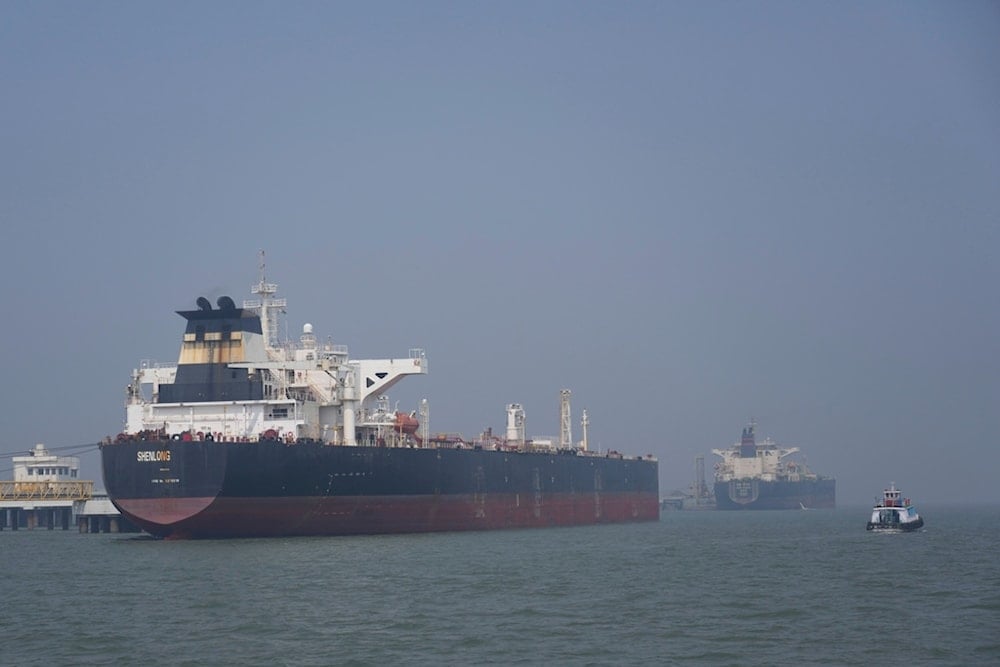
Liberia-flagged tanker Shenlong Suezmax is seen at the Mumbai Port in Mumbai, India, Thursday, March 12, 2026. (AP Photo/Rafiq Maqbool)
The ongoing US-Israeli war on Iran has thrown global shipping networks into disarray, with industry players describing conditions as a “wild west” marked by soaring costs, disrupted routes, and mounting uncertainty.
Shipping companies and customers report that escalating tensions in the Gulf have forced carriers to suspend bookings, reroute cargo, and impose significant additional charges, placing growing pressure on global trade flows.
The scale of disruption has led industry figures to characterize the situation in stark terms.
David Ozard, general manager at John Mason International, described to the Financial Times the current environment as chaotic and coercive, “At the moment it’s a complete wild west,” adding that customers are being compelled to absorb rising costs, “If we don’t, shipping lines put our accounts on hold and hold us to ransom.”
Containers bound for West Asia are increasingly being diverted to alternative ports, leaving customers responsible for unexpected storage and import costs.
Strait of Hormuz tensions disrupt global trade
The effective closure of the Strait of Hormuz following US-Israeli strikes on Iran, alongside fears of potential Ansar Allah activity in the Red Sea, has significantly disrupted maritime routes.
Fires following strikes near Dubai’s main port, Jebel Ali, have further compounded the situation, triggering cancellations and congestion across key shipping hubs.
These developments have forced shipping lines to halt bookings and redirect vessels away from high-risk areas, reshaping established trade routes.
Carriers invoke emergency rules, shift burden to clients
Major shipping groups, including MSC, Maersk, CMA CGM, and Hapag-Lloyd, have invoked contractual provisions allowing them to offload cargo at the nearest available port.
This practice shifts logistical and financial responsibility onto customers, who must then arrange onward transport and cover additional expenses.
Read more: Iran issues urgent evacuation warnings near key Gulf energy sites
War risk, fuel, and insurance pressures
Freight rates have risen sharply, with some routes experiencing increases of up to fourfold due to war-risk insurance premiums and fuel surcharges.
Craig Reilly, chief executive of Dubai Arabian Shipping Agency, noted to the Financial Times that the cost of transporting a standard container from the UK to Jebel Ali has surged from about $1,500 to nearly $6,000.
Additional expenses, including land transport, storage, port charges, and import fees—have further inflated total costs.
Shipping companies have also introduced surcharges ranging from $160 to $400 per container on long-haul routes to offset rising fuel prices.
Supply chains strained across industries
The disruption is rippling across multiple sectors, exposing vulnerabilities in global supply chains.
Hakan Bulgurlu, outgoing chief executive of appliance manufacturer Beko, criticized shipping firms as “very opportunistic” and described the situation as a “whack-a-mole” problem, with disruptions appearing unpredictably across different parts of the network.
The fresh produce sector has been particularly affected. Philippe Binard of Freshfel noted to the Financial Times that the challenges of maintaining supply chains during peak export season, “If you go to Jeddah [in Saudi Arabia], you then need to find land transportation [and] it’s not easy, there is big competition.”
“It’s a huge extra cost,” he added.
Companies are now forced to renegotiate pricing structures, often absorbing losses due to already thin margins.
Read more: Trump's US counterterrorism chief resigns over Iran war
Rerouting creates logistical bottlenecks
Cargo originally destined for West Asia is being diverted to ports such as Nhava Sheva in India and Khor Fakkan in the UAE, or rerouted through Saudi Arabia’s Jeddah port.
From there, goods must be transported overland, creating additional logistical challenges, including border controls and documentation requirements.
Refrigerated goods and livestock shipments face particular difficulties, as delays and rerouting complicate handling and delivery.
Shipping disruption rivals pandemic-era pressures
The scale of disruption has drawn comparisons to the Covid-19 pandemic, though some industry participants argue the current situation is more acute due to the effective shutdown of key Gulf routes.
Approximately 3,200 vessels are reported to be stuck in the Gulf, reflecting the severity of the bottlenecks.
While global freight rates remain below pandemic-era peaks, increases on Gulf-bound routes have been substantial.
Industry response and mitigation efforts
Shipping companies say they are working with customers to manage the crisis.
Maersk stated that it is engaging with clients to find alternative solutions, including temporary storage and land transport options.
Hapag-Lloyd noted that surcharges reflect rising war risk, fuel costs, and operational uncertainties.
CMA CGM has resumed some bookings and is managing logistics through alternative routes, including trucking cargo from regional ports.
Despite these measures, industry participants warn that ongoing instability continues to drive costs higher and complicate global trade flows.


