
Chinese shipping giant COSCO suspends Gulf services
 3 Min Read
Chinese shipping company COSCO has suspended cargo services to several Gulf ports, citing escalating regional tensions and restrictions affecting maritime traffic.
-
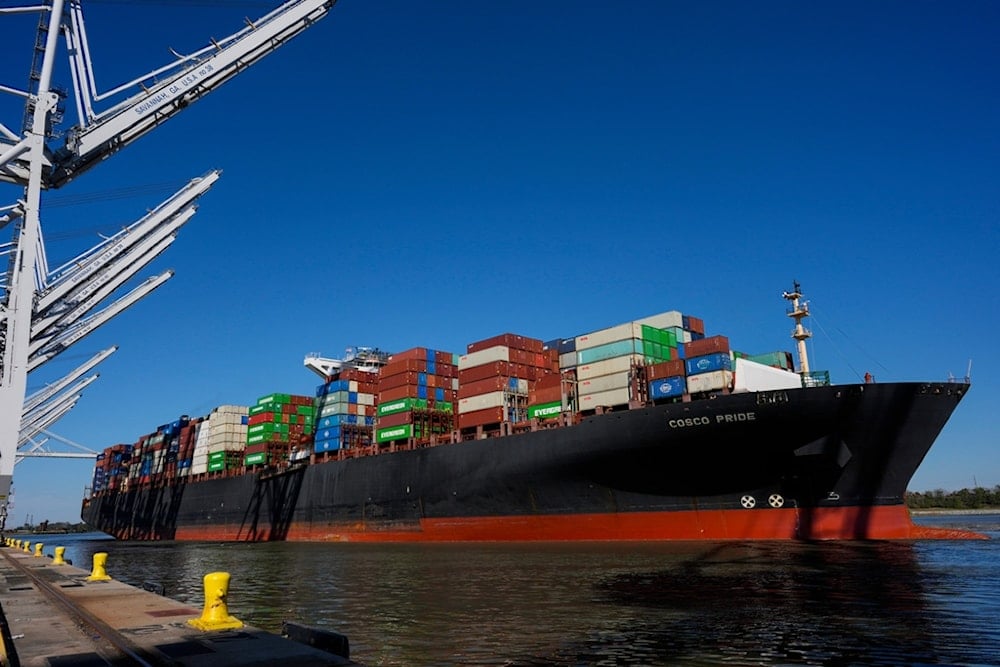
The Cosco Pride is pushed to the dock at the Port of Savannah, Thursday, Nov. 13, 2025, in Garden City, near Savannah, Ga. (AP)
Chinese state-owned shipping giant COSCO Shipping Lines has suspended cargo services to and from several Gulf destinations, citing mounting security risks linked to the war on Iran.
The Shanghai-based company said the decision affects routes serving the United Arab Emirates, Bahrain, Saudi Arabia, Iraq, and Kuwait, as instability surrounding maritime traffic in the Strait of Hormuz continues to intensify.
In a statement, the company confirmed it would “suspend all new bookings” for shipments moving through the strategic waterway “with immediate effect until further notice.”
Some ports unaffected, for now
COSCO attributed the move to “the escalating conflicts in the Middle East region and the resultant restrictions on maritime traffic” affecting vessels transiting the strait.
The company indicated that new cargo bookings destined for Bahrain, Iraq, Kuwait, and certain ports in the UAE and Saudi Arabia have been halted. Shipments originating from Qatar, Bahrain, Iraq, Kuwait, and parts of the UAE and Saudi Arabia have also been paused under the new policy.
However, some regional ports remain outside the suspension. COSCO noted that Saudi Arabia’s Jeddah and the UAE ports of Khor Fakkan and Fujairah will continue to be served, as vessels can reach them without entering the Strait of Hormuz.
Hormuz Shipping Halt
The move comes amid rising tensions across the Gulf following the launch of US-Israeli attacks on Iran. Iran’s Islamic Revolution Guard Corps (IRGC) announced on Wednesday that it had taken full control of the Strait of Hormuz, a development that has deepened uncertainty around one of the world’s most critical energy chokepoints.
The disruption is already reverberating across global markets. The Strait of Hormuz normally carries roughly one-fifth of the world’s seaborne oil supply, making it one of the most important arteries of the international energy system. Concerns that tanker traffic could be disrupted have driven sharp volatility in oil and gas markets and heightened fears of supply shocks.
Global shipping companies reconsider
Global shipping companies have begun reassessing their exposure to the region. Freight rates for crude tankers and container vessels have surged, while war-risk insurance premiums for ships entering the Gulf have climbed significantly as insurers adjust to the rising threat level.
Energy-importing economies in Asia and Europe are also closely monitoring the situation, given their heavy dependence on Gulf exports transported through the strait. Analysts warn that prolonged disruption could raise global energy prices, increase shipping costs, and place additional strain on already fragile supply chains.
COSCO said it is closely monitoring developments in the Middle East, suggesting further adjustments to operations could follow if the security environment deteriorates.
The Chinese carrier is not alone in reassessing regional routes. Other major shipping operators, including Maersk and MSC, have also suspended vessel movements through parts of the Gulf as insurers and logistics companies reassess the risks tied to shipping in the area.
Read more: Strait of Hormuz closure sends global stock markets into freefall


