
Asian markets fall sharply as oil fears shake global trade
 4 Min Read
Asian markets declined sharply as rising oil prices and fears of disruptions in Gulf shipping routes rattled investors and raised concerns about global inflation and economic slowdown.
-
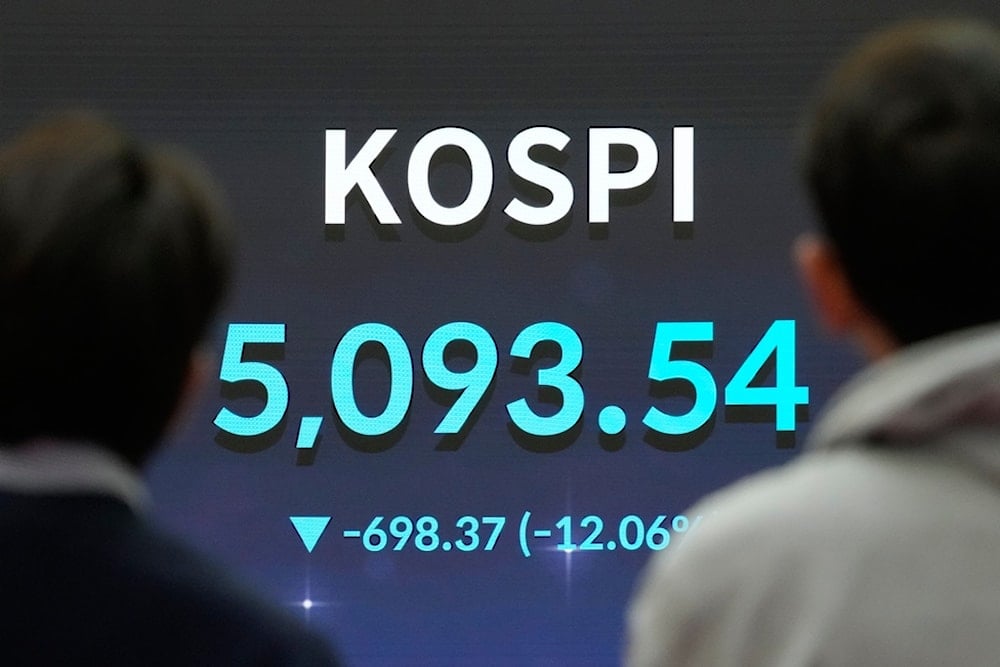
A screen shows the Korea Composite Stock Price Index (KOSPI) at the Korea Exchange in Seoul, South Korea, Wednesday, March 4, 2026 (AP)
Asian markets fell sharply as investors reacted to surging oil prices and mounting concerns over potential disruptions to energy shipments from the Persian Gulf, CNN reported on Wednesday.
The downturn was particularly severe in Seoul, where stocks recorded a historic selloff as traders assessed the economic risks tied to instability in one of the world’s most critical energy corridors. The anxiety reflects Asia’s heavy dependence on Gulf oil, with the region receiving the overwhelming majority of crude transported through the Strait of Hormuz.
The market turmoil unfolded as Iran’s Islamic Revolution Guards Corps (IRGC) announced that it had taken full control of the Strait of Hormuz, a development that has deepened uncertainty surrounding one of the world’s most important energy chokepoints. Speaking to Fars News Agency, the IRGC Navy’s political advisor Mohammad Akbarzadeh said that "the Strait of Hormuz is currently under the full control of the naval forces of the Revolutionary Guard."
Iranian officials also issued stark warnings regarding shipping through the waterway. Brigadier General Ebrahim Jabbari, advisor to the commander of the IRGC, warned that Iran would prevent vessels from transiting the passage. “Any ship attempting to pass through the Strait of Hormuz will burn,” Jabbari said, adding that “not one drop of oil will be allowed to leave the region.”
Trade shock
Shipping activity through the strait has already slowed dramatically. CNN reported that "only two oil and chemical tankers crossed the Strait of Hormuz on Monday," citing data from S&P Global Commodities at Sea. Under normal conditions, roughly 60 vessels pass through the waterway each day, carrying around 20% of globally traded oil and a comparable share of liquefied natural gas supplies.
More than 80% of the oil moving through the strategic corridor in 2025 was destined for Asian buyers, leaving regional economies especially exposed to any disruption in maritime traffic.
Fuel prices have already begun to climb. In the United States, gasoline recorded its steepest single-day increase since 2005, when Hurricane Katrina triggered major disruptions to energy supply.
US assurances
The market turbulence unfolded as US President Donald Trump moved to reassure shipping companies and energy traders. The White House said Trump had ordered US “insurance and guarantees” for vessels operating in the Gulf and suggested that American naval forces could escort tankers through the Strait of Hormuz “if necessary".
Despite those assurances, concerns about the broader economic fallout continue to grow, particularly as maritime security in the Gulf deteriorates following attacks on vessels near Oman and the United Arab Emirates.
Fuel rationing measures
Several countries have already begun implementing precautionary measures to manage fuel supplies.
In Myanmar, the ruling military authorities announced a rationing scheme in response to the disruption. Under the new system, private vehicles with even-numbered license plates will be allowed on the road only on even dates, while cars with odd-numbered plates may operate on odd dates, according to Reuters.
Thai officials have also urged the public to avoid panic buying and fuel hoarding, while encouraging government employees to work from home in order to reduce gasoline consumption.
Humanitarian officials warn the economic shock could extend far beyond financial markets if energy disruptions persist. UN humanitarian chief Tom Fletcher cautioned that a prolonged conflict could trigger severe consequences for vulnerable populations, warning that “food prices will soar, health systems will be squeezed, and basic supplies will tighten in countries that rely on imports.”
Read more: War on Iran sends shockwaves through Europe's energy supply


