
Gulf oil producers lose $15bln as Hormuz shipping nears standstill
 6 Min Read
Gulf energy producers have lost more than $15 billion in revenue since US-Israeli strikes on Iran disrupted shipping through the Strait of Hormuz.
-
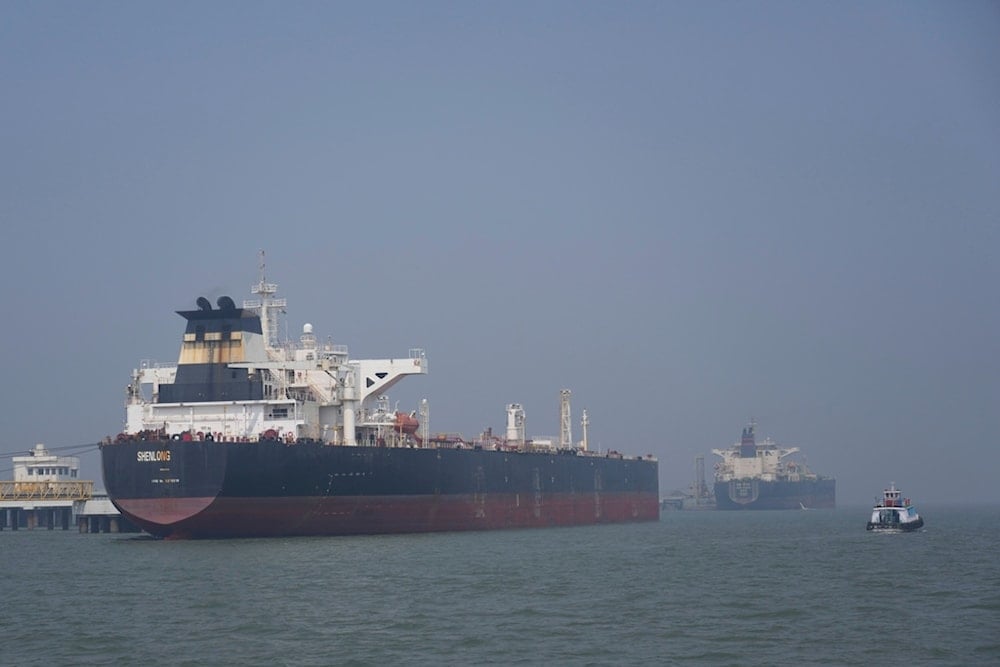
Liberia-flagged tanker Shenlong Suezmax, carrying crude oil from Saudi Arabia, tis seen at the Mumbai Port in Mumbai, India, Thursday, March 12, 2026 (AP)
Gulf oil producers have lost an estimated $15.1 billion in energy revenues since the start of US-Israeli aggression on Iran, as shipping through the Strait of Hormuz has nearly ground to a halt, the Financial Times reported.
According to estimates by commodities analytics firm Kpler, the waterway normally carries about $1.2 billion worth of crude oil, refined products, and liquefied natural gas (LNG) per day, based on average prices and export volumes recorded in 2025.
Since the US and "Israel" launched the war on February 28, traffic through the strategic shipping route has largely stopped amid Iranian attacks on vessels and sharply rising maritime insurance premiums.
Kpler analyst Florian Gruenberger said the strait is now seeing only “negligible” flows compared with prewar levels, highlighting the scale of the disruption to global energy markets.
Billions in cargo stranded in the strait
The collapse in shipping has left at least $10.7 billion worth of crude oil, refined products, and LNG cargoes stranded inside the Strait of Hormuz, according to Kpler.
Many of the shipments had already been loaded onto tankers but were unable to leave the waterway due to security concerns.
Some of these cargoes were sold under long-term contracts signed before the war, meaning producers could still receive payments depending on contractual terms. Energy payments are typically settled 15 to 30 days after loading.
Crude oil accounts for the majority of the stranded value, representing around 71% of the total cargo value, analysts said.
Saudi Arabia faces largest losses
Among Gulf producers, Saudi Arabia has suffered the largest revenue losses due to its status as the region’s biggest oil exporter.
Energy consultancy Wood Mackenzie estimates the kingdom has already missed out on roughly $4.5 billion in export revenue since the start of the war.
However, Saudi Arabia is preparing to increase shipments from Red Sea export terminals in an effort to partially bypass the Strait of Hormuz.
The kingdom can also reroute oil from its eastern fields through its East-West pipeline, which transports crude to the Red Sea.
State energy giant Saudi Aramco has said up to 70 percent of shipments could theoretically be redirected through the pipeline, although analysts warn the system has never previously operated at that level of capacity.
Iraq, smaller producers more exposed
Analysts say Iraq is among the most economically vulnerable countries to the disruption because oil accounts for roughly 90% of government revenues.
Peter Martin, head of economics at Wood Mackenzie, said the financial impact on Iraq could be particularly severe if the disruption continues.
“Kuwait and Qatar are also highly exposed, but both can call on large sovereign wealth funds to buffer the short-term impact,” Martin said.
Wood Mackenzie estimates that Gulf oil producers, including Saudi Arabia, Iraq, the UAE, Kuwait, and Bahrain, have collectively deferred about $13.3 billion in oil sales and tax revenues due to the shipping disruption.
Qatar halts production
The disruption has also affected Qatar’s natural gas sector, with QatarEnergy, the country’s state-owned energy company, suspending production on March 2.
Wood Mackenzie estimates the company had already lost approximately $571 million in revenue by Wednesday, excluding potential losses linked to delays in planned expansion projects or new facilities.
Global consumers may bear the cost
Despite the heavy losses facing Gulf producers, analysts say higher global oil prices could partially offset some revenue losses, particularly for larger exporters such as Saudi Arabia.
Antoine Halff, co-founder of satellite analytics company Kayrros, said Saudi Arabia is relatively better positioned than some regional producers to absorb the disruption.
The kingdom maintains oil reserves in overseas storage facilities, allowing it to continue supplying customers temporarily even if exports through the Strait of Hormuz remain limited.
Ultimately, however, Halff warned that the economic impact of the disruption is likely to fall on global consumers.
“Motorists and other end consumers are likely to bear the brunt of the price impact,” he said.
Business leaders warn of economic fallout
Abdulaziz Sager, chairman of the Saudi-based Gulf Research Center, previously told Reuters that Washington had failed to establish safeguards for its regional allies or ensure oil and gas flows during wartime, warning that the economic toll on Gulf states is “horrendous".
Sager said the war demonstrates the risks of relying solely on external security guarantees and that Gulf countries must strengthen their own defense capabilities to prepare for future crises.
“External powers also tend to make decisions based on their own strategic interests rather than those of the Gulf,” Sager told Reuters, adding that Gulf states may adopt a more cautious and balanced approach in their relations with Iran as well as with major international powers.
In a rare public rebuke, prominent Emirati businessman Khalaf Al Habtoor questioned the objectives of the US-Israeli war on Iran.
'Dragging the Gulf' into war
“If the strikes were aimed at containing Iran, did they take into account the regional consequences — or was the cost of dragging the Gulf into a conflict it was not party to simply ignored?” he said.
Saudi Aramco CEO Amin Nasser warned that continued disruption to shipping through the Strait of Hormuz could have “catastrophic consequences” for global oil markets.
The Islamic Revolution Guard Corps (IRGC) has warned it would not allow “one litre of oil” to leave the Middle East if US and Israeli attacks continue, while Trump has threatened further military action if Iran attempts to block energy exports.
Sources close to Gulf governments told Reuters that frustration with Trump privately runs deep across the region, with many officials believing Washington dragged the Gulf into a war shaped heavily by the Israeli regime without a clear strategy or consultation.
Read more: Gulf states say resent being dragged into Trump’s war on Iran: Report


