
'We're just getting started': Araghchi on Iran strikes
 4 Min Read
Iranian Foreign Minister Abbas Araghchi says his country's missiles are striking "Israel" as its army bans live skyline broadcasts.
-
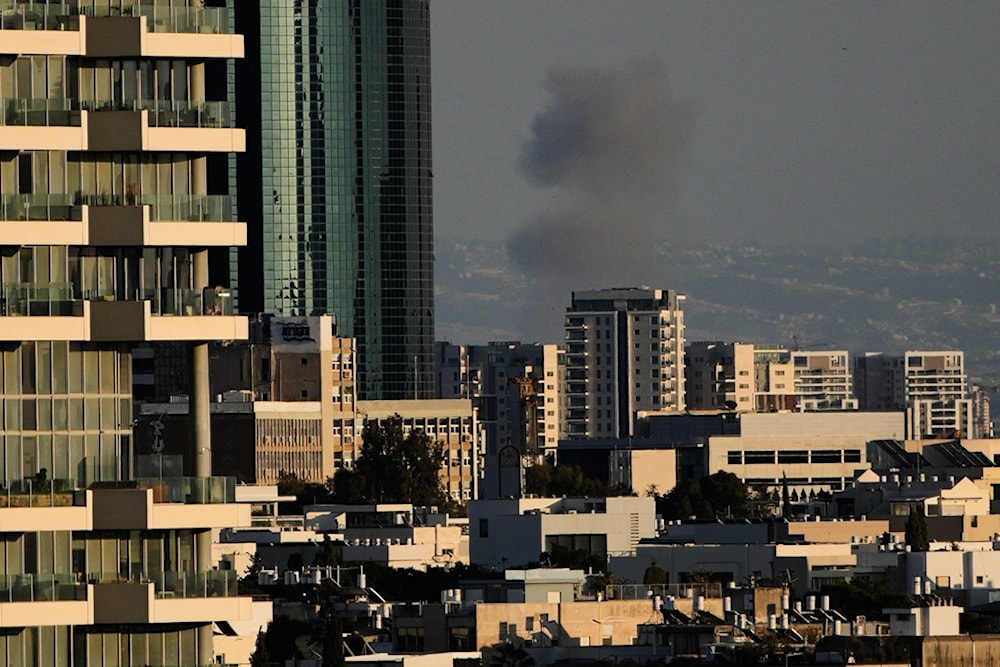
Smoke billows following an Iranian missile strike in central occupied Palestine, Monday, March 9, 2026 (AP)
Iranian Foreign Minister Abbas Araghchi said Iran’s armed forces are still carrying out strikes against the Israeli occupation, accusing the Israeli regime of attempting to prevent the public from seeing the impact of the attacks.
In a post on X, Araghchi wrote that Israeli Prime Minister Benjamin Netanyahu does not want the public to witness the effect of Iran’s retaliation.
“Netanyahu doesn't want you to see how Iran's Powerful Armed Forces are punishing Israel for its aggression,” Araghchi said.
He added that personnel on the ground reported “utter destruction caused by our missiles, panicked leaders, and air defenses in disarray,” warning that the operations were ongoing.
Israeli army restricts coverage of missile attacks
New restrictions were imposed on media coverage of missile and drone attacks.
According to a report by France 24, the Israeli occupation forces have banned live broadcasts of the Israeli skyline when alarms sound warning of incoming missiles or drones.
Images showing air defenses intercepting incoming missiles, which had been widely broadcast during the early stages of the war and during the early days of the June 2025 war waged by the Israeli occupation on Iran, are now prohibited.
The 12-Day War also saw similar restrictions by Israeli police.
The IOF has also banned filming the impact of strikes at or near security sites, although coverage of damage is still permitted as long as exact locations are not revealed.
Iran not seeking ceasefire
Amid the relentless destruction being dealt to the Israeli occupation and US assets in the region, Iranian Parliament Speaker Mohammad Bagher Ghalibaf said on Tuesday that the Islamic Republic is not seeking a ceasefire amid the ongoing war, instead, it intends to impose a decisive response on its adversaries.
In a post on X, Ghalibaf wrote: “We are certainly not seeking a ceasefire," adding, “We believe that the aggressors must be taught a harsh lesson so they never dare attack Iran again.”
Ghalibaf also accused "Israel" of relying on recurring cycles of conflict to maintain its dominance, stating, “The Israeli entity believes that its survival lies in continuing the cycle of ‘war–negotiation–ceasefire and then war again’ in order to consolidate its hegemony, but Iran will break this cycle."
Iran did not initiate war, will be the one to end it: Mohajerani
Iran did not initiate the war but will be the one to end it, Iranian government spokesperson Fatemeh Mohajerani asserted, emphasizing that any discussion of mediation to end the war must be based on the principle of preventing repeated aggression, not merely on a ceasefire.
Speaking at her weekly press conference, Mohajerani stated, "The election of Sayyed Mojtaba Khamenei as the third Leader of the Revolution and the Islamic Republic strengthened harmony and national unity in Iran and thwarted the enemies’ schemes."
She also noted that "the Strait of Hormuz is a strategic resource for Iran, and it is natural to invest all resources in the war."
Regarding recent attacks, Mohajerani highlighted that the US-Israeli aggression on Iran’s oil facilities caused an environmental issue in Tehran, explaining that "Iran was able to restore the fuel shortage caused by the aggression on oil depots within 24 hours."
She added, "The US-Israeli aggression against Iran aims to divide it and plunder its wealth," stressing that the aggression does not target any particular group in Iran but "targets the life of all its citizens and their future."


