
Schools, hospitals, historic landmarks: Targets of aggression on Iran
 7 Min Read
Schools, a hospital, and historic landmarks in Iran came under attack as US and Israeli airstrikes intensified, with civilian casualties continuing to rise.
-
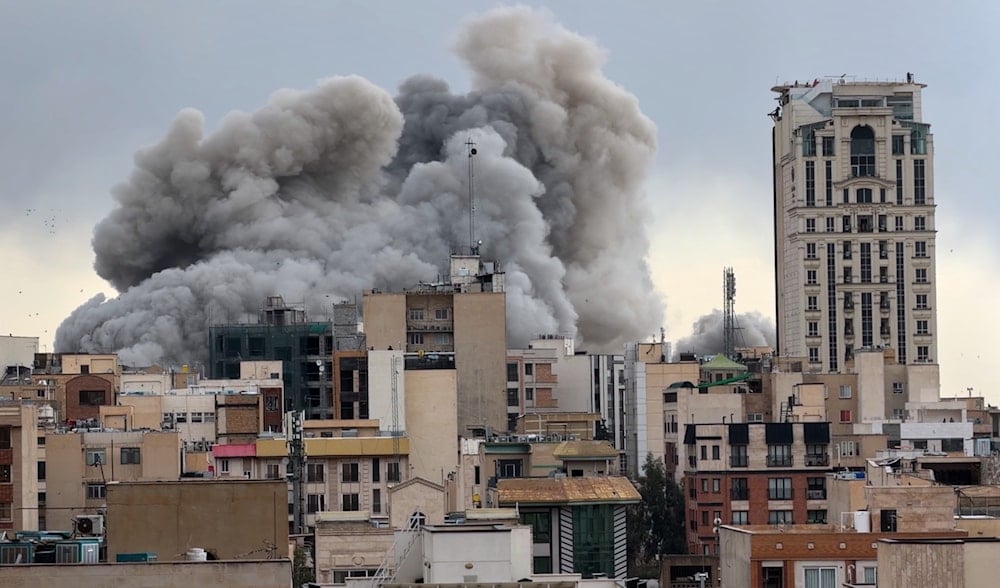
A plume of smoke rises after a strike in Tehran, Iran, Monday, March 2, 2026. (AP)
Schools, a hospital, and historic landmarks have sustained severe damage amid US and Israeli airstrikes on Iran since Saturday, with civilian casualties continuing to rise, satellite images and videos verified by the BBC showed.
The US-Israeli aggression on Iran has killed more than 1,200 people since February 28, including 200 children and nearly 200 women, Iran’s Ministry of Health announced on Sunday. The scale of the damage has been difficult to confirm fully due to an almost complete internet blackout across the country.
Residents of Tehran described Thursday night as the most intense and frightening night of bombings. “It was hell on earth,” one said, while another compared it to “a scene from a dystopian film,” as many stayed awake through the night, fearing further attacks.
BBC Verify has documented damage to a hospital, sporting centres, a UNESCO World Heritage site, and two schools, including one where 168 people, many of whom were children, were killed on Saturday morning, according to Iranian officials. Separate verified images show damage to a school building in Urmia, northwestern Iran.
Among the other structures affected is Gandhi Hospital in Tehran, struck on Sunday. Verified video footage shows extensive damage, debris scattered across the area, and patients, including a baby in an incubator, being evacuated. Mohammad Raeiszadeh, head of Iran’s Medical Council, told state media that the hospital’s IVF department was destroyed in the attack.
Strike on sports hall kills 20
At least 20 people were killed on Saturday after a blast struck a sports hall in the southern coastal city of Lamerd, Iranian state media reported.
Footage filmed shortly after the explosion and shared with the BBC by Iranian social media user Mamlekate shows heavy damage to the building, scorch marks on the walls, and smoke slowly rising from the exterior. Other images reveal damage to nearby buildings less than 300 meters away, indicating multiple strikes in the area.
In Tehran, at least three major sporting complexes have suffered significant damage following strikes on Thursday, according to satellite imagery and verified reports. Among those hit was the 12,000‑seat indoor arena at the Azadi Sports Complex, where images show the venue nearly collapsed under the impact of the blasts.
Similar scenes of destruction were evident at the Besat and Esmaeili stadiums elsewhere in the city, with rubble and structural damage visible in verified footage.
Commercial businesses take a hit
Commercial businesses and historic sites across Iran have also suffered significant damage amid the ongoing strikes. Verified videos show severe destruction to a café in central Tehran, with the shop’s distraught owner inspecting the ruins. The damage may have resulted from a strike on a police station directly across the street, which has been flattened.
BBC Verify has documented damage to an old bazaar in Tehran’s historic quarter and a palace listed as a UNESCO World Heritage site. Footage from Monday shows shattered glass and scorched walls at the Grand Bazaar, a sprawling network of shops and stalls that has stood for centuries.
On Tuesday, Iranian state media broadcast footage of the palace showing shattered glass, damage to parts of the exterior, and destroyed solid wooden doors. Both the palace and the bazaar are located near a complex housing Iran’s judiciary and Supreme Court.
Verified videos and satellite imagery confirm that the nearby judicial complex was also damaged, illustrating the widespread impact of the strikes on civilian, cultural, and governmental infrastructure.
Environmental fallout of US-Isaeli aggression
"Israel’s" bombing of Iran’s oil infrastructure will have major long-term environmental repercussions, experts have warned, as monitors admitted they were struggling to keep track of the environmental disasters arising from the widening war, The Guardian reported.
The Shahran oil depot north-east of Tehran and the Shahr-e fuel depot to its south continued to burn on Monday, two days after they were bombed by Israeli warplanes.
Immediately after the attacks, Iran’s environmental agency and the Iranian Red Crescent Society warned Tehran residents to stay at home, warning that the toxic chemicals spread by airstrikes on five fossil fuel installations around the city could lead to acid rain and damage the skin and lungs.
Addressing the grave situation, the head of the World Health Organization, Tedros Adhanom Ghebreyesus, said, “Damage to petroleum facilities in Iran risks contaminating food, water and air – hazards that can have severe health impacts especially on children, older people, and people with pre-existing medical conditions.”
Black rain
The black rain that fell across Tehran in the hours after the bombings was a mixture of soot and fine particulate matter from the explosions with rain from a storm that was already moving across the region, according to Akshay Deoras, a research scientist at the University of Reading.
“The airstrikes on oil depots released soot, smoke, oil particles, sulphur compounds, and likely heavy metals and inorganic materials from the buildings, whilst a low‑pressure weather system, which typically sweeps across Iran and west Asia around this time of year, created conditions favourable for rainfall,” Deoras said.
“In terms of atmospheric chemistry, the oil fires produce sulphur and nitrogen compounds that could form acids if they dissolve in rainwater.
“The risks to human health come from inhaling or touching the smoke and particles. Immediate impacts can include headaches, irritation of the eyes and skin, and difficulty breathing – particularly for people with asthma, lung disease, older adults, young children, and those with disabilities.”
'All manner of undesirable and toxic chemical species'
Residents of Tehran reported difficulty breathing on Sunday, as well as headaches and burning sensations in their eyes and throats. But the acute effects of the black cloud that spread across the city could just be the beginning, according to Andrea Sella, professor of inorganic chemistry at the University College London.
“The explosions will have exposed the local population to all manner of undesirable and toxic chemical species, a problem that is well known to accompany warfare,” he said, explaining that the crude oil will have contained a range of elements, including metals, that would “also be spread indiscriminately”.
“There will be a real cocktail of chemistry including significant amounts of aromatic compounds that are known to interact with DNA and have been linked to cancers. Whether or not this manifests will depend strongly on how long and serious the exposure is of any individual.
“And on top of this, once the containment provided by the tanks and pipes is destroyed the material will flow everywhere leaving a mess of harmful material that permeates the soil and coats everything else. There is the potential for contamination of drinking water supplies.”
Amid their gravity, the US instantly distanced itself from the attacks, yet this has not stopped a spokesperson for the Iranian Revolution Guards Corps from warning it could take “similar actions [against oil infrastructure] in the region."


