
Israeli security officials privately questioning Iran war goals: WP
 4 Min Read
A senior Israeli security official breaks with Netanyahu and Trump's public stance.
-
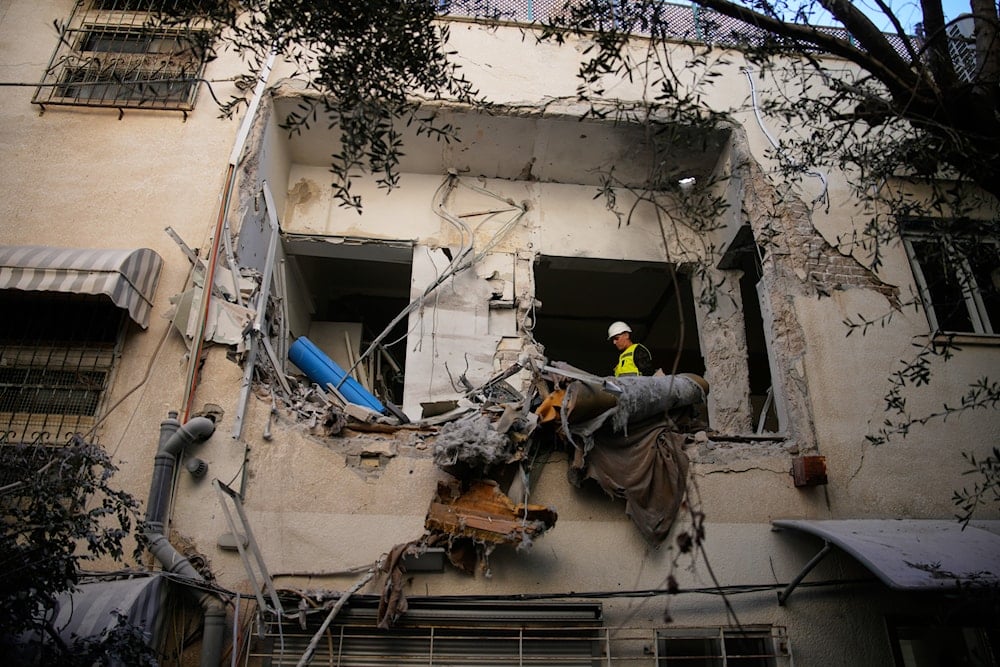
Israeli security forces inspect a damaged apartment building struck by an Iranian missile in Tel Aviv, occupied Palestine, Sunday, March 8, 2026 (AP)
Senior figures within "Israel's" security establishment are quietly voicing concern over the escalating war on Iran and pressing for a defined endgame, even as Prime Minister Benjamin Netanyahu and US President Donald Trump continue to publicly demand all-out victory, The Washington Post's foreign affairs columnist David Ignatius reports.
In an opinion piece, Ignatius recounts a telephone conversation with a senior Israeli official familiar with war planning who spoke anonymously, given the sensitivity of the situation. The official's remarks reveal a growing unease within parts of the Israeli security apparatus, and a view of the war that diverges sharply from the maximalist rhetoric dominating both Washington and Tel Aviv.
"I'm not sure it's in our interest to fight until the regime is toppled," the official told Ignatius. "Nobody wants a never-ending story."
A war with rising costs
The comments come against a backdrop of mounting costs. Gulf states, hosting US assets, continue to absorb Iranian missile strikes, global oil and gas prices are surging toward levels that analysts warn could trigger a worldwide economic crisis, and Trump faces growing domestic opposition to a war he launched without broad public support.
The unnamed official alleged the aggression was nearing the completion of its core military objectives, which include the destruction of Iran's remaining nuclear infrastructure following US strikes last June, its ballistic missile stockpiles and production facilities, and the top tiers of its military and intelligence command.
Once those targets are destroyed, the official argued, "Israel" would have achieved its goals without requiring a formal Iranian capitulation. "Iran won't surrender, but it can send messages to accept a ceasefire with US conditions," he claimed.
From 'self-defense' to regime change
The official's position stands in contrast to the stated aims of both governments entering this war. Joint Israeli–US airstrikes launched on February 28, 2026, were openly framed as a regime-change campaign, a significant escalation from the June 2025 war, in which "Israel" targeted Iran's nuclear and missile programmes under the banner of self-defense without formally declaring regime change as an objective.
Netanyahu, announcing "Operation Roaring Lion," pledged to "strike the terror regime hard and create conditions" for Iranians to overthrow their government. Trump, for his part, told Iranians "your hour of freedom is at hand" and vowed to destroy Iran's missiles, raze its missile industry, and annihilate its navy.
Netanyahu reiterated that maximalist vision, saying "Israel" wants "to destabilize the regime, to enable change." Nonetheless, the Israeli official Ignatius spoke with was explicit that he was not speaking for the prime minister, but expressed a view increasingly shared by some in the Israeli regime's security establishment.
The Israeli official noted that they "don't see anyone who can replace the regime," highlighting a view shared by US and Israeli intelligence analysts. He doubted whether arming the Kurds or other minorities would pose a sensible strategy, recognizing that it would alienate the majority of Iranians.
Ignatius argues that the election of Sayyed Mojtaba Khamenei as the third Leader of the Revolution and the Islamic Republic of Iran is likely to harden positions on both sides, suggesting that he offers little prospect of a negotiated off-ramp.
The Lebanon question
The Israeli official also flagged concern over two additional fronts. First, in Lebanon, he warned against being "dragged into the quagmire" of large-scale ground operations, referencing the disastrous 1982 invasion as a cautionary precedent.
The official insisted "we are not planning large ground operations" and expressed openness to engaging Lebanese President Joseph Aoun and Prime Minister Nawaf Salam toward a ceasefire agreement. Yet, Lebanon and "Israel" signed a ceasefire agreement in November 2024, which "Israel" breached thousands of times, leading to retaliatory strikes by Hezbollah earlier this month.
Second, on the US alliance, the official sought to pre-empt growing bipartisan American frustration. "We won't drag the US into an endless war," he explained. "Israel is a reliable ally," not a burden, he claimed.
Ignatius closes with a pointed observation: Trump has set his sights on destroying the Islamic Republic and speaks of building a new Iran that reflects Washington's aspirations, but has no discernible plan for achieving it. The question echoing from the war on Iraq era, Ignatius writes, is once again being asked: "Tell me how this ends?"


