
War on Iran disrupts global trade routes, shipping, energy markets: WP
 4 Min Read
An analysis by The Washington Post warns that the war involving Iran is disrupting global trade routes, driving up shipping and energy costs while hitting Asian and European economies hardest.
-
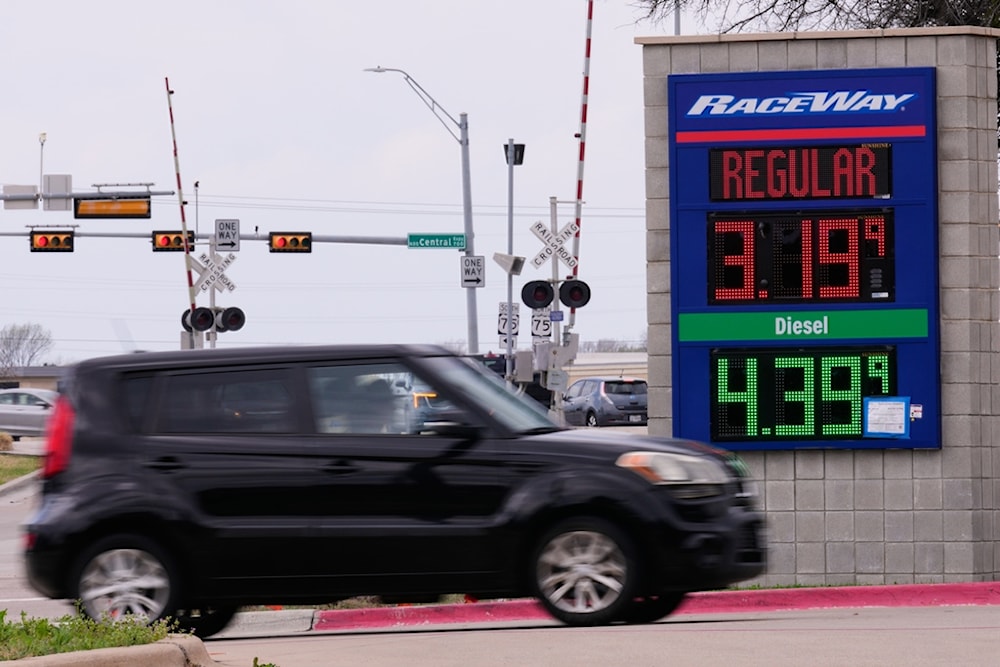
Gas prices are displayed as a customer drives past at a filling station in Plano, Texas, Friday, March 6, 2026. (AP Photo/Tony Gutierrez)
An analysis published by The Washington Post's David J. Lynch on Monday examined the widening economic consequences of the ongoing US-Israeli war on Iran, warning that the war is disrupting major global trade routes and sending shockwaves through supply chains, energy markets, and financial systems.
According to the report, missile and drone strikes launched by Iran in response to the assault have severely disrupted transportation corridors linking Asia and Europe. Maritime traffic through the Gulf and aviation networks across the region have both been affected, forcing companies to reroute shipments and absorb rising logistics costs.
The analysis noted that the temporary closure of several airports in the region, including major hubs in the Gulf, has removed a significant share of global air cargo capacity. As a result, shipments of electronics, pharmaceuticals, precious metals, and other high-value goods that typically travel by air have been delayed or rerouted.
Shipping costs surge globally
The disruptions have rapidly pushed transportation prices higher. Ryan Petersen, chief executive of the logistics firm Flexport, said the cost of shipping goods between Asia and Europe has climbed sharply since the beginning of the hostilities.
“The cost of shipping goods by air from Asia to Europe is up 45 percent since the war began,” Petersen said.
Economists cited in the analysis argued that the economic shock triggered by the war on Iran is affecting Europe and Asia more immediately than the United States, largely because these regions rely heavily on energy imports from the Gulf and on the trade routes that pass through it.
Maurice Obstfeld, former chief economist at the International Monetary Fund, explained that these structural dependencies expose those economies to stronger spillover effects.
“Europe and Asia are heavily dependent on energy imports, so that alone makes them more vulnerable to negative macroeconomic spillovers from the Iran war,” Obstfeld said. “Being closer geographically to the hostilities also makes Europe and Asia more vulnerable to shock waves from the war.”
Hormuz disruptions shake global trade
At the center of the disruption is the Strait of Hormuz, one of the world’s most critical maritime chokepoints. Roughly 20 percent of global oil supplies normally pass through the narrow waterway connecting the Gulf to international markets, making any instability there immediately consequential for global energy trade.
Since the start of the war on Iran on February 28, shipping activity through the Strait has fallen sharply, with numerous tankers and cargo vessels either stranded or diverted as companies respond to security risks and rising insurance costs.
The decline in maritime traffic is already beginning to ripple through global supply chains. Several major shipping companies have halted new cargo bookings for Gulf destinations or redirected vessels to other ports, leaving businesses scrambling to adjust their delivery schedules and manage mounting storage costs.
Air transport networks are facing even greater pressure. With multiple countries closing their airspace amid missile and drone exchanges, freight carriers have been forced to take longer flight paths that require additional fuel and reduce available cargo capacity.
Oscar de Bok, chief executive of DHL Global Forwarding, said the backlog in cargo deliveries could take weeks to clear even if flights resume quickly.
“For each week that air shipments are suspended, cargo carriers will need at least a week and a half to catch up,” he said.
War Sparks Global Inflation Risks
Energy markets have also been shaken by the war. The disruption of shipments through the Gulf has contributed to rising oil prices and fears of tighter supplies, while gas markets have faced additional uncertainty after production interruptions in the region.
The economic consequences are already spreading to other sectors. Rising fuel and fertilizer prices could soon increase costs for farmers, while financial markets in several Asian countries have experienced volatility amid fears of prolonged instability.
Josh Linville, vice president at the financial services firm StoneX, said the magnitude of the disruption is unprecedented.
“I don’t even know how to place numbers on it,” Linville said. “This is an event we’ve never seen before.”
Analysts warn that if the war on Iran continues, the combined effects of disrupted shipping routes, higher energy prices, and strained logistics networks could weigh heavily on global economic growth, echoing the supply-chain shocks experienced during the COVID-19 pandemic.
Read more: Oil surges above $110 as US-Israeli war on Iran rattles global markets


