
Gulf states say resent being dragged into Trump’s war on Iran: Report
 5 Min Read
Gulf states face economic and security fallout from the US-led war on Iran, as regional leaders question Washington’s protection and warn of severe oil market disruption.
-
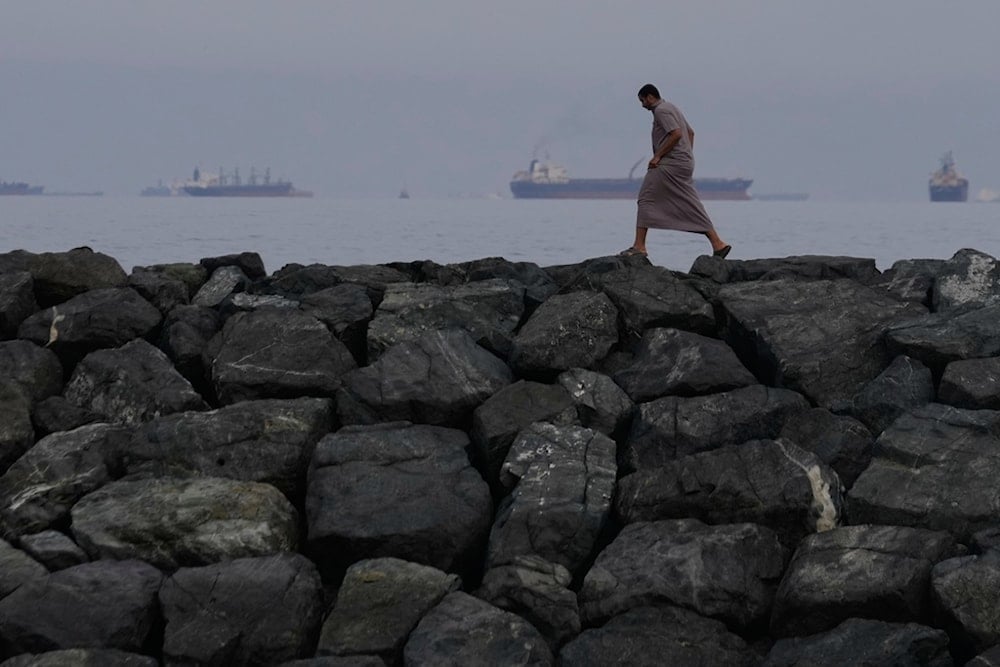
A man walks along the shore as oil tankers and cargo ships line up in the Strait of Hormuz, as seen from Khor Fakkan, United Arab Emirates, Wednesday, March 11, 2026. (AP)
The US may have launched the war against Iran, but Gulf oil-producing states are now paying the economic and security costs, Gulf sources and analysts told Reuters, as tensions grow due to the growing economic toll of the US-Israeli-initiated war.
Behind the scenes, resentment is mounting in Gulf capitals over being drawn into a war they see as neither having initiated nor supported, yet are now suffering its consequences, three regional sources told Reuters. Airports, ports, hotels, oil facilities, and military installations across the region have been struck by drone and missile attacks.
“It is not our war. We did not want this conflict, yet we are paying the price in our security and our economy,” Ebtesam Al-Ketbi, president of the Emirates Policy Center, told Reuters.
Iranian Foreign Ministry spokesperson Esmail Baghaei has said that Iran struck to US bases in these countries because their territories were used to initiate attacks on Iran.
Toll of Iranian retaliation on region
Tehran responded to the US-Israeli aggression by launching strikes against the Israeli occupation and Gulf states hosting US military installations being used against it, effectively halting oil and gas shipments through the Strait of Hormuz, which carries roughly one-fifth of the world’s oil and liquefied natural gas.
Across the region, airspace closures forced airlines to cancel some 40,000 flights, marking the largest disruption to global air travel since the COVID-19 pandemic. Tourism has also been adversely affected.
United Arab Emirates President Sheikh Mohammed bin Zayed Al Nahyan said the country was in a time of war but remained secure, warning adversaries that the UAE was “no easy prey,” in his first public remarks since Iranian missiles struck the country.
At the same time, analysts told Reuters the conflict has triggered a deeper reassessment of the Gulf’s reliance on Washington as the region’s primary security guarantor.
Gulf reassesses reliance on US security umbrella
For decades, relations between the United States and Gulf states rested on an implicit bargain: Gulf energy resources and vast financial investments, including hundreds of billions of dollars spent on US weapons and advanced technology, in exchange for American protection.
Fawaz Gerges of the London School of Economics told Reuters the war had shaken that assumption. Gulf states, he said, are likely to accelerate efforts to diversify their foreign and security partnerships after realizing “they cannot really rely on the United States to protect their energy, oil, gas, their people, and their sovereignty.”
The concerns echo earlier tensions following the 2019 drone and missile attacks on Saudi Arabia’s Abqaiq and Khurais oil facilities, which Washington and Riyadh arbitrarily blamed on Tehran.
Regional economic leaders have also warned of the war’s mounting consequences.
Business leaders warn of economic fallout
Abdulaziz Sager, chairman of the Saudi-based Gulf Research Center, told Reuters that Washington had failed to establish safeguards for its regional allies or ensure oil and gas flows during wartime, warning that the economic toll on Gulf states is “horrendous.”
Sager said the conflict demonstrates the risks of relying solely on external security guarantees and that Gulf countries must strengthen their own defense capabilities to prepare for future crises.
“External powers also tend to make decisions based on their own strategic interests rather than those of the Gulf,” Sager told Reuters, adding that Gulf states may adopt a more cautious and balanced approach in their relations with Iran as well as with major international powers.
In a rare public rebuke, prominent Emirati businessman Khalaf Al Habtoor questioned the objectives of the US-Israeli war on Iran.
'Dragging the Gulf' into war
“If the strikes were aimed at containing Iran, did they take into account the regional consequences — or was the cost of dragging the Gulf into a conflict it was not party to simply ignored?” he said.
Saudi Aramco CEO Amin Nasser warned that continued disruption to shipping through the Strait of Hormuz could have “catastrophic consequences” for global oil markets.
The Islamic Revolution Guard Corps (IRGC) has warned it would not allow “one litre of oil” to leave the Middle East if US and Israeli attacks continue, while Trump has threatened further military action if Iran attempts to block energy exports.
Sources close to Gulf governments told Reuters that frustration with Trump privately runs deep across the region, with many officials believing Washington dragged the Gulf into a war shaped heavily by the Israeli regime without a clear strategy or consultation.


