
Private firms launch evacuations as war strands travelers
 3 Min Read
Evacuations of staff and families from the Middle East are underway as private charter missions and government repatriation efforts expand amid war-linked travel chaos.
-
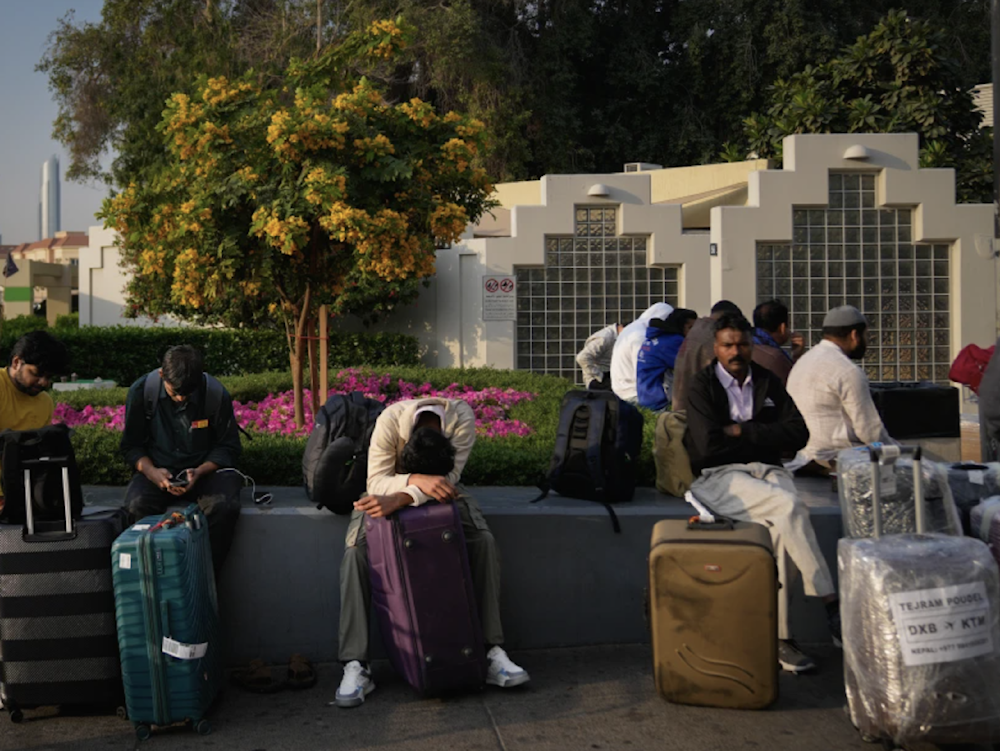
Passengers stranded by the closure of Dubai International Airport await assistance in the airport parking lot in Dubai, United Arab Emirates, on March 1, 2026 (AP)
Companies have begun evacuating staff and families from the Middle East as the US-Israeli war on Iran and Tehran's retaliatory operations disrupt regional travel and heighten security risks, The Wall Street Journal reported.
Greg Raiff’s team from Miami-based private charter operator Elevate Aviation is in the midst of a 72-hour mission to evacuate roughly 1,000 people on behalf of a corporate client after the conflict began.
Elevate, which has operated emergency flights for over two decades, including during Venezuela crises, was fielding evacuation requests within minutes of the aggression on Iran.
Route shifts after direct threats
Raiff said the original plan to use a regional airport had to be abandoned after that location was reportedly targeted by Iranian forces. His team pivoted to operating out of Oman, where airspace has remained open. So far, Elevate has completed nearly a dozen flights using Muscat as a hub.
Evacuation flights are costly: private charters often run two to three times the price of regular flights, and insurance and crew premiums are high due to increased risks. Raiff said a corporate evacuation of this scale can run into the millions of dollars.
“This is not flying to Augusta to play a round of golf and drink some beer,” he said. “This is trying to get people home to loved ones.”
Logistical hurdles and rising demand
The first group of roughly 300 evacuees was moved by ground to a location near Muscat’s airport before being flown out. Subsequent groups were scheduled to depart on Tuesday, Wednesday, and Thursday.
One client’s jet staged at a North African airport and, once cleared, landed in Muscat, completed boarding, and departed within 90 minutes — an operation Raiff described as a “scheduled, just-in-time ballet.”
Broader travel disruptions amid war
The need for private evacuation flights reflects wider chaos in Middle East travel. Major Gulf airspace closures — including Dubai, Abu Dhabi, Qatar, and other hubs — have stranded hundreds of thousands of travelers and dramatically reduced regular commercial flights.
Some travelers in Dubai and other cities have resorted to private charter flights, paying exorbitant sums — in some cases up to €200,000 — to secure evacuation seats, as regular flights remain limited or suspended.
Governments around the world are also stepping in. For example, the Czech government dispatched military aircraft for the emergency evacuation of its nationals, and the UK and France are readying charter flights to bring their citizens home.
Airlines and repatriation efforts slowly rising
Some commercial carriers have begun limited repatriation services from permitted departure points like the UAE and Oman, as authorities gradually clear airspace for specific flights.
However, travel chaos persists, and many airlines remain grounded or operate under severe restrictions, forcing evacuees to seek alternate and often costly routes out of the region.


