
US intel warned Trump: Iran regime change 'unlikely'
 3 Min Read
US intelligence assessments conclude Iran's government will remain intact despite sustained US-Israeli strikes, outcomes that Trump was briefed on before the war began.
-
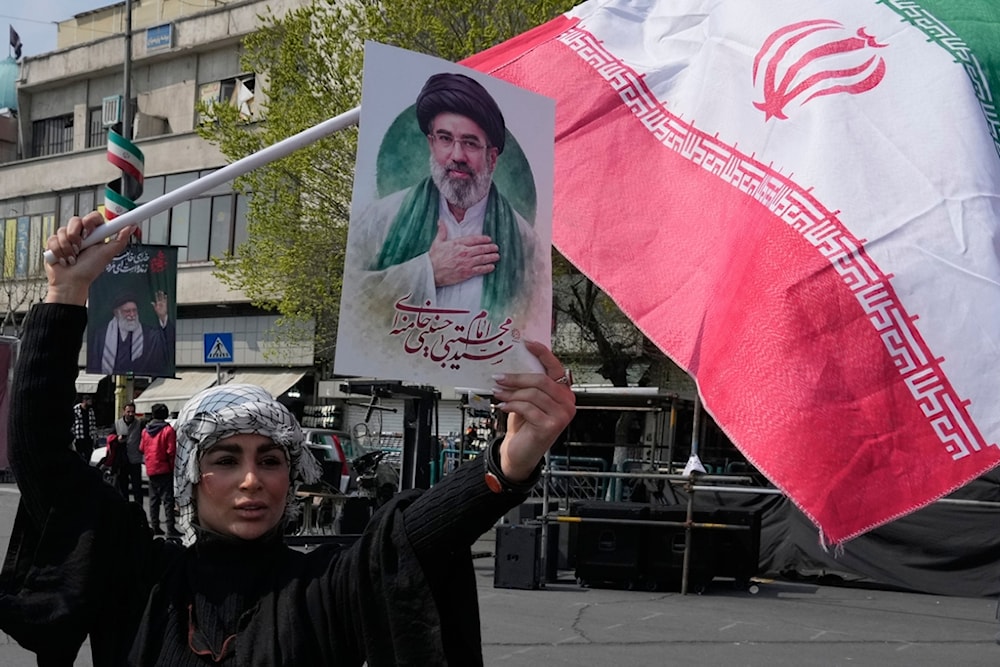
A woman displays a poster of Sayyed Mojtaba Khamenei as she waves her country's flag during a campaign in support of the government at the Enqelab-e-Eslami, or Islamic Revolution, square in downtown Tehran, Iran, Saturday, March 14, 2026 (AP)
US intelligence assessments conclude that Iran's government is not at risk of collapse and is likely to remain in place despite more than two weeks of sustained US-Israeli strikes and large-scale leadership assassinations, according to a Washington Post report.
The assessments predict Iran's leadership will remain intact and may emerge from the conflict emboldened, believing it withstood the military campaign launched by Washington and Tel Aviv, according to two people familiar with the findings who spoke to the Washington Post on condition of anonymity.
A classified pre-war assessment by the National Intelligence Council, completed roughly a week before the start of the aggression, concluded that even a large-scale US military campaign would be unlikely to dismantle Iran's entrenched clerical and military establishment. The report examined scenarios ranging from targeted strikes on senior officials to broader attacks on government institutions, in both cases concluding that institutional continuity mechanisms would hold.
Trump was personally briefed on these projections before authorising the war. "It wasn't just predictable," one source told the Post. "It was predicted. He was told in advance."
There are no overt signs of defections or fractures within Iran's power structure, the report notes.
Gulf allies alarmed as conflict drags on
Washington's Gulf allies have expressed anger at the trajectory of the conflict. A senior Gulf official told the Post that the Trump administration had assured regional partners the confrontation would be swift. "They started this war for Israel and then left us to face the attacks by ourselves," the official said.
Trump publicly acknowledged being caught off guard by the scope of Iranian retaliation across the Gulf. "They hit Qatar, Saudi Arabia, UAE, Bahrain, Kuwait," he said. "Nobody expected that. We were shocked."
The official warned that Gulf states are unprepared for a prolonged conflict. "We don't have a plan for a long war. We need to finish it as soon as possible," he said.
The Trump administration has meanwhile moved to press other nations to designate the IRGC and Lebanon's Resistance movement Hezbollah as terrorist organisations, instructing US diplomats in a Monday cable to deliver the message to host governments by Friday "at the highest appropriate level."
The Strait of Hormuz remains the war's most consequential pressure point, with global energy markets in sustained turmoil over the prospect of extended disruption to major shipping traffic. The White House had been advised by the intelligence community that Iran might seek to close the waterway.


