
Froun Municipality rejects inclusion in Israeli ‘security zones’ plan
 4 Min Read
Lebanon’s Froun municipality rejects inclusion in Israeli so-called “pilot zones,” as Israeli officials detail a phased plan involving occupying southern Lebanon under a new framework agreement.
-
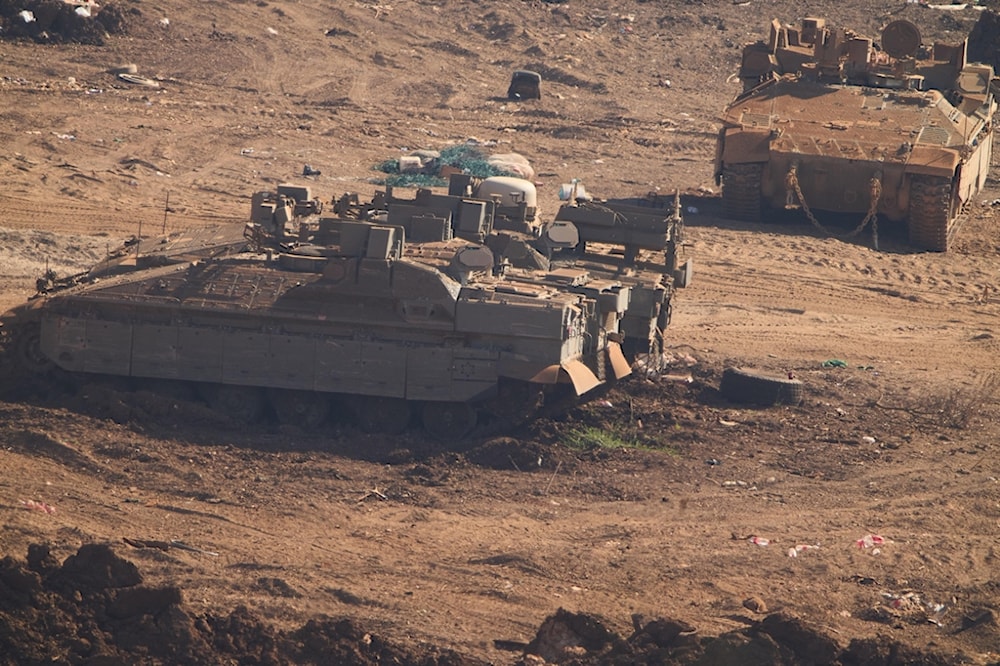
Israeli military APCs parked in northern occupied Palestine, near the border with Lebanon, Saturday, June 27, 2026 (AP Photo)
The municipality of Froun in southern Lebanon has rejected reports suggesting the town would be included in so-called "pilot zones" under the recently announced framework agreement between Lebanon and "Israel", insisting the claims have no factual or legal basis.
The statement came in response to a report by the Israeli Public Broadcasting Corporation, which claimed that Israeli occupation forces would begin withdrawing from the southern Lebanese villages of Zawtar al-Gharbiyeh and Froun as areas within the "security zone".
In a statement signed by Mayor Hassan Adel Bazzi, the municipality said it "strongly condemns" the circulating reports, stressing that Froun "is not an occupied area" and lies outside the so-called Yellow Line.
According to the municipality, raising the issue of including Froun in any experimental arrangement is "entirely unnecessary" and unsupported by the reality on the ground, particularly stressing there are no occupation forces in the town or any form of Israeli occupation, firmly rejecting false Israeli claims of withdrawal.
The municipality reaffirmed that the residents of Froun remain committed to their right to live freely and safely in their town and to carry out their daily lives without restrictions or measures "that have no basis in reality or law."
It also called on the Lebanese state, relevant official bodies, and international organizations to assume their responsibilities by ensuring respect for Lebanon's sovereignty, protecting citizens' rights, and rejecting "decisions or dictates that the Israeli enemy seeks to impose."
Israeli officials outline framework implementation
The municipality's response comes as senior Israeli officials continue to present the framework agreement as one that would allow the Israeli occupation to maintain its military presence in southern Lebanon.
Earlier, Israeli War Minister Israel Katz claimed that the agreement grants the occupation "the right to remain on Lebanese territory as long as Hezbollah's weapons have not been dismantled," arguing that Iran had sought to force an Israeli withdrawal from Lebanon through threats and pressure on the United States.
Katz's remarks were followed by statements from Israeli Prime Minister Benjamin Netanyahu, who claimed the framework agreement paves the way toward ending the war on Lebanon after direct negotiations between the two sides.
Netanyahu hailed the accord as a "historic achievement" for the Israeli occupation, saying the Lebanese government and "Israel" had agreed to establish two security zones where "the disarmament of Hezbollah would first be tested."
He further claimed that the United States and the Lebanese government had agreed to allow Israeli occupation forces to remain in the "security zone" in southern Lebanon while preserving the Israeli military's freedom of operation.
As part of the agreement's implementation, Netanyahu is insisting that the occupation would not leave the buffer "security zone" and that Washington was fully aware of this position.
The Israeli premier also claimed that the Lebanese government seeks peace with "Israel," describing this as "a fundamental change," while simultaneously threatening that the occupation would re-enter Lebanon "if deemed necessary."
Recorded Israeli ceasefire violations
Meanwhile, Israeli warplanes carried out a series of intense airstrikes on the town of Nabatieh al-Fawqa in southern Lebanon on Saturday, hitting the area with four concurrent raids, in what marked the second attack on the town within the same day. The attacks came just a day after the Lebanese government signed the US-mediated framework agreement in Washington widely viewed as formalizing a security arrangement with the Israeli occupation.
According to Lebanon’s National News Agency (NNA), earlier in the day, an Israeli drone had already targeted the vicinity of the Farah Amusement Park intersection in Nabatieh al-Fawqa, before the later wave of airstrikes escalated the assault on the area.
Simultaneously, Israeli occupation forces carried out ground movements and intensive “combing operations” across several areas in southern Lebanon. In the Hasbaya district, forces advanced toward the outskirts of Kfar Chouba, supported by heavy and medium machine gun fire, with operations also extending toward Buyout al-Siyad in the Tyre district.
Additional incidents were reported across multiple southern towns, where Israeli forces dropped stun grenades in Baraachit in the Bint Jbeil district and near Kfar Tebnit in Nabatieh. Meanwhile, Israeli drones continued extensive low-altitude flights over the Zahrani region and surrounding villages, maintaining near-continuous activity in Lebanese airspace since 2023.


