
FSB foils Ukrainian plots to assassinate Russia official, gas pipeline
 6 Min Read
FSB says it foiled a Ukrainian plot to kill a Russian officer in Crimea and stopped a bombing attempt targeting a gas pipeline near Moscow.
-
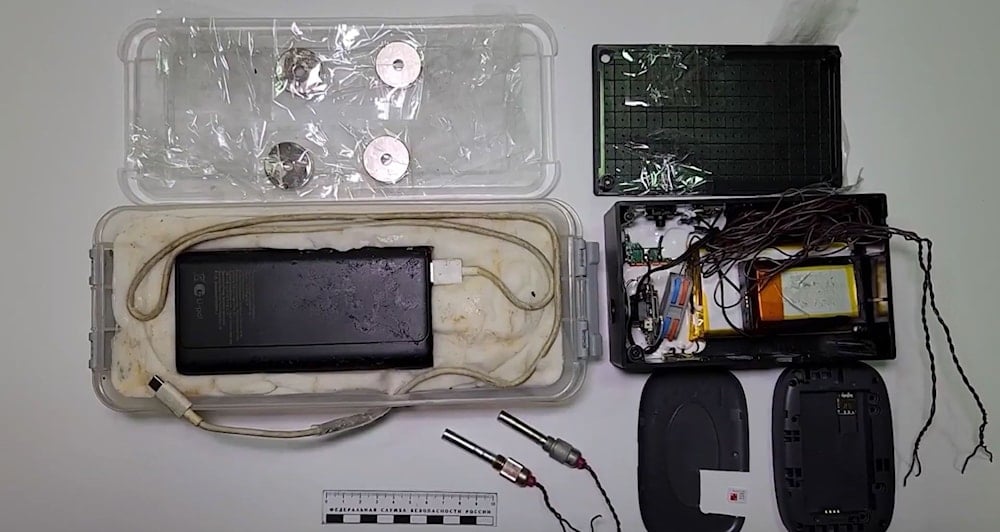
Footage released by the Russian Federal Security Service revealing devices meant to be used for an assassination plot in Crimea, Russia, December 1, 2025 (Sputnik)
Russia’s Federal Security Service said on Monday it had foiled an alleged plot to assassinate a senior officer from the Russian Defense Ministry in Crimea, attributed to Ukraine.
"The Federal Security Service (FSB) has prevented a terrorist attack planned by the Main Intelligence Directorate (GUR) of the Ukrainian Ministry of Defense in the Republic of Crimea against a senior officer of the Russian Ministry of Defense," the Ministry said in a statement.
The FSB said the plot was directed by the GUR, claiming that a Ukrainian citizen recruited by Ukrainian intelligence had been instructed to detonate an explosive device placed in the officer’s personal vehicle. It added that the failed plot to kill the Russian Defense Ministry official in Crimea was orchestrated by Rustem Fakhriev, an officer with Ukraine’s military intelligence.
"The perpetrator's means of communication with his handler and components of a Western-made explosive device were seized," the statement read, noting that one of the accomplices has been arrested.
FSB detain agent attempting to detonate gas pipeline
Additionally, in a separate sabotage incident two days ago, a detained agent from Kiev described the instructions he said he received from Ukrainian special services ahead of an attempted bombing targeting a gas pipeline in the Serpukhov area of the Moscow Region, according to a video released by the FSB.
"Mikhail [the Ukrainian supervisor] told me to head to the site; he sent me the coordinates and location, told me to drill with an electric drill, it turned out to be a gas pipeline, and to do it near the pipeline. He sent me a video instruction: I had to arrive, drill a hole in the evening, cut off the capsule head, press the button, wrap it with string and tape so it would not fall, and carefully lower it to the bottom of the hole," the perpetrator said.
He said he was instructed to bury the device, cover and camouflage it, install a photo trap on a nearby tree, and then report back to his handler, but as he began drilling the hole he was intercepted and detained by FSB officers.
A trail of failed attempts
On November 25, Russia’s Federal Security Service (FSB) announced that it had neutralized two individuals allegedly plotting to derail trains in Siberia’s Altai Territory under the coordination of Ukrainian intelligence services.
According to the FSB, the men had planned to place a derailing device on a railway line on Saturday evening. When agents approached their vehicle to detain them, the suspects opened fire and were subsequently killed by return fire.
State media released footage purportedly showing the nighttime confrontation, along with images of the scene, where two bodies lay near an SUV riddled with bullet holes. The TASS news agency reported that the suspects were armed with automatic rifles bearing the phrase “Glory to Ukraine” in Russian.
Recruited through Telegram
The FSB stated that the two men had been recruited through Telegram by a member of a “terrorist organization” banned in Russia, who had promised them a material reward for carrying out the sabotage.
Russia’s Investigative Committee has opened a probe into the case, examining charges of sabotage, illegal arms possession, and attempted murder of law enforcement officers.
The FSB’s announcement adds to Moscow’s repeated claims of Kiev-directed sabotage operations inside Russian territory, amid ongoing tensions between the two countries.
FSB foils Ukrainian assassination attempt via British poison
On November 20, the FSB announced thwarting yet another Ukrainian plot and that it detained a resident of the Donetsk People’s Republic (DPR) accused of plotting to assassinate a senior officer of the Russian Defense Ministry on instructions from Ukrainian military intelligence.
According to the FSB, the suspect had prepared to carry out a terror attack using a chemical agent to poison the unnamed high-ranking official. The plan allegedly involved delivering gift bottles of British beer laced with a lethal toxin mixture.
"The Federal Security Service of the Russian Federation has detained a DPR resident involved in plotting a terrorist attack using chemical warfare agents against a high-ranking Russian Defense Ministry officer," the agency said in its statement.
Agonizing death within 20 minutes
Laboratory tests on the confiscated beer bottles reportedly revealed the presence of colchicine and tert-butyl bicyclophosphate (TBPO), the latter described as an analogue of the banned nerve agent VX. Both substances, according to the FSB, were produced in the United Kingdom, an allegation consistent with Moscow’s broader accusations of Western involvement in Ukrainian operations.
Combining TBPO, described as a "cage convulsant", and colchicine would likely result in an unpredictable and potentially fatal combination of severe neurological seizures from TBPO and systemic toxicities, organ failure, and muscle damage from colchicine.
“These chemicals, when consumed, cause agonizing death within 20 minutes,” the statement said.
Read more: FSB arrests suspected Kiev collaborator in Stavropol bomb plot
Further British-Ukrainian plots
In mid-October, Russia accused the United Kingdom and Ukraine of attempting coordinated sabotage operations against the TurkStream gas pipeline, a vital conduit transporting Russian natural gas to Turkey and European markets. During the 57th Shanghai Cooperation Organization (SCO) session in Uzbekistan, FSB Director Alexander Bortnikov revealed some of the details behind the plot.
According to Bortnikov, British instructors from the Special Air Service (SAS) and the Secret Intelligence Service (MI6), in coordination with Ukrainian intelligence, are actively planning a series of attacks targeting Russian energy infrastructure. These operations reportedly include drone strikes on the TurkStream pipeline, as well as attacks on the Caspian Pipeline Consortium, a multi-national venture with Russian, Kazakh, and US shareholders.
Bortnikov said that the UK has been directly involved in training and coordinating these sabotage groups.
"Together with MI6, they are coordinating Ukrainian sabotage groups to carry out raids in Russia’s border regions, targeting critical infrastructure using drones, unmanned boats, and combat divers," Bortnikov stated.
Read more: FSB foils Kiev plot to assassinate Russian official at Moscow cemetery