
Germany launches new federal police unit to combat drones
 4 Min Read
Germany has launched a nationwide federal police unit equipped with advanced technology to detect and neutralize suspicious drones amid a sharp rise in UAV activity around critical infrastructure and airports.
-
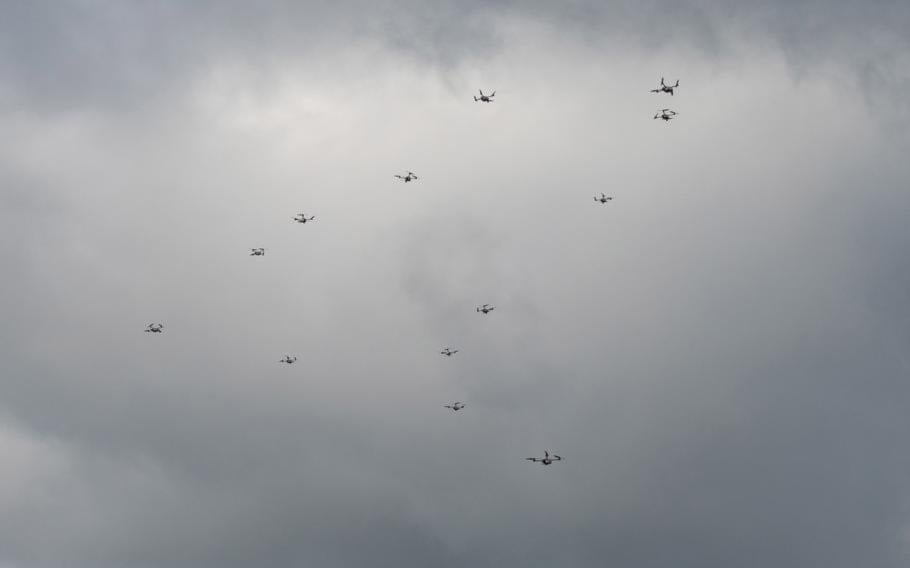
A simulated drone swarm flies above the Putlos Training Area in northern Germany on Nov. 21, 2025, during the exercise Project Flytrap 4.5. The training was combined with an industry competition intended to get emerging technology into the hands of soldiers more quickly (Phillip Walter Wellman/Stars and Stripes)
Germany has rolled out a new national police team dedicated to countering unauthorized drone activity, a move driven by a sharp rise in unexplained UAV sightings over critical sites across Europe. The Interior Ministry said on Tuesday that Interior Minister Alexander Dobrindt had officially activated the unit, noting: "Today, Interior Minister Alexander Dobrindt officially put the federal police anti-drone unit into service."
The ministry described the force as a mobile, countrywide capability equipped with modern systems for identifying and disabling drones, and said its members receive tailored training. Airports are simultaneously being outfitted with improved detection and interception tools.
According to Dobrindt, the initiative reflects Berlin’s posture toward emerging security risks. "The new federal police anti-drone unit will show how we respond to new hybrid threats - quickly, precisely and with new technologies. Within the fight against drone threats we rely on a simple principle: detect, neutralize, intercept," he said.
A continent-wide pattern of unexplained drones
The police deployment comes after a year marked by repeated alerts across Europe. Airports in Denmark, Belgium, Sweden, Norway and Germany faced temporary shutdowns or flight diversions following drone sightings. Munich Airport, one of Germany’s busiest, was forced to close runways in October after multiple reports of UAVs in its airspace, disrupting thousands of passengers.
Beyond airports, drones have been observed near military sites, energy infrastructure, ammunition depots, and naval facilities in several European states.
A review of 61 cases across 11 countries between September and November showed that while some incidents were confirmed drones, many remained unverified due to lack of recovered hardware or conclusive tracking data.
In Germany alone, the Federal Criminal Police Office recorded roughly 850 suspicious flights between January and mid-October, a number that Spiegel reported is steadily climbing.
Legal bottlenecks force reliance on civilian police
A long-standing legal division in Germany complicates the national response: neutralizing unidentified drones is a matter for federal police, not the military. This restriction prevents the Bundeswehr from acting independently even when UAVs appear over sensitive defense installations, slowing reaction times in a fast-moving threat environment.
Recent disruptions have pushed Berlin to consider reforms. Government officials have proposed expanding police powers to allow pre-emptive drone takedowns, including jamming or shooting down UAVs if they are deemed a security risk. Germany has also begun coordinating more closely with neighboring states that face similar incursions.
European governments eye broader counter-drone cooperation
Several EU countries have called for deeper cross-border coordination, arguing that the pattern of sightings points to hybrid pressure tactics rather than isolated hobbyist misuse. Some security services in Europe have attempted to draw links to foreign state actors, though many incidents remain unattributed, and the Kremlin has dismissed speculation about Russian involvement.
Rapid-response teams specializing in counter-drone operations have already been deployed in some countries, and discussions are underway over integrating airspace monitoring systems and intelligence-sharing platforms across the region.
Growing concern, limited answers
Despite months of alerts, the exact motives behind the drone activity remain unclear. While some devices appear to have performed reconnaissance missions, others may have been misidentified objects or flights by private operators.
Governments have warned, however, that even unarmed UAVs pose significant risks: airport closures, interference with air traffic, and potential exposure of critical infrastructure.
Read more: UNDP economist warns AI-driven weapons could trigger mass casualties


