
Golan Druze authority warns Suwayda crisis is worsening, rebukes Hijri
 5 Min Read
A year after the July 2025 massacre in Suweida, which killed more than 1700 people, most of them Druze, the province remains locked in an unresolved standoff.
-
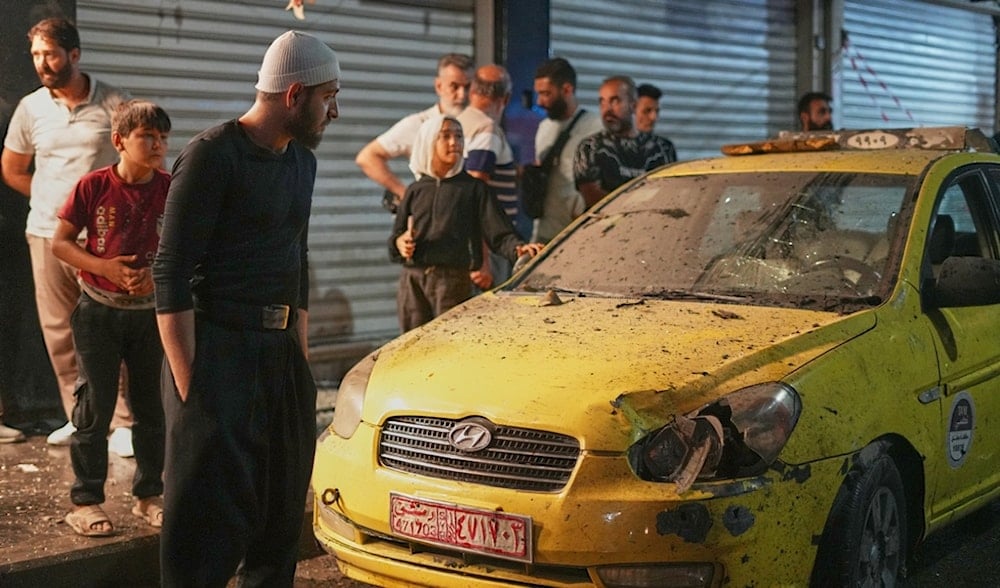
Residents gather around a damaged taxi near the site of an explosion in the Jaramana suburb, home to a large Druze population, in Damascus, Syria, Thursday, Aug. 6, 2026. (AP Photo/Omar Albam)
The Druze religious authority in Syria's occupied Golan has warned that developments in Suwayda have taken a dangerous turn on every front since the sectarian massacres of July 2025.
More than a year on, it said, the situation has not improved and may have worsened, holding Syria's ruling authorities primarily responsible for the current escalation.
Inflammatory statements were complicating matters rather than resolving them, the authority stressed, adding that remarks by Sheikh Hikmat al-Hijri had compelled it to speak out in rejection and condemnation.
The authority rejected any use of the Druze faith to serve foreign agendas and ambitions, stressing that throughout their history, the Druze have been an integral part of the Arab and Islamic worlds.
"The Druze have built an honorable legacy through their principled positions and the blood they have shed to uphold their belonging to this nation," it affirmed, stressing the duty to preserve that legacy.
"No one can sever us from our deep Islamic roots," the authority said.
Earlier on Monday, the Syrian Observatory for Human Rights reported fierce clashes between the National Guard and government forces northwest of Suwayda, saying they broke out after government forces targeted the vicinity of a National Guard position in the al-Naql area. The clashes wounded 4 security personnel, Syria's al-Ikhbariya channel reported.
Massacres that killed more than 1,700 people
The violence the Golan authority referenced began in mid-July 2025, when al-Sharaa's government forces launched a military assault on Suwayda following clashes between Druze militias and Bedouin tribes. The UN Human Rights Office's independent Commission of Inquiry has since documented what it called a conservative death toll of 1707 people, most of them Druze.
The commission's breakdown found that around 1342 of the dead were Druze, including 1190 men, 99 women, 22 boys and 31 girls. It also found that at least 225 members of interim Syrian government forces and around 70 Bedouin and tribal fighters were killed, along with civilians killed by ground forces and in Israeli airstrikes that hit Damascus and Suwayda between July 14 and 16, 2025.
Amnesty International concluded that Syrian government forces and their allies carried out the massacre, documenting 46 cases of Druze people extrajudicially executed in Suwayda city on July 15 and 16 alone, including two mock executions of elderly victims. The UN also reported that 105 Druze women and girls were abducted by government-affiliated groups during the assault, with 80 still unaccounted for as of late August 2025.
A Syrian government-appointed committee put the combined death toll across all sides at 1760, with 2188 wounded, while the Syrian Observatory for Human Rights has cited a toll exceeding 2000.
Continued siege, violence against Suwayda
In the year since, Suwayda has remained under what local officials have described as a policy of collective punishment. Damascus-backed forces imposed a near-total blockade on the province after the ceasefire, blocking food, fuel and medical supplies at checkpoints and turning away humanitarian convoys even along an officially designated humanitarian corridor.
General Security forces have also prevented residents of 32 towns and villages in western and northern Suwayda from returning home, leaving more than 100000 people displaced for extended periods. Pro-government forces and allied Bedouin factions have looted and destroyed electricity infrastructure in an estimated 34 towns and villages and disrupted the water supply, forcing residents to rely on contaminated water.
Sporadic lethal clashes have continued to erupt. On August 30 and 31, two civilians were killed near Suwayda when a shell fired from a government-controlled area struck a tractor, amid gunfire exchanges between government troops and National Guard fighters.
Days earlier, two National Guard security commanders were wounded in intra-city clashes, part of a broader pattern of ceasefire violations, killings and lawlessness that residents and analysts warn could tip into a renewed government push to retake the province.
'Israel'-backed Hikmat al-Hijri
The remarks that prompted the Golan authority's statement came from Sheikh Hikmat al-Hijri, Syria's top Druze spiritual leader and Sheikh al-Aql, who declared in late August 2026 that the Druze are "an integral part of the State of Israel" and share doctrinal "common denominators" with it.
Hijri has been pushing for an autonomous "civil state" in Suwayda and for international intervention in the province, and has hinted at unspecified "developments" regarding its status emerging within days, without elaborating.
Yet, Hijri's stance is far from universally shared. In Lebanon, the Druze religious council, the Mashyakhat al-Aql, said his remarks "do not reflect the truth of the community" and are inconsistent with its "religious and historical constants," calling it unacceptable to place the Druze in an "artificial partnership" with the Israeli regime.
Druze residents of Jaramana, near Damascus, issued their own statement disavowing Hijri, saying he "does not represent us, nor does he represent the position of Jaramana and its people," and rejecting any positions or practices associated with him.
Lebanese Druze leader Walid Jumblatt has taken a starkly different line from Hijri throughout the crisis, calling Suwayda "an inseparable part of Syria," demanding a ceasefire and an independent investigation committee, condemning Israeli strikes and rejecting calls for the province's separation.
Most Druze leaders inside Syria, including the religious authority in the occupied Golan, have publicly rejected foreign interference and reaffirmed their commitment to a unified Syrian state.


