
Half of Europeans see Trump as enemy of Europe: Survey
 3 Min Read
A 2025 survey reveals Europeans see Trump as a threat, fear war with Russia, and doubt their countries’ ability to defend themselves without EU support.
-
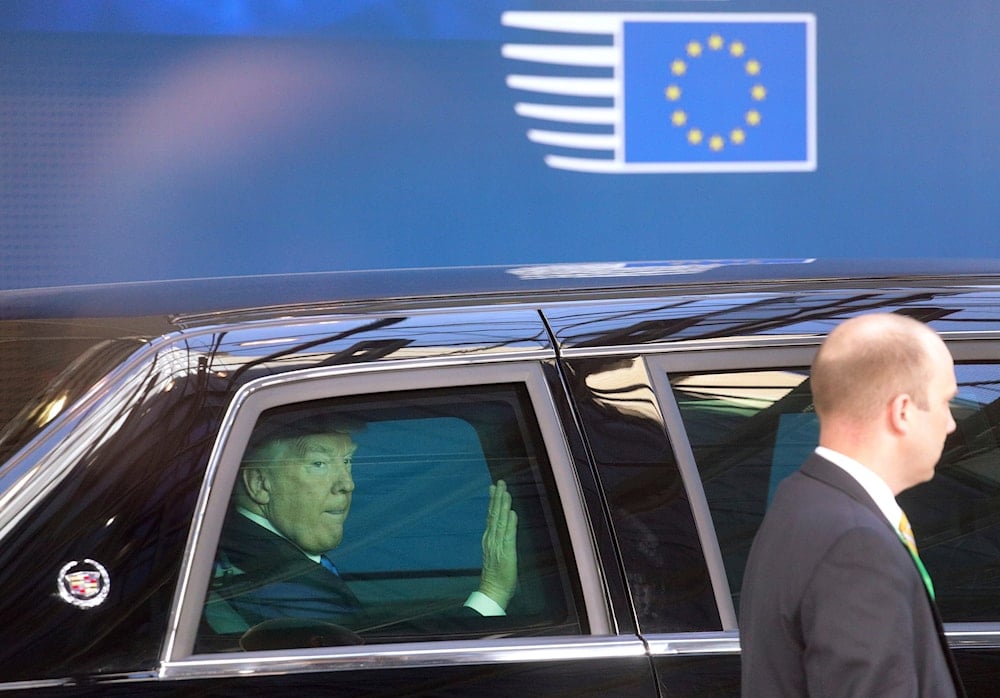
US President Donald Trump leaves the Europa building in Brussels after meeting EU officials on May 25, 2017. (AP)
A new survey assessing European public opinion in 2025 has found that nearly half of respondents across nine countries consider Donald Trump to be "an enemy of Europe."
The poll, conducted for the Paris-based European affairs platform Le Grand Continent, revealed a growing perception of Trump’s Europe stance as hostile, with the sentiment particularly strong in Belgium (62%) and France (57%). Only 19% of respondents in Poland and 37% in Croatia viewed Trump in the same way, indicating significant regional variation.
Political science professor Jean-Yves Dormagen, founder of polling agency Cluster17, said the results suggest that "Trumpism is clearly considered a hostile force" and that European views of Trump are hardening.
Nonetheless, Europeans remain aware of the strategic importance of transatlantic relations. When asked what posture the EU should adopt toward the US government, the most common response (48%) was compromise.
Fears of war with Russia rise across the continent
The survey also reveals a sharp increase in anxiety over the risk of war with Russia. A majority of respondents (51%) viewed the possibility of open conflict in the coming years as high, with 18% rating the likelihood as very high.
Dormagen noted that such figures “would have been unthinkable just a few years ago,” and signal a shift in the European geopolitical mindset. Fear of a war with Russia was particularly acute in Poland, where 77% considered the threat high, compared with 54% in France and 34% in Italy.
Widespread doubt about national military preparedness accompanied fears of conflict. Across the nine surveyed countries, 69% of respondents said their country was not capable of defending itself in the event of a Russian attack.
Even in France, only 44% believed in their military's readiness. In Poland, 58% of people expressed doubts about their country’s defensive capability, despite its proximity to Russia. Dormagen summarized: “We are entering an age of danger while feeling a persistent sense of national weakness.” The findings highlight concerns over EU defense capabilities and the perceived need for a stronger collective security strategy.
Overall, 74% of respondents said they wanted their country to remain in the EU, with backing highest in Portugal (90%) and Spain (89%), and lowest in Poland (68%) and France (61%). A significant majority (69%) also said the EU should take on a protective role, offering support against not only military threats, but also growing risks in technology, energy, and food security. Only 12% of people across all countries reported feeling largely safe from the full range of threats assessed.


